
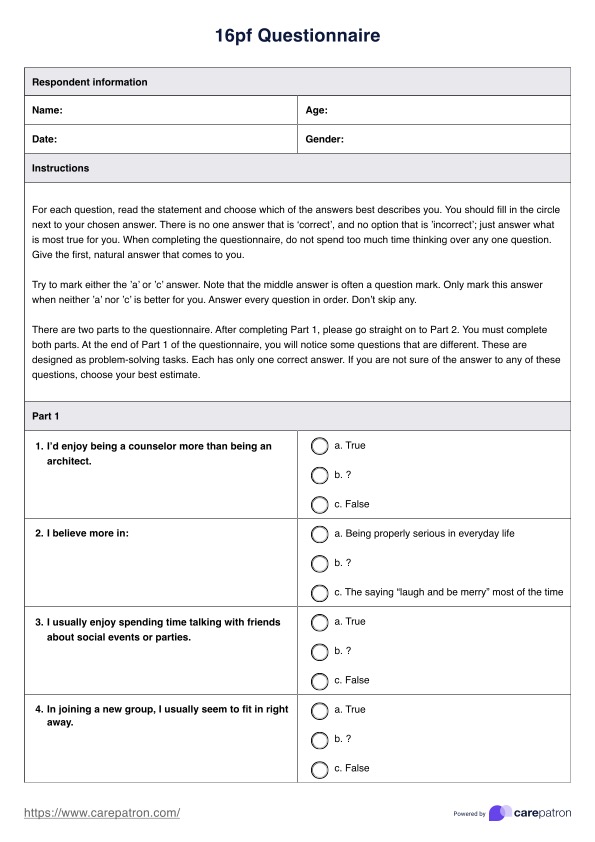




Trait theory and the 16 personality factors
Trait theory is a psychological framework in which specific underlying patterns of behavior, thought, and affect are grouped into "traits" that can be identified and measured. Theoretically, individual differences in the strength and combination of various traits make up personality.
One of the most commonly used models of personality measurement is the 16 personality dimensions developed by Raymond Cattell in the mid-20th century. According to this personality theory, an individual possesses all 16 of these basic traits to varying extents.
Identified using factor analysis, each trait is independently measurable. This means an overall measure of personality can be obtained by identifying where an individual sits on the spectrum of each trait. The 16 personality traits are as follows:
- Abstractedness: Imaginative versus practical
- Apprehension: Worried versus confident
- Dominance: Forceful versus submissive
- Emotional stability: Calm versus high-strung
- Liveliness: Spontaneous versus restrained
- Openness to change: Flexible versus attached to the familiar
- Perfectionism: Controlled versus undisciplined
- Privateness: Discreet versus open
- Reasoning: Abstract versus concrete
- Rule-consciousness: Conforming versus non-conforming
- Self-reliance: Self-sufficient versus dependent
- Sensitivity: Tender-hearted versus tough-minded
- Social boldness: Uninhibited versus shy
- Tension: Impatient versus relaxed
- Vigilance: Suspicious versus trusting
- Warmth: Outgoing versus reserved









