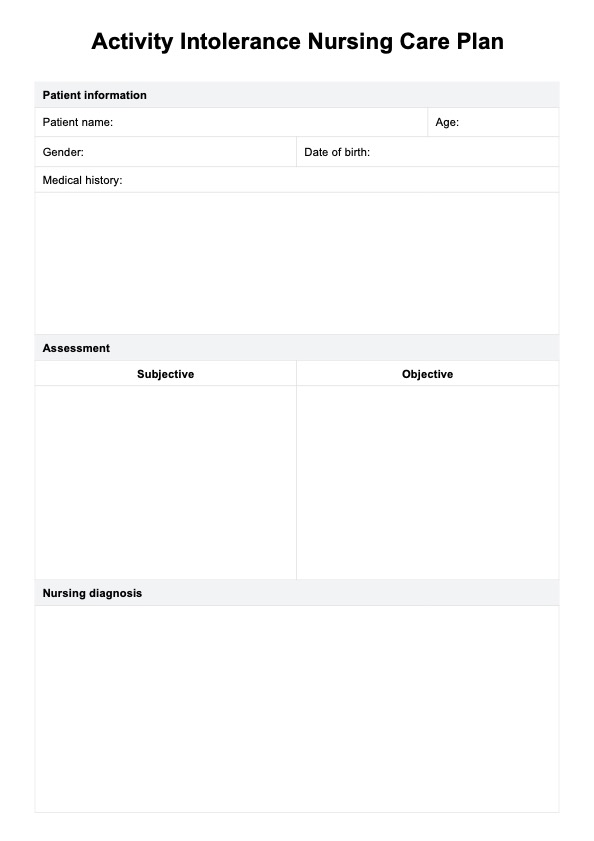
How to use our Activity Intolerance Nursing Care Plan template?
Exercise tolerance can be improved by giving proper attention and interventions. To use this care plan, follow the steps below:
Step 1: Access the template
To begin using the Activity Intolerance Nursing Care Plan, click the "Use template" button to open it in the Carepatron app. You can then customize the plan to suit your patient’s specific needs, such as adding relevant assessments, nursing interventions, and goals. The Carepatron app allows for easy storage and tracking, ensuring that all patient care plans are accessible and organized for future reference. Alternatively, you can click "Download" to save a non-editable PDF version for printing or sharing.
Step 2: Conduct a nursing assessment
Begin by performing a thorough nursing assessment. This involves gathering the patient’s medical history, documenting current activity levels, and identifying any activity intolerance-related symptoms, such as fatigue or shortness of breath. Be sure to monitor vital signs like heart rate, respiratory rate, and blood pressure to assess the patient’s physiological response to activity. Record this data in the Subjective and Objective fields of the template.
Step 3: Formulate the activity intolerance nursing diagnosis
Based on your assessment, develop an activity intolerance nursing diagnosis. Consider potential causes like decreased cardiac output, respiratory issues, or general deconditioning. Use standardized NANDA-approved statements. This diagnosis should be entered into the Nursing diagnosis section of the template.
Step 4: Set goals and outcomes
Next, set short-term and long-term goals for your patient’s recovery. For example, a short-term goal may be for the patient to walk a certain distance without experiencing significant fatigue, while a long-term goal might aim to improve overall stamina and exercise to maintain muscle strength. These goals should be realistic and time-bound, and you can document them in the Goals and outcomes section of the care plan.
Step 5: Implement nursing interventions
Now, implement specific nursing interventions to address activity intolerance. Teach energy conservation techniques to help the patient pace themselves during daily activities and conserve energy. You can also incorporate exercises like ROM exercises to improve strength and mobility, as well as breathing exercises to enhance respiratory function. Other interventions might include providing assistive devices for mobility or assessing nutritional status and functional status to ensure the patient is adequately supported. Record these interventions and their rationales in the relevant sections of the template.
Step 6: Monitor and evaluate progress
Finally, evaluate the patient’s progress regularly. Monitor vital signs during and after activities, and assess the patient’s tolerance levels. Adjust the care plan as necessary based on how the patient responds to the interventions. If improvements are seen, gradually increase the intensity of activities to further build endurance. Be sure to document any changes in the Evaluation section of the template to track progress and ensure continuous care.