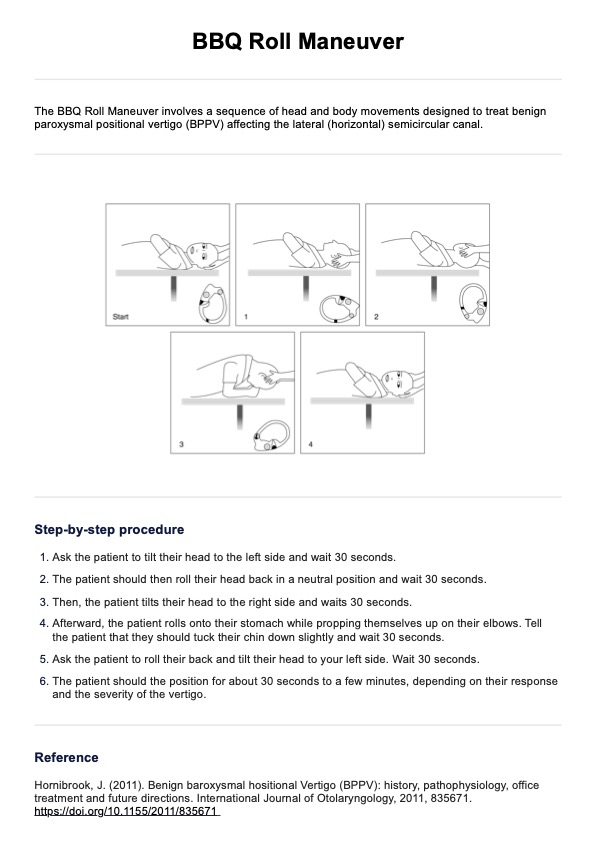
What is the BBQ Roll Maneuver?
The BBQ Roll Maneuver, also known as the Lempert maneuver, is a therapeutic technique healthcare professionals use to treat lateral benign paroxysmal positional vertigo (BPPV), particularly when it affects the right horizontal canal or semicircular canal. This maneuver involves a series of sequential movements that aim to reposition the dislodged calcium carbonate crystals in the inner ear, thereby alleviating the symptoms of vertigo.
How do physical therapists perform this maneuver?
Physical therapists perform the BBQ Roll Maneuver by guiding the patient through a series of rolls:
- The patient starts by sitting on an examination table.
- They lie down on one side with their nose pointed slightly towards the ceiling.
- After waiting a few minutes for any dizziness to subside, the therapist helps the patient roll over onto their back, maintaining the head’s rotation relative to the body.
- The patient continues rolling in the same direction to the opposite side, and finally,
- The patient rolls into a facedown position before sitting back up.
Each position is held for about 30 seconds to a few minutes, depending on the patient’s response and the severity of the vertigo.
How exactly does it help treat lateral BPPV?
The BBQ Roll Maneuver helps treat lateral BPPV by facilitating the movement of the dislodged otoconia out of the horizontal canal back to their original location in the utricle, where they can be reabsorbed or cease to cause disturbance. The sequential rolling motion utilizes gravity to guide the crystals, effectively clearing them from the canal and reducing the triggering of false rotational sensations that lead to vertigo.
Next steps after conducting this maneuver
To maximize the effectiveness of the BBQ Roll Maneuver and ensure the best outcomes, it's important to follow a specific set of steps in the hours and days after the procedure.
Step 1: Maintain an upright position
Immediately following the maneuver, the patient must remain upright for at least 4 to 6 hours. This posture helps ensure that the crystals don’t return to the semicircular canals. Patients are advised to avoid activities that could significantly tilt or bend their neck or head, such as looking down or lying flat.
Step 2: Nighttime precautions
For several nights after the treatment, the patient should sleep with their head elevated at about a 45-degree angle. This can be achieved by using extra pillows or a recliner. They should also avoid sleeping on a pillow on the affected side to prevent the crystals from re-displacing.
Step 3: Follow-up and monitoring
The patient should have a follow-up visit with their healthcare provider to evaluate the maneuver's success. During this visit, the provider will assess symptoms and may perform diagnostic tests to see if the crystals are still causing problems. Continuous monitoring at home is crucial, and the patient should report any recurrence of symptoms to their healthcare provider.
Step 4: Repeat treatment if necessary
If symptoms persist despite the initial maneuver, it may need to be repeated in two patients. Some cases require multiple sessions to resolve the displacement of the otoconia fully. Alternative treatments or referrals to a specialist might also be considered if the patient does not respond to repeated maneuvers.