
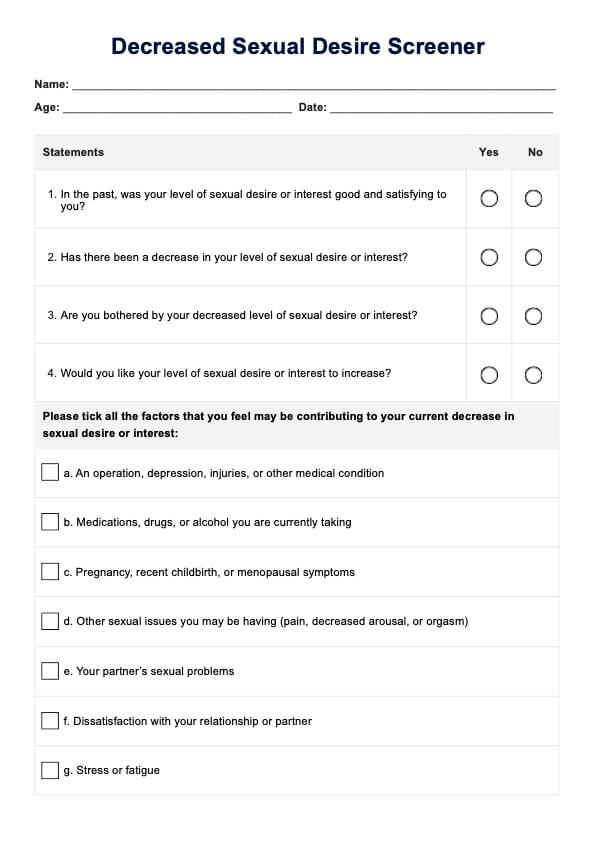




What is the Decreased Sexual Desire Screener?
The Decreased Sexual Desire Screener (DSDS) is a validated five-item questionnaire for diagnosing generalized acquired hypoactive sexual desire disorder (HSDD) in premenopausal women. It provides a brief diagnostic procedure for healthcare providers who are neither trained nor specialized in female suxal dysfunction (FSD). The first four questions assess the patient's sexual desire and distress, while the fifth question identifies potential confounding factors.
The DSDS was validated in a multicenter study involving 263 women, comparing its diagnostic outcomes with those obtained from a standard diagnostic interview conducted by an expert clinician. The agreement rate was 85.2%, with a sensitivity of 83.6% and a specificity of 87.8% (Clayton et al., 2009), indicating its effectiveness in accurately diagnosing HSDD.
The DSDS is valuable in clinical settings with limited access to specialized expertise, providing a brief and straightforward method for non-expert clinicians to screen for HSDD. The inclusion of psychological factors in the fifth question is crucial, as these can significantly impact sexual desire and help clinicians provide a more comprehensive assessment and tailored treatment plan for female sexual dysfunction.
However, it is important to note that this screener is based on the DSM-IV, which was made obsolete in 2015 by the release of the 5th edition (DSM-5). HSDD has been merged with female sexual arousal disorder to form a single diagnosis called female sexual interest/arousal disorder (FSIAD).
Understanding hypoactive sexual desire disorder (HSDD)
Hypoactive sexual desire disorder (HSDD) is a condition where there is a persistent or recurrent deficiency or absence of sexual desire and fantasies, causing marked distress or interpersonal difficulty. Recognized in the 4th edition of the Diagnostic and Statistical Manual of Mental Disorders (DSM-IV), HSDD is often underdiagnosed and poorly treated due to sociocultural barriers and limited understanding among healthcare providers.









