Treatment of femoroacetabular impingement
Femoroacetabular impingement is managed through a combination of non-operative and surgical interventions, tailored to the severity of symptoms, the extent of damage to the hip joint, and the patient’s activity level.
Non-operative management
Non-operative management is the first-line approach for treating FAI, especially in mild or asymptomatic cases. It focuses on alleviating hip pain and preventing progression through conservative strategies. Activity modification reduces stress on the hip joint by avoiding movements that worsen symptoms, such as deep hip flexion or high-impact activities. Physical therapy plays a crucial role by improving hip mobility, strengthening stabilizing muscles, and addressing compensatory movement patterns.
Targeted exercises protect joint mechanics and minimize hip impingement. Medications, such as nonsteroidal anti-inflammatory drugs (NSAIDs), are commonly prescribed to manage pain and reduce inflammation. While these methods are often effective for early-stage FAI, their benefits may diminish in patients with severe symptoms, significant structural abnormalities, or highly active lifestyles, who may require surgical treatment.
Operative management
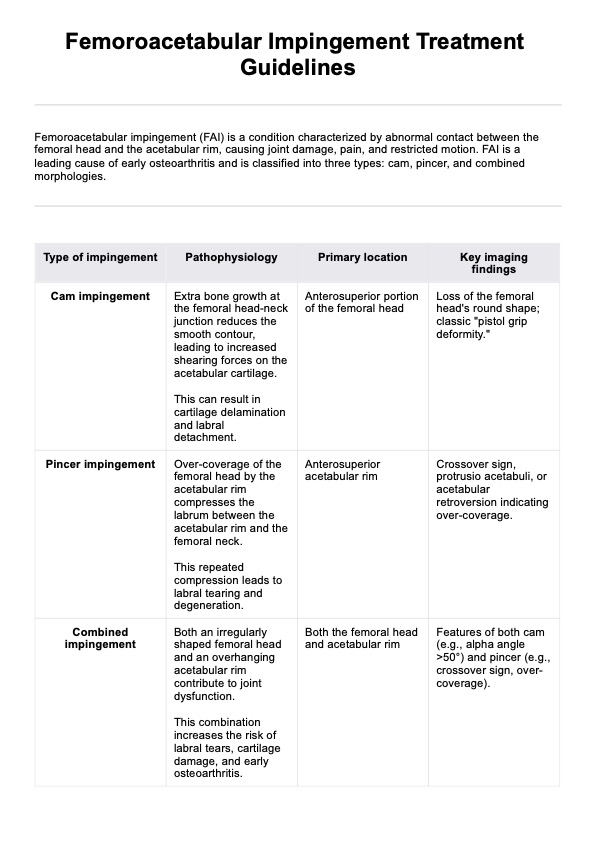
Surgical intervention is recommended when non-operative treatments fail to provide relief after six months or when imaging confirms structural issues, such as cam deformities, pincer lesions, or damage to the labrum and articular cartilage. The primary goals of surgery are to restore proper mechanics of the ball-and-socket joint, repair damaged soft tissue, and relieve hip pain.
- Hip arthroscopy: A minimally invasive procedure that addresses intra- and extra-articular pathologies. This includes reshaping cam deformities, trimming excess acetabular rim bone, and repairing the labrum to restore joint stability. Studies like Griffin et al. (2018) demonstrate that hip arthroscopy significantly improves functional outcomes, although complications such as neuropraxia or labral re-injury can occur.
- Open surgical dislocation: This technique provides 360° visualization of the hip joint, enabling precise correction of complex deformities. While effective for severe FAI, it is more invasive and associated with longer recovery times and higher risks, including blood loss and soft tissue damage.
- Combined mini-open arthroscopy: This approach combines the advantages of arthroscopic and open techniques, addressing both bony and soft tissue abnormalities without requiring a trochanteric osteotomy. It reduces some risks of open surgery but carries slightly higher complication rates compared to pure arthroscopy.
Post-surgical rehabilitation
Rehabilitation is a vital component of treatment, focusing on restoring function, reducing the risk of recurrence, and supporting long-term joint health.
- Initial phase: Gradual reintroduction of weight-bearing activities and gentle exercises to regain mobility while managing pain.
- Strengthening phase: Progressive strengthening of hip stabilizers and core muscles to improve joint support and mechanics.
- Advanced phase: Functional training tailored to the patient’s daily activities or athletic goals to ensure a full return to activity.
Recovery timelines typically range from 3 to 7 months, depending on the severity of the condition, the type of surgical treatment performed, and individual progress during rehabilitation. By integrating surgical and non-surgical approaches, along with structured rehabilitation, patients can achieve significant improvements in hip function and quality of life.