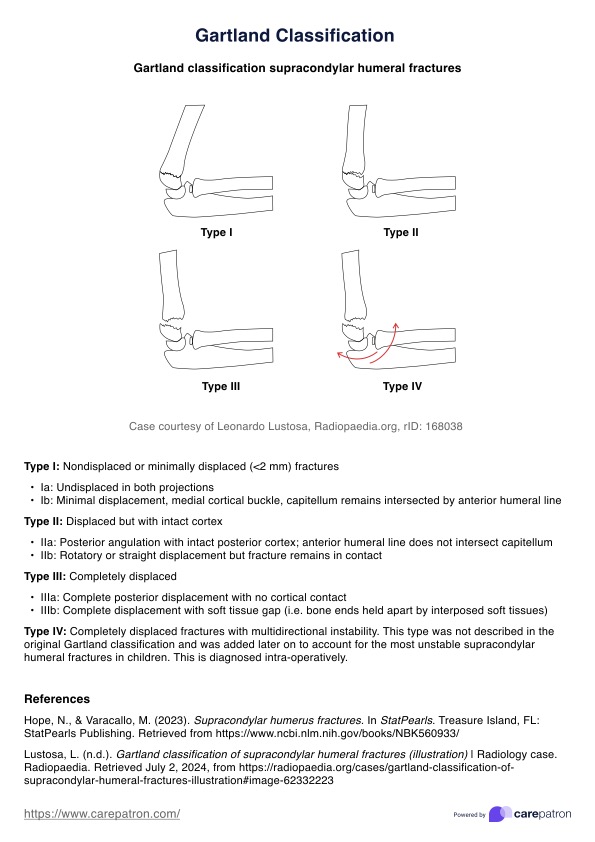
What is the Gartland Classification system?
The Gartland Classification system is a method used to categorize the severity of extension type fractures in the supracondylar humerus at the elbow based on sagittal plane displacement. This classification categorizes the severity of displaced supracondylar fractures and is crucial as it helps guide the treatment approach and predict potential complications. The system divides the fractures into three main types based on the degree of displacement of the bone fragments.
Type I
Type I fractures are considered non-displaced, meaning the bone remains aligned correctly despite the fracture. These fractures may not be easily visible on X-rays and typically require conservative treatment, such as immobilization with a cast.
Type II
Type II fractures involve partial displacement of the bone, where a hinge is still intact. This means that while part of the bone has shifted, another segment remains in place, maintaining some connection. In Type II injuries, the displacement may still allow the anterior humeral line to intersect part of the capitellum, unlike in more severe displacements. However, this type can already lead to sagittal plane deformity, as well as the more severe types. Treatment often involves immobilization and may require manipulation under anesthesia to realign the bone.
Type III
Type III fractures, being completely displaced, carry a higher risk of complications such as ulnar nerve palsy and ulnar nerve injury. They are the most severe and require surgical intervention to realign and stabilize the bone fragments, often using pins or other hardware. The risk of complications, including nerve and vascular injury, is higher with Type III fractures. Type II and Type III are considered displaced supracondylar fractures, requiring more intensive intervention. Type III can lead to worse issues like coronal plane deformity or compartment syndrome.
Type IV
Initially not part of the original Gartland classification, Type IV fractures were later added to account for pediatric supracondylar humeral fractures that exhibit greater instability. Type IV fractures are characterized by complete displacement with no cortical contact and disruption of the periosteal hinge, leading to multidirectional instability. This means that the fracture is unstable in both flexion and extension, unlike the other Gartland types (I-III), which maintain some degree of cortical contact or an intact posterior hinge, making them more stable. Type IV fractures require more extensive surgical treatment, such as open reduction and percutaneous pinning, compared to the other Gartland types, which may be amenable to closed reduction and pinning. Like Type III, Type IV can lead to coronal plane malalignment and compartment syndrome.