
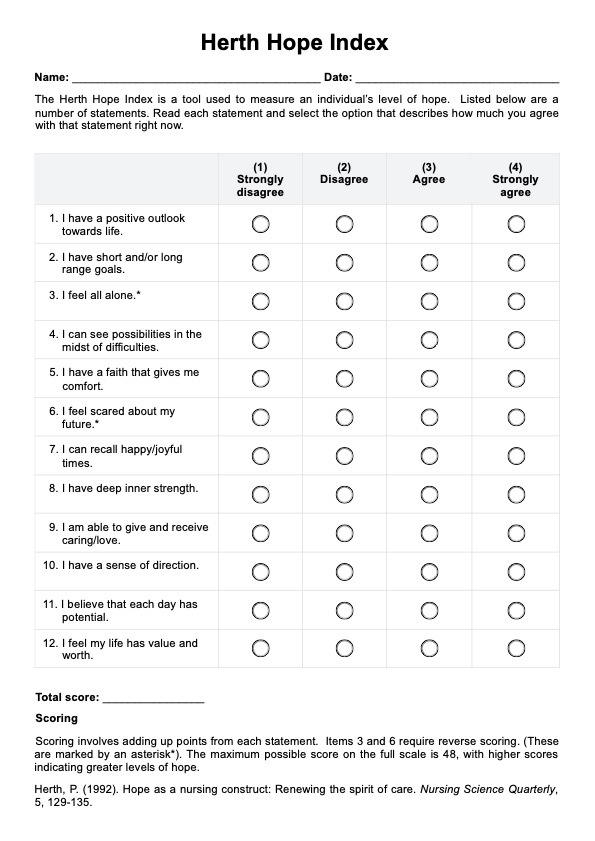




What is the Herth Hope Index (HHI)?
The Herth Hope Index (HHI) is a scale developed by Kaye Herth to measure hope in adults (Herth, 1992). It has been widely used in patients facing chronic, life-threatening, mental health, and cancer-related conditions. The HHI consists of three subscales:
- Inner sense of temporality and future (cognitive-temporal): The belief in the possibility of positive outcomes in the near or distant future.
- Inner positive readiness and expectancy (affective-behavioral): Confidence and action towards achieving desired outcomes.
- Interconnectedness with self and others (affiliative-contextual): Awareness of personal connections with others and a higher spiritual force.
The HHI is used in clinical settings, particularly in chronic health conditions, mental health recovery and active cancer treatment, making it a valuable tool for healthcare professionals like psychologists, counsellors and oncologists.
The HHI has undergone thorough psychometric evaluation including exploratory factor analysis and confirmatory factor analysis to validate its psychometric properties and factor structure, as well as its varying factor structures across different samples, proving it to be a valid and reliable instrument for measuring hope (Chan et al., 2012). Rimaponti et. al (2012) also found that the HHI has a Cronbach's alpha of 0.84 and test-retest reliability of 0.64 (95% CI 0.51; 0.76).
The index also shows strong internal consistency, meaning that it reliably measures hope across different patient demographic and clinical characteristics. Further research has explored the Herth Hope Index's effectiveness across diverse populations, leading to the development of internationally translated and validated versions that maintain the tool's reliability and cultural relevance (Nikoloudi et al., 2021).









