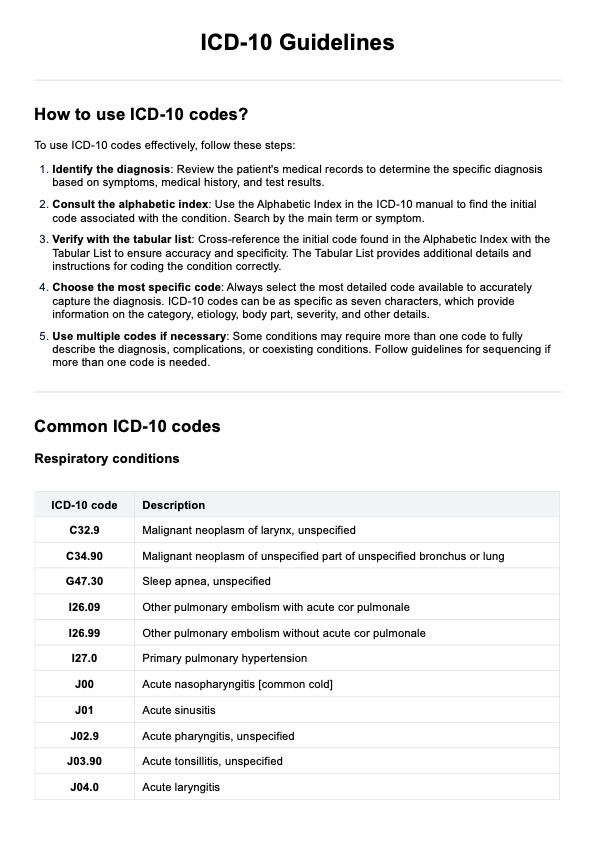
Basic coding guidelines for ICD-10
The ICD-10 is a comprehensive global coding system for diagnosing and coding health conditions. Here are some essential guidelines for using ICD-10:
Locating a code
Begin by locating the condition in the Alphabetic Index, then verify it in the Tabular List. This ensures accuracy since the Alphabetic Index might not provide the complete code, especially for codes that require additional characters. Always cross-reference the code in both lists to ensure the code is as specific as possible.
Level of detail in coding
Codes must be reported with the highest level of specificity available. ICD-10 codes can range from three to seven characters. Codes with three characters are headings and must be expanded if more detail is available. A code is invalid if it lacks the necessary characters, including any required seventh character.
Multiple coding for a single condition
Some conditions require multiple codes to describe them fully. Use the "use additional code" notation to determine if a secondary code is needed. Follow the etiology/manifestation convention, coding the primary condition first, followed by the secondary code.
Combination codes
Combination codes classify two diagnoses: a diagnosis with a secondary manifestation or a diagnosis with a complication. These codes are listed in the alphabetic index and tabular list and should be used when fully describing the conditions. If more detail is needed, an additional code may be required.
Sequela (late effects)
Sequela refers to the residual effects after the acute phase of an illness or injury. Coding sequela generally requires two codes: one for reporting the residual condition and one for the sequela.
Use of sign/symptom/unspecified codes
Use sign/symptom and unspecified codes when a definitive diagnosis is unavailable. These codes should reflect the highest level of certainty known during the encounter. Specific codes should be used when documentation and clinical knowledge support them, but sign and symptom codes are appropriate when a definitive diagnosis is not determined.
Coding impending or threatened conditions
For conditions described as "impending" or present or "threatened":
- If the condition occurred, code it as confirmed.
- If it did not occur, use the Alphabetic Index to find subentry terms for "impending" or "threatened" and assign the appropriate code.
- If sub-terms are not listed, code the existing underlying condition(s).