




The importance of infant language development
A baby's language development is crucial to infant development as it lays the foundation for communication skills, cognitive development, and social interaction. Early development of baby language skills predicts later success in early literacy skills (reading and writing) and overall academic achievement in very young children.
Foundation for communication
Language skills are fundamental for effective communication. Early language development enables infants to express their needs, desires, and emotions effectively. As they grow, these skills enable them to interact more complexly with others, fostering better relationships.
Cognitive development
Language acquisition is closely linked to cognitive development. Learning to speak and understand a language involves memory, listening skills, problem-solving, and using logic, all of which are crucial cognitive skills.
Academic success
Early language skills strongly predict later success in reading, writing, and overall academic performance. Children who develop strong language skills early on are typically better prepared for the academic demands of school.
Social interaction and emotional health
Language development is critical for social interactions and emotional health. It allows children to build relationships and engage in social settings effectively. Communicating helps children express their feelings and understand the emotions of others, which is essential for emotional development. Immersing them in a literacy-rich language environment is highly recommended to ensure a child's speech development and literacy go off without a hitch.
Future opportunities
Language proficiency opens up numerous opportunities throughout life, including career options, social mobility, and access to information. Early language development sets the stage for lifelong learning and adaptability to develop language further.
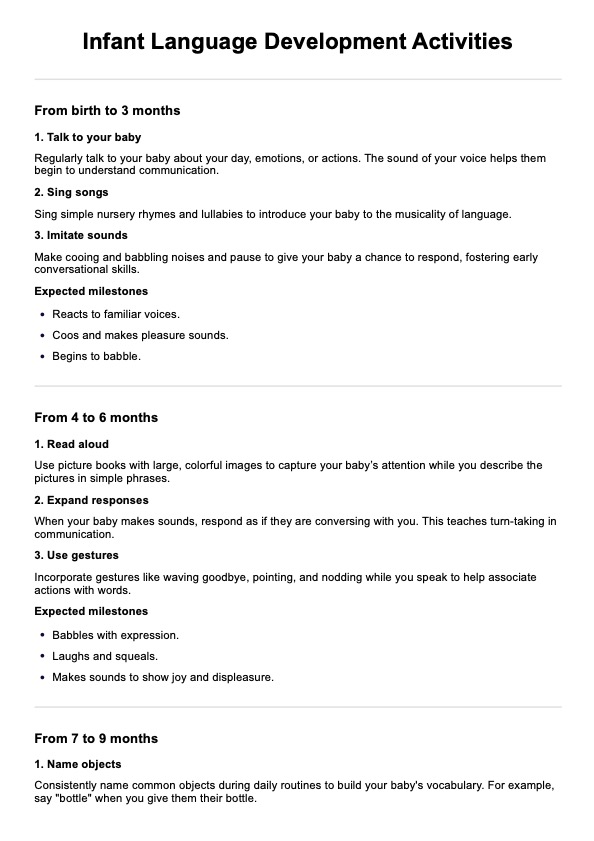
Relevant infant language development milestones
Infant language development involves several key milestones that mark different stages of a child's ability to understand and produce language. These milestones are indicators of normal development and can vary from one child to another. Here are some of the major language milestones:
- Cooing (around 2 months): Infants begin to vocalize and experiment with sounds.
- Babbling (around 4-6 months): Babies start to produce sounds that include p, b, and m. They combine vowels and consonants, like "ba," "ma."
- Gestures (around 7-9 months): Before they start speaking, babies use gestures (baby sign language) to communicate, such as waving or pointing, beyond using facial expressions.
- First words (around 12 months): Typically, babies say their first words at about one year old. These are usually simple and heavily repeated within their environment, like "dada" or "mama."









