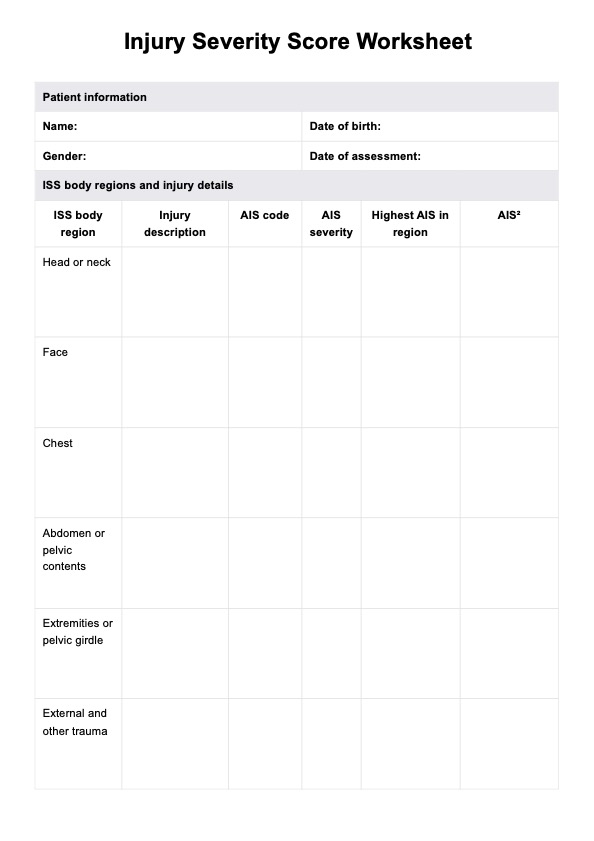
## **What is an Injury Severity Score (ISS)?**
The Injury Severity Score (ISS) is a widely used medical scoring system designed to evaluate the overall severity of multiple traumatic injuries in a patient (Dehouche, 2022). It plays a critical role in trauma assessment by helping healthcare providers estimate the likelihood of outcomes such as mortality, morbidity, and length of hospital stay. The ISS is derived from the Abbreviated Injury Scale (AIS), which assigns a numerical value from 1 (minor) to 6 (maximal, currently untreatable) based on injury severity in specific body regions.
The ISS specifically considers six body systems (also called ISS body regions), but only the three most severely injured regions, based on their AIS scores, are used in the final calculation. Each of these three AIS values is squared and then summed to determine the ISS, which ranges from 3 to 75. An ISS greater than 15 typically indicates major trauma. Notably, if any injury is given an AIS of 6, the ISS automatically defaults to the maximum score of 75, highlighting the severity characterization of that injury.
This scoring system is essential in acute care surgery, emergency medicine, and public health research to evaluate trauma, including abdominal injuries, head injury, chest injuries, cervical spine trauma, thoracic spine fractures, and soft tissue injury across any body region. It also supports trauma mortality prediction model development, helping healthcare professionals understand the outcome likelihood in both adult and pediatric trauma cases.
## **What are the levels of injury severity?**
The levels of injury severity are primarily categorized using the Abbreviated Injury Scale (AIS), which provides a numerical score to describe the severity of individual injuries. This score is then used to compute broader assessments like the ISS, new Injury Severity Score (NISS), and other trauma-related scoring systems.
The AIS uses a scale of 1 to 6, with each level reflecting the potential threat to life and the probable need for medical intervention (Agency for Clinical Innovation, 2021). Below is an extensive breakdown of each AIS level:
### **AIS 1: Minor**
Injuries classified as AIS 1 are minor and usually do not require extensive medical treatment. Examples include small cuts, minor bruises, and sprains. These injuries typically heal with basic first aid and seldom lead to significant functional impairment.
### **AIS 2: Moderate**
Moderate injuries, or AIS 2, involve more significant damage but are still not life-threatening. Examples might include non-complicated fractures, deep lacerations, or minor head injuries without loss of consciousness. These injuries often require medical treatment, such as stitches or casting, but full recovery is expected.
### **AIS 3: Serious**
Serious injuries fall under AIS 3. These are injuries that pose a potential threat to life and definitely require professional medical attention. Examples include complicated fractures, injuries with potential blood loss, or small organ injuries. Such injuries might lead to some degree of permanent disability.
### **AIS 4: Severe**
AIS 4 injuries are severe and pose a significant threat to life. They typically involve extensive organ damage or injuries that significantly impair bodily functions. Examples include severe head trauma with prolonged unconsciousness, injuries requiring surgical intervention to prevent death, or injuries that result in permanent functional impairment.
### **AIS 5: Critical**
Critical injuries, classified as AIS 5, are life-threatening and require immediate and aggressive medical intervention. These injuries often involve major trauma to vital organs, body system or multiple body systems. Examples are severe head injuries with irreversible brain damage or extensive and critical internal injuries.
### **AIS 6: Maximal**
Finally, AIS 6 represents injuries that are currently considered untreatable and invariably fatal, such as severe whole-body trauma or decapitation. This level indicates that survival is not expected regardless of medical intervention.
Understanding the AIS levels helps medical professionals accurately assess the severity of injuries, prioritize treatment accordingly, and predict potential outcomes. This scale also facilitates communication among healthcare providers and aids in the research and development of safety regulations and measures. It's a critical tool in the fields of trauma assessment and emergency medicine.
## **Are the AIS and ISS the same?**
No, the Abbreviated Injury Scale and the Injury Severity Score are not the same, although they are closely related. The AIS is a coding system that classifies and describes the severity of individual injuries on a scale from 1 (minor) to 6 (maximally fatal) (Association for the Advancement of Automotive Medicine, 2025). Each injury is assigned an AIS score based on its severity, injury type, and affected body region.
The ISS, on the other hand, is a scoring system used to assess the overall severity of trauma in patients who have sustained multiple injuries. The ISS is derived from the AIS, but it uses only the three scores from the most severely injured body regions—those with the highest AIS scores—to calculate a total injury severity score ISS. This distinction is critical in describing patients with complex trauma, including head, neck, thoracic, and abdominal injuries.
This scoring approach, including the ISS and new injury severity score (NISS), supports trauma mortality prediction models and severity scoring efforts in both adult and pediatric trauma, and it is often applied in evaluating outcomes such as heart rate response, respiratory rate changes, and critical care admission rates.
## **How does it work?**
Carepatron’s Injury Severity Score Worksheet tool is designed to seamlessly support trauma assessment workflows. With structured fields and automated scoring logic, it ensures consistency, accuracy, and efficiency during high-stakes evaluations. Here’s how healthcare professionals can use the ISS template within Carepatron to enhance clinical decision-making.
### **Step 1: Access the template**
Click the “Use template” button on this page to get started. You’ll be directed to download or open the Carepatron app, where the ISS template will be ready for immediate use. This eliminates setup delays and gets you straight to documentation.
### **Step 2: Use the template in patient assessment**
Open the template during the trauma evaluation and input injury data across the six ISS body regions. The template guides you through each entry using the AIS-based structure, streamlining the documentation process and reducing the risk of error.
### **Step 3: Explain how the assessment will go**
Before scoring, explain to the patient (or relevant team) that the assessment identifies the three most severe injuries, assigns severity ratings using AIS, and calculates an overall ISS to inform treatment priorities and prognosis.
### **Step 4: Gather and interpret findings**
Enter the AIS scores for each injured region. Carepatron will automatically compute the ISS by squaring the top three values and summing the results. If an AIS 6 is detected, the tool will default to a maximum ISS of 75, aligning with standard trauma protocols.
### **Step 5: Discuss findings with patient and provide next steps**
Once the ISS is generated, discuss its implications with the patient or care team. Use the results to guide referrals, admissions, or surgical planning. Carepatron’s built-in sharing and exporting features make it easy to integrate findings into broader clinical workflows.
## **References**
Agency for Clinical Innovation. (2021, November 4). Injury scoring. Institute of Trauma and Injury Management. https://aci.health.nsw.gov.au/networks/trauma/data/injury-scoring
Association for the Advancement of Automotive Medicine. (2025, May 27). Abbreviated Injury Scale (AIS) - Association for the Advancement of Automotive Medicine. https://www.aaam.org/education-resource-center/public-position-statements/abbreviated-injury-scale-ais-position-statement/
Dehouche, N. (2022). The injury severity score: An operations perspective. BMC Medical Research Methodology, 22(1). https://doi.org/10.1186/s12874-022-01528-6