
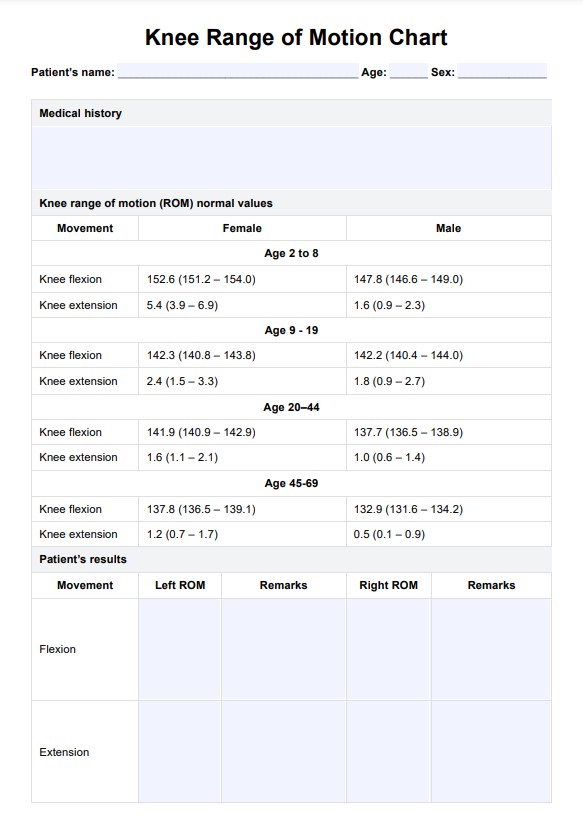




What is range of motion (ROM)?
Range of motion (ROM) is crucial to assessing and understanding the capabilities of the human musculoskeletal system. This term encompasses how much a specific joint or body part can be moved around a joint or a fixed point. ROM assessment plays a pivotal role in various medical and rehabilitative contexts, aiding in the diagnosis, treatment, and monitoring of musculoskeletal conditions.
ROM is categorized into three primary types, each offering distinct insights into the mobility of a joint:
Passive ROM (PROM)
This refers to the range of motion achieved when an external force, such as a therapist or a mechanical device, exclusively induces joint movement. Typically, PROM represents the maximum range of joint motion, providing a baseline for assessing the potential limitations or restrictions in joint mobility.
Active-assisted ROM (AAROM)
In cases where a joint requires partial assistance for movement, an active-assisted range of motion comes into play. This assistance is often necessary when a patient experiences weakness, pain, or alterations in muscle tone. AAROM allows for a more controlled and supported movement, contributing to rehabilitation.
Active ROM (AROM)
Active range of motion involves joint movement achieved through the contraction and relaxation of opposing muscles. For instance, the bending of the elbow or elbow flexion requires the contraction of the biceps while the triceps muscle relaxes. AROM is particularly significant as it reflects an individual's voluntary and functional movement potential without external assistance.
Do note that normal ROM values vary depending on the specific body part and individual characteristics. Individual variations in joint mobility are considered when interpreting ROM assessments, emphasizing the importance of personalized and patient-centered care.









