
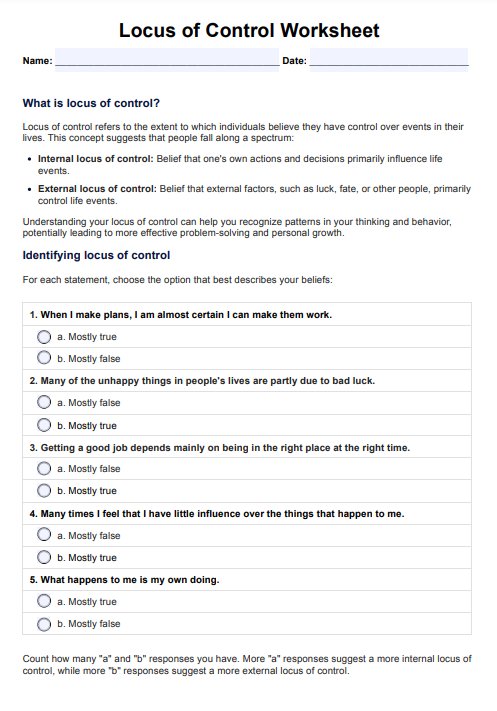




What is the locus of control?
Locus of control is a psychological concept that refers to the degree to which individuals believe they can control events that affect them. It was first introduced by psychologist Julian B. Rotter. This concept, related to the social learning theory, helps to understand the extent to which people attribute the outcomes of their lives to internal or external factors.
There are two main types of locus of control – the internal and external locus of control:
Internal locus of control
Individuals with an internal locus of control believe that their actions and decisions directly influence the outcomes in their lives. They tend to take responsibility for their successes and failures, attributing them to their own abilities, efforts, and choices. People with a high internal locus of control are often more proactive, independent, and confident.
External locus of control
On the other hand, individuals with an external locus of control believe that external factors, such as luck, fate, or powerful others, determine the outcomes in their lives. They may feel that they have little control over their circumstances and that events are largely influenced by external forces beyond their control. People with a high external locus of control may exhibit a more passive attitude and may be more prone to feelings of helplessness.
It's important to note that the locus of control is a continuum, and individuals may have to focus on a combination of both rather than treating it as internal versus external control. The concept is often used in personality psychology and has implications for understanding behavior, motivation, and coping strategies in various situations.









