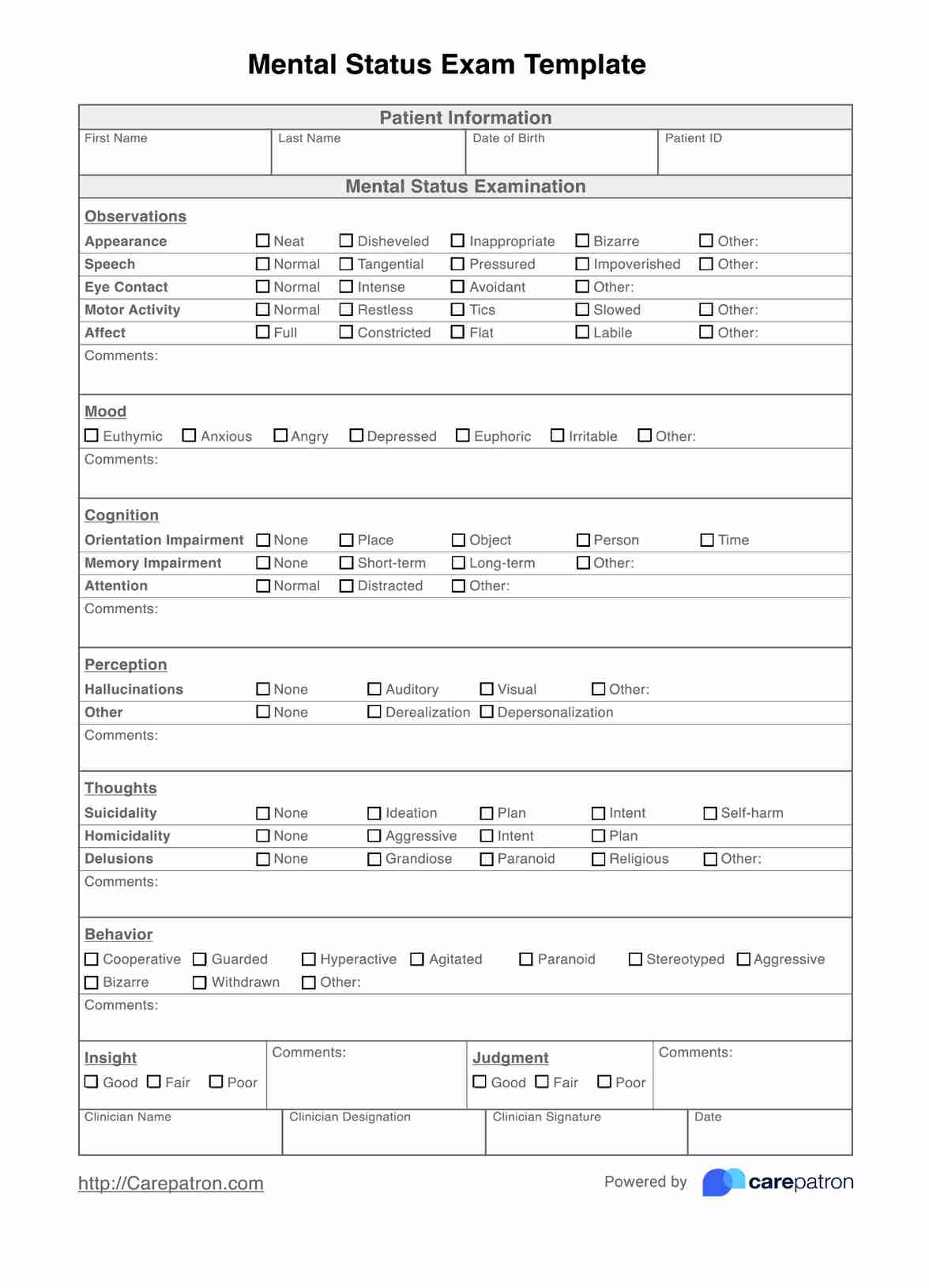
What is included in a Mental Status Exam?
While it can be tailored to the specific needs of the patient, a comprehensive Mental Status Exam typically covers these key areas (Voss & Das, 2022):
Appearance and behavior
The Mental Status Exam begins with observing the patient's appearance and behavior, including personal hygiene, whether they are dressed appropriately, eye contact, facial expression, and posture. A practitioner might also note repetitive movements or abnormal movements during the session. These observations can provide clues about the patient's mental status, physical health, emotional state, and potential neurological conditions.
Speech
Assessing the patient's speech involves evaluating qualities such as rate, volume, articulation, and coherence. Abnormalities in speech, such as pressured speech, monotonous speech, slurred speech, or word salad (incoherent speech), can indicate an underlying mental health problem or cognitive impairment.
Mood and affect
The Mental Status Exam assesses the patient's affect, which refers to their emotional expression, and their mood, which refers to their subjective emotional state. Healthcare professionals observe the patient's facial expressions, eye contact, and body language, which can be mood-congruent or incongruent.
Thought process and content
Evaluating the patient's thought process involves assessing their thoughts' logical flow and organization. Practitioners may also explore the content of the patient's thoughts, including the presence of any delusions (fixed and false beliefs), hallucinations (perceptual abnormalities such as auditory hallucinations), loose associations, overvalued ideas (unreasonable and sustained belief of less than delusional intensity), or obsessions.
Cognition
The cognitive domain of the Mental Status Exam assesses various aspects of the patient's cognitive functioning, including orientation (awareness of self, time, and place), attention, concentration, memory (recent and long-term), language abilities, and executive functioning (problem-solving, abstraction, and fair judgment).
Insight and judgment
Insight refers to the patient's understanding and awareness of their mental health condition. At the same time, judgment involves evaluating the patient's ability to make reasonable decisions and understand the consequences of their actions. Poor insight and impaired judgment can often accompany various psychiatric disorders and personality disorders and may influence treatment adherence and decision-making.