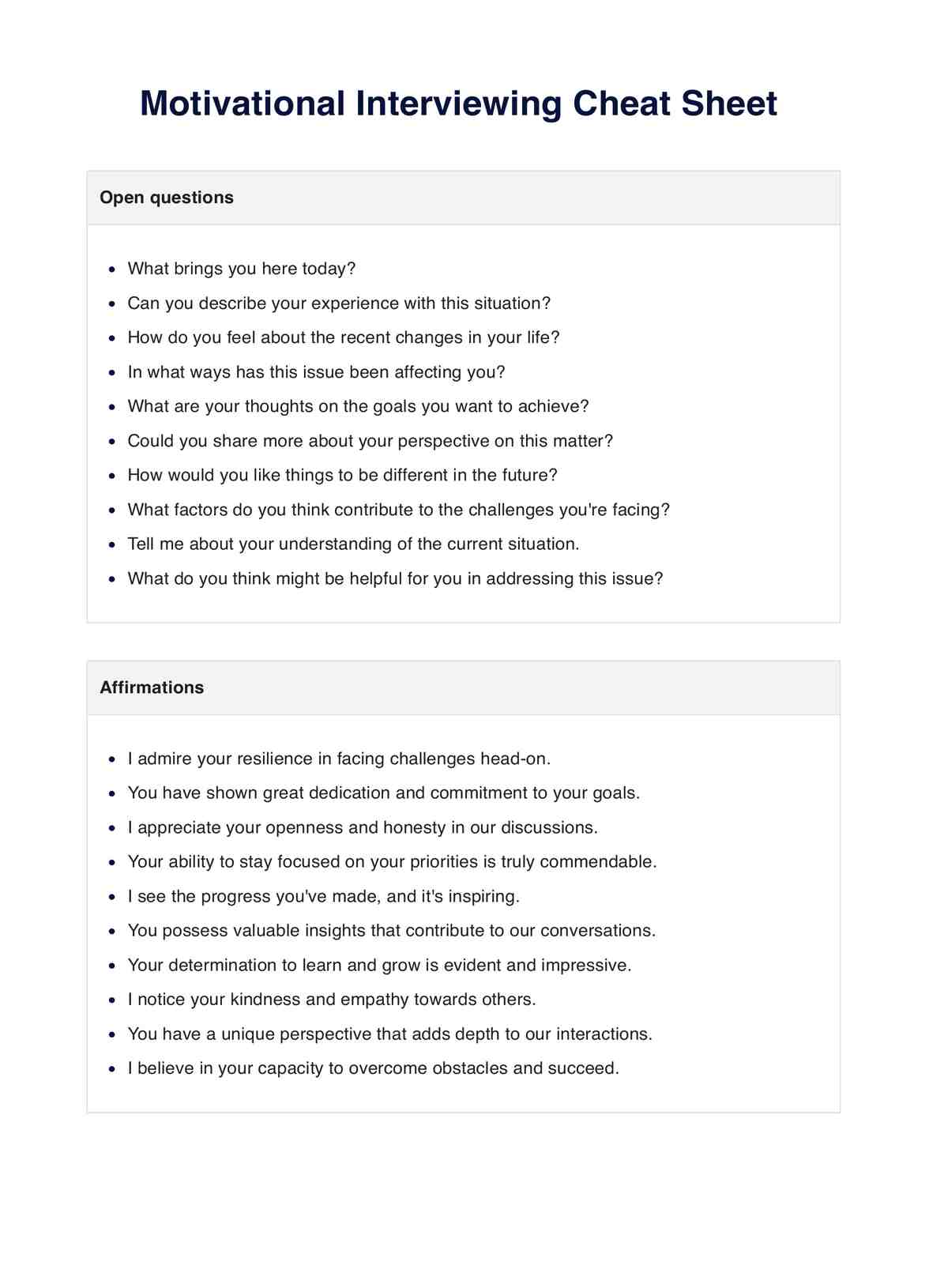
What is OARS?
OARS is the acronym for the four basic tools that make motivational interviewing effective in therapy sessions. Let's go ahead and discuss them in further detail.
OARS: Open questions
Open questions are a standard therapy tool that mental health practitioners can utilize to make their conversations go further or gain a better understanding of the situation or process that is going on for the individual. Open-ended questions allow individuals to tell their stories (Motivational Interviewing: Open Questions, Affirmation, Reflective Listening, and Summary Reflections, n.d.).
Open-ended questions are the opposite of closed-ended questions. This means that individuals are inclined to answer more than a "yes" or "no" when asked. Open-ended questions that you may want to use can look a bit like this:
- Can you help me understand ___?
- How would you like things to be different?
- What are the good things about ___?
- What are the less good things about?
- When would you be most likely to?
- What have you tried before to make a change?
- What do you want to do next?
As you can see, these questions allow individuals to reflect on their situation, decipher the relevant information, and slow down the emotions behind the conversation. These types of questions allow individuals to work through their situation with confidence.
OARS: Affirmations
Affirmations are statements that recognize the client's strengths and acknowledge their positive behaviors. It is a good idea to identify the behaviors that contribute positively to their healing journey. Affirmations can build confidence in their ability to make positive changes.
The most important thing about affirmations is that they must be genuine and congruent to be effective (Motivational Interviewing: Open Questions, Affirmation, Reflective Listening, and Summary Reflections, n.d.). This means they can't be pushed into a conversation without context. Those utilizing motivational interviewing need to know when it's appropriate to implement an affirmation and when it isn't.
Here are a few affirmations that Motivational Interviewing: Open Questions, Affirmation, Reflective Listening, and Summary Reflections (n.d.) note can be helpful:
- I appreciate you are willing to meet with me today.
- You are a very resourceful person.
- You handled yourself well in that situation.
- That’s a good suggestion.
- I’ve enjoyed talking with you today.
Affirmations highlight the positive aspects of the individual. They can help build confidence and foster motivation.
OARS: Reflective listening
Reflective listening is a crucial process within therapy sessions. It's also a key aspect, specifically within the motivational interviewing sector. The overall goal of reflective listening is that it's there to close the loop in communication. This supports the conversation's strength and ensures that breakdowns within communication don't occur.
There are three levels of reflective listening that every therapist should already know. These are:
- Repeating/rephrasing
- Paraphrasing
- Reflection of feeling
OARS: Summaries
Further, summaries are a specialized version of reflective listening. Often, at the end of a conversation between a therapist and a client, during motivational interviewing, the therapist can utilize this technique to guide towards the end of the conversation and use it as an excellent way to support the client into a final reflection for the session. Good ways to summarize include:
- Let me see if I understand...
- Here's what I've heard today...
Responding to these types of sentences can help individuals reflect on their situation. Using your own words as a therapist, you can also enhance rapport by rephrasing what words they have said to ensure they know you acknowledge the situation.