## **What is in a nursing case study?**
A nursing case study is a detailed examination of a patient's health condition, treatment plan, and overall care journey, specifically from the perspective of nursing practice. These case studies are essential components of nursing education and professional development, providing valuable insights into clinical scenarios and patient care experiences.
Various elements are included in a case nursing study to comprehensively understand the patient's situation. A sample case study typically contains the patient's demographic information, including age, gender, medical history, and presenting symptoms. This demographic overview sets the stage for understanding the context in which healthcare interventions occur.
Moreover, nursing case studies often delve into the nursing assessment process, which has five sequential steps: assessment, diagnosis, planning, implementation, and evaluation (Toney-Butler & Thayer, 2023). These assessments involve physical examinations, vital sign monitoring, interventions, and reassessments depending on the patient's condition.
Critical thinking skills are also essential in nursing case studies, as they enable nurses to analyze complex clinical situations, identify priority needs, and develop effective care plans tailored to individual patients. Nursing students and experienced nurses use case studies as opportunities to enhance their critical nursing knowledge and clinical practice.
## **Purpose**
Nursing case studies serve several vital purposes within healthcare education and professional practice, whether they are used by a primary care physician or a group of nursing students.
Nursing case studies use clinical data to enhance clinical reasoning, bridge theoretical knowledge and practice, promote collaboration between nurses, support evidence-based practice, and foster professional development for nurse practitioners.
## **Examples of nursing case studies**
Aside from the ones included in our template, let's explore a few more examples of nursing case studies to illustrate how they are developed and analyzed:
### **Case study 1: Management of chronic pain in elderly patients**
Scenario:Mrs. Smith, a 75-year-old woman, is admitted to the hospital with complaints of chronic pain in her lower back and joints. She has a history of osteoarthritis and hypertension. Mrs. Smith reports difficulty performing activities of daily living due to her pain, which has been progressively worsening over the past year.
Assessment: Nursing assessment reveals a limited range of motion, joint stiffness, and increased blood pressure readings. Mrs. Smith's pain is rated 7 out of 10 on the scale. Vital signs are within normal limits except for elevated blood pressure.
Diagnosis: Nursing diagnosis includes chronic pain related to osteoarthritis and impaired mobility, and activity intolerance related to pain and limited joint mobility.
Interventions: Nursing interventions focus on pain management strategies such as administering analgesic medications, providing heat therapy, and assisting with gentle exercise (Vera, 2017). Patient education is provided on proper body mechanics and joint protection techniques.
Evaluation: Mrs. Smith's pain is reassessed regularly, and interventions are adjusted based on her response. Progress notes indicate a reduction in pain intensity, improved mobility, and increased participation in activities of daily living. Blood pressure readings are monitored closely to ensure optimal management of hypertension.
### **Case study 2: Family-centered care for a child with chronic illness**
Scenario: Johnny, a 6-year-old boy with cystic fibrosis, is admitted to the pediatric unit for respiratory exacerbation. His parents express concerns about managing his condition at home and coping with the emotional impact of his illness on the family.
Assessment: Nursing assessment reveals decreased lung function, persistent cough, and increased respiratory rate. Johnny's parents report feeling overwhelmed and anxious about his health.
Diagnosis: Nursing diagnosis includes ineffective airway clearance related to thick, tenacious secretions.
Interventions: Nursing interventions focus on airway clearance techniques, respiratory treatments, and emotional support for Johnny and his family. Nursing staff facilitate support groups for families of children with chronic illnesses to provide mutual support and share coping strategies.
Evaluation: Johnny's respiratory status is monitored closely, and interventions are implemented to improve airway clearance. Respiratory treatments are administered as prescribed, and progress is documented in the medical record. Johnny's parents report feeling more confident in managing his care at home and express appreciation for the support received from the healthcare team.
## **How to write a nursing case study?**
Writing a nursing case study involves several essential steps to ensure accuracy, relevance, and clarity. Let's break down the process into actionable steps:
### **Step 1: Select a patient case**
Begin by selecting a patient case that presents a relevant and compelling healthcare scenario. Consider factors such as the patient's demographic information, medical history, presenting symptoms (e.g., joint stiffness, pain), and healthcare needs (e.g., medication administration, vital signs monitoring). Choose a case that aligns with your learning objectives and offers meaningful analysis and discussion opportunities.
### **Step 2: Gather relevant data**
Collect comprehensive data about the selected patient case, including medical records, test results, nursing assessments, and relevant healthcare documentation. Pay close attention to details such as the patient's current health status, past medical history (e.g., diabetes), treatment plans, and any ongoing concerns or challenges. Utilize assessment tools and techniques to evaluate the patient's condition thoroughly and identify areas of clinical significance.
### **Step 3: Assess the patient's needs**
Based on the gathered data, evaluate the patient's needs, considering physical, emotional, social, and environmental factors. Assess the patient's pain levels, mobility, vital signs, and other relevant health indicators. Identify any potential complications, risks, or areas requiring immediate attention. Consider the patient's preferences, cultural background, and individualized care requirements in your assessment.
### **Step 4: Formulate nursing diagnoses**
Based on your assessment findings, formulate nursing diagnoses that accurately reflect the patient's health needs and priorities. Identify actual and potential nursing diagnoses related to the patient's condition, considering factors such as impaired mobility, ineffective pain management, medication adherence issues, and self-care deficits.
### **Step 5: Develop a care plan**
Develop a comprehensive care plan outlining the nursing interventions and strategies to address the patient's identified needs and nursing diagnoses. Prioritize interventions based on the patient's condition, preferences, and care goals. Include evidence-based nursing interventions to promote optimal health outcomes, manage symptoms, prevent complications, and enhance the patient's overall well-being. Collaborate with other healthcare professionals as needed to ensure coordinated care delivery.
### **Step 6: Implement and evaluate interventions**
Implement the nursing interventions outlined in the care plan while closely monitoring the patient's response to treatment. Administer medications, provide patient education, perform nursing procedures, and coordinate care activities to effectively meet the patient's needs. Continuously evaluate the effectiveness of interventions, reassessing the patient's condition and adjusting the care plan as necessary. Document all interventions, observations, and outcomes accurately and comprehensively.
### **Step 7: Reflect and seek assistance**
Reflect on the nursing case study process, considering what worked well, areas for improvement, and lessons learned. Seek assistance from nursing instructors, preceptors, or colleagues if you encounter challenges or have concerns about the patient's care. Collaborate with interdisciplinary team members to address complex patient issues and ensure holistic care delivery. Continuously strive to enhance your nursing practice through ongoing learning and professional development.
## **What is a Nursing Case Study with Answers template?**
A Nursing Case Study with Answers template is a guide that presents a patient scenario for nurses to assess, analyze, and make care decisions. It includes situations to help nurses apply critical thinking and clinical knowledge.
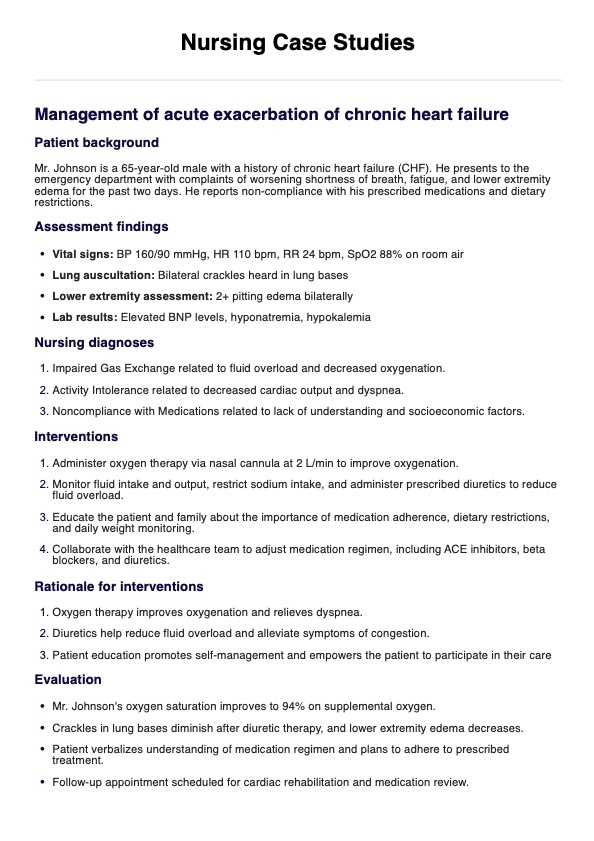
Our Nursing Case Study with Answers template provides two examples of health issues that may occur within the health practice. It includes scenarios for managing acute exacerbation of chronic heart failure in a patient, as well as a case involving a patient with a broken bone. We've also added an extra blank section for student nurses, nurses, and other practitioners to add another example for practice and analysis.
## **How does our Nursing Case Studies with Answers work?**
Our Nursing Case Studies with Answers template is a structured tool and resource that's designed to help you, fellow healthcare professionals, and students learn how to document clinical scenarios, clinical reasoning, and patient outcomes during real scenarios. To make the most out of the template, follow the step-by-step instructions provided below:
### **Step 1: Familiarize yourself with the content**
In our template, you are provided with two examples of nursing case studies you can use as a reference prior to writing one yourself. The examples include a patient background, assessment findings, diagnoses, interventions, rationale, and evaluation for a hypothetical patient with a broken bone and a patient who needs assistance with the management of an acute exacerbation of chronic heart failure.
### **Step 2: Write your own case study**
Begin by labeling the case study title and filling in the Patient Background with your patient's age, gender, medical history, and presenting symptoms.
### **Step 3: Document data and diagnoses**
Note down your assessment findings (vitals, lab results, and physical exam observations) and use the data you gathered to identify the primary nursing diagnoses.
### **Step 4: Pland and justify your action**
List down the interventions you will perform and provide a rationale for each to explain why it's the appropriate course of action.
### **Step 5: Record the outcome**
Complete the evaluation section by noting down the patient's response to treatment as well as any necessary follow-up care.
## **Tips for organizing Nursing Case Studies**
To organize nursing case studies effectively, prioritize a logical, patient-centered structure that mirrors clinical practice. Start by utilizing the Nursing Process (ADPIE) framework—Assessment, Diagnosis, Planning, Implementation, and Evaluation—as your primary organizational outline (Walden University, 2023).
According to the American Nurses Association (ANA), this systematic approach ensures all critical data points, from subjective patient history to objective clinical findings, are presented in a cohesive sequence (Ernstmeyer & Christman, 2021).
Use clear headings to separate the patient’s chief complaint, relevant pathophysiology, and nursing interventions. This professional structure not only enhances readability but also demonstrates your clinical reasoning and ability to synthesize complex information into an actionable care plan.
Furthermore, maintaining HIPAA compliance and data integrity is essential for a high-quality case study. Avoid using any identifiable patient information, such as names or specific birthdays, to ensure ethical standards are met.
Integrating evidence-based practice (EBP) is another hallmark of a strong case study. They also recommend citing peer-reviewed journals to support why specific interventions were chosen (Oermann et al., 2020).
To keep the document scannable, use bulleted lists for medications and laboratory values, and conclude with a reflective summary that evaluates the patient's outcomes against the initial goals. This blend of structured data and evidence-based analysis provides a comprehensive view of the patient’s journey.
## **References**
Ernstmeyer, K., & Christman, E. (2021). Nursing process. National Library of Medicine. https://www.ncbi.nlm.nih.gov/books/NBK591807/
Oermann, M. H., Wrigley, J., Nicoll, L. H., Ledbetter, L. S., Carter-Templeton, H., & Edie, A. H. (2020). Integrity of Databases for Literature Searches in Nursing. Advances in Nursing Science, 44(2), 102–110. https://doi.org/10.1097/ans.0000000000000349
Toney-Butler, T. J., & Thayer, J. M. (2023, April 10). Nursing process. StatPearls Publishing. https://www.ncbi.nlm.nih.gov/books/NBK499937/#:~:text=The%20nursing%20process%20functions%20as,planning%2C%20implementation%2C%20and%20evaluation
Vera, M. (2017, March 7). Chronic pain (pain management) nursing diagnosis & care plan. Nurseslabs. https://nurseslabs.com/chronic-pain/
Walden University. (2023). The 5 steps in the ADPIE nursing process. https://www.waldenu.edu/programs/nursing/resource/the-five-steps-in-the-adpie-nursing-process