Read our guide to learn how nursing concept maps enhance clinical reasoning and critical thinking, then download our free template to create structured care plans that connect assessment data, nursing diagnoses, and interventions in one clear diagram.
## **What is a nursing concept map?**
In patient care, every piece of information is interconnected and vital for the well-being of those under your watch, and understanding these intricate connections is crucial. Nursing concept maps are visual tools that organize patient information into structured diagrams showing relationships between clinical data, nursing diagnoses, medical conditions, and care interventions. These maps help healthcare professionals connect information comprehensively and accessibly, supporting systematic clinical reasoning, the nursing process, and care planning (Nevada State University, 2024).
Nursing Concept Map Templates help healthcare professionals, like spider maps for healthcare, connect information in a way that's both comprehensive and accessible. These maps come in various forms, from spider-like structures capturing the complexity of medical diagnosis to flow charts to hierarchical maps organizing findings in a structured manner. This can also be helpful in nursing school for educational purposes and training nurses.
Consider a patient presenting with a medical diagnosis involving multiple care aspects. Nursing concept maps excel in breaking down these complexities, providing a clear visual representation of the relationships between various nursing concepts.
Concept mapping serves as an effective learning tool in nursing education and clinical practice by:
- **Strengthening critical thinking skills**: It forces nurses to analyze relationships between assessment data, diagnoses, and outcomes rather than viewing information in isolation.
- **Supporting clinical judgment**: The concept map approach helps identify risk factors and potential complications before they escalate.
- **Enhancing patient care planning**: Concept system maps create comprehensive care plans that address multiple aspects of patient care simultaneously.
- **Facilitating meaningful learning**: It connects theoretical nursing concepts to real-world clinical setting applications.
### **HIPAA compliance with nursing concept maps**
When creating nursing concept maps for comprehensive patient care, nurses must protect patient privacy. All patient identifiers—names, dates of birth, medical record numbers—must be removed or de-identified according to HIPAA guidelines when concept maps are used for educational purposes or shared outside the direct care team.
In the clinical setting, store completed maps with the same security measures as other protected health information, using secure [electronic health records](https://www.carepatron.com/feature/electronic-patient-records) or locked physical files. For nursing education purposes, nursing students should use only fictitious patient scenarios or properly de-identified cases that maintain no connection to actual individuals.
### **Limitations to consider**
While concept maps offer significant benefits, nurses should be aware of:
- **Time investment**: Creating detailed maps initially requires more time than traditional linear notes, though efficiency improves with practice.
- **Learning curve**: Nursing students need training and understanding to develop effective concept mapping techniques.
- **Complexity management**: Overly detailed maps can become cluttered and difficult to interpret—focus on key elements is essential.
- **Not universal**: Some learners may find other organizational tools more intuitive for their learning style.
## **How to use this basic nursing concept map?**
Creating a nursing concept map is a beneficial skill for healthcare professionals. It helps correct nursing diagnosis, establish relationships between various aspects of nursing care, and determine the most effective nursing care plan.
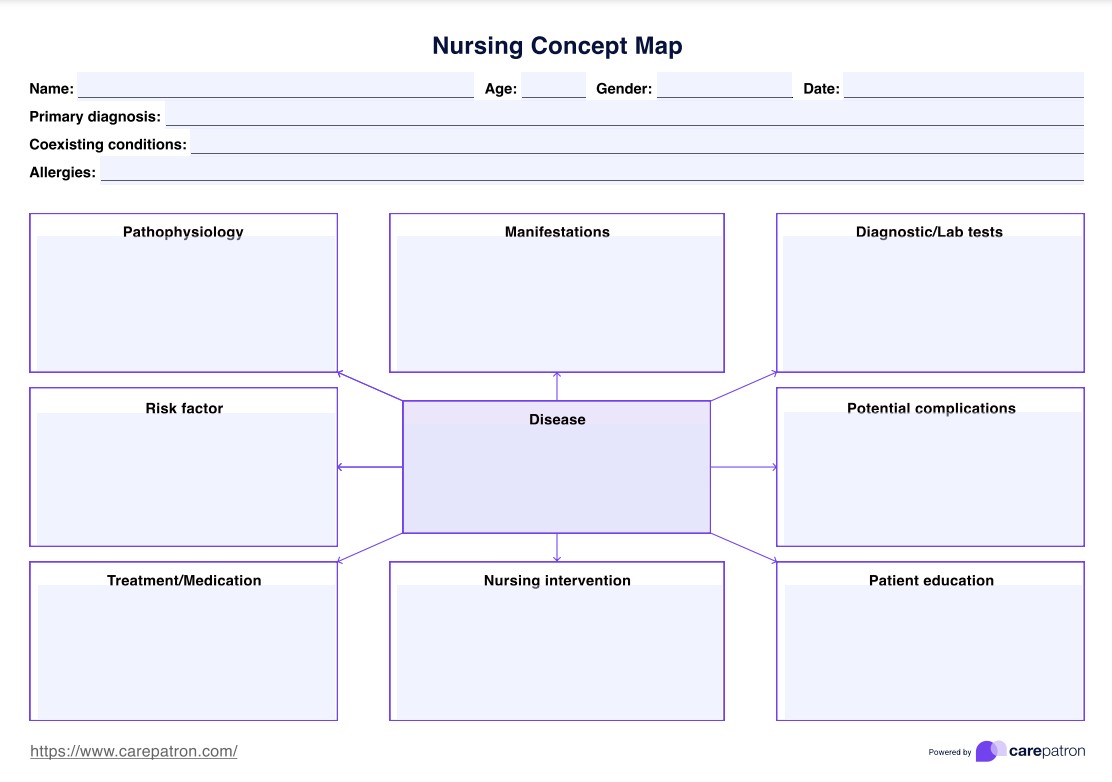
Our template follows a spider map structure with the disease or primary diagnosis at the center, with related concepts branching outward. This format helps you visualize how different aspects of patient care connect to the main health issue.
Here's a comprehensive guide to creating a basic nursing concept map:
### **Step 1: Download the template**
Begin by clicking "Use template" to open and edit the printable Nursing Concept Map Template within the Carepatron platform. You can also click "Download" to save a PDF copy on your device or print it to maximize assessment and learning.
### **Step 2: Gather and document patient information**
Fill in the demographic section with the patient's basic information. Record the primary diagnosis in the center box. List any coexisting conditions, allergies, and past medical history that influence care planning. This establishes your foundation for building connections between various nursing concepts.
### **Step 3: Complete pathophysiology and manifestations**
In the Pathophysiology section, briefly explain the disease process and how it affects body systems. In the Manifestations section, document symptoms and clinical signs you observe or that the patient reports. These boxes help connect the biological mechanism to observable outcomes, supporting your clinical judgment.
### **Step 4: Identify risk factors and potential complications**
Document risk factors that contributed to or worsened the condition—these may include lifestyle factors, medical history, or genetic predisposition. In the Potential Complications section, anticipate what could go wrong based on the pathophysiology and manifestations. This demonstrates proactive critical thinking and helps prioritize nursing interventions.
### **Step 5: Map treatments, medications, and diagnostic tests**
Fill in prescribed medications and treatments, noting their purpose and relationship to the primary diagnosis. List relevant diagnostic or lab tests used to monitor the condition. Connect these elements visually to show how medical interventions target specific aspects of the disease.
### **Step 6: Define nursing interventions and patient education**
Document specific nursing interventions that address the patient's needs—both independent nursing actions and collaborative care activities. Complete the Patient Education section with teaching priorities that help the patient manage their condition effectively. Share the completed map with your health care team to ensure comprehensive, coordinated care.
## **Tips for writing a nursing concept map**
Beyond learning how to use this template, here are some tips for doing your own concept maps:
### **Start with a thorough assessment**
Collect comprehensive assessment data before beginning your map; the quality of your concept map depends on the depth of your initial patient assessment. Review the medical history, clinical setting context, current symptoms, and available diagnostic results. The more complete your data collection, the more meaningful the connections you can identify.
### **Use linking phrases to show relationships**
Use linking phrases like "leads to," "increases risk for," "managed by," or "monitors for" to demonstrate how concepts connect. These phrases transform isolated facts into integrated knowledge, strengthening your clinical reasoning.
### **Prioritize key information**
Focus on the most relevant information rather than including every possible detail. A cluttered map loses its value as a visual tool. Identify what directly impacts patient care and outcomes, keeping your map scannable and actionable.
### **Practice regularly to build proficiency**
Concept mapping becomes more intuitive with repeated use. Nursing students should create maps for different patient scenarios to develop pattern recognition and strengthen critical thinking skills. Over time, you'll naturally identify connections faster and structure maps more efficiently.
## **Reference**
Nevada State University. (2024, October 2). How to create a nursing concept map. https://nevadastate.edu/son/rn-bsn/how-to-create-a-nursing-concept-map/