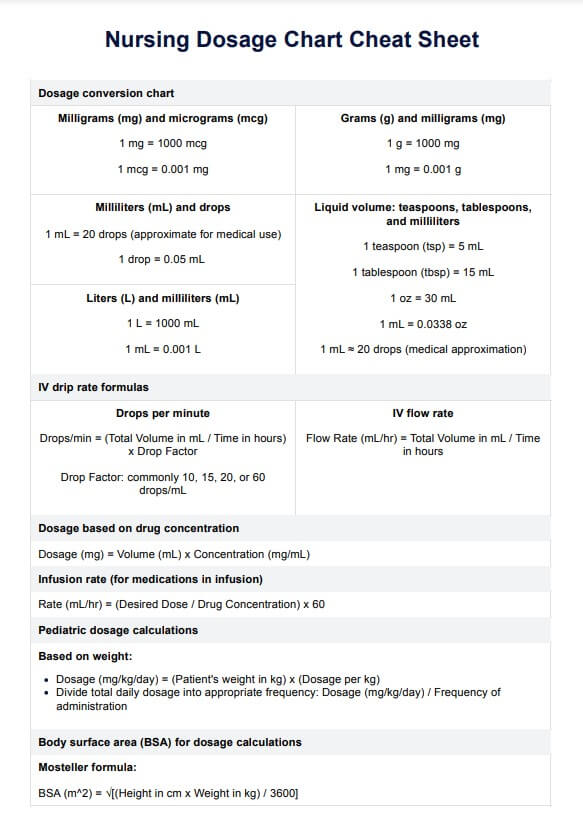
Looking for a tool that can help you refresh your knowledge about dosages and conversions? Read our guide to learn more about medicine dosages and the importance of appropriate dosages and conversions. Then, download our Nursing Dosage Chart Cheat Sheet to help you refresh whenever you need to!
## **An overview of medical dosages**
Accurately calculating and administering medical dosages are fundamental competencies for nurses, directly impacting patient safety and treatment efficacy.
Nurses must be proficient in various mathematical concepts, including dosage calculations and unit conversions (e.g., kilograms to pounds, milligrams to micrograms), to ensure the prescribed dose is safe and correct for the individual patient. This skill is especially critical for vulnerable populations, such as pediatrics, where dosages are often weight-based, and for high-alert medications with narrow therapeutic ranges (Ernstmeyer & Christman, 2023). A single miscalculation can have severe, life-threatening consequences, highlighting the legal and ethical responsibility nurses bear in this area.
Consequences resulting from incorrect dosages can be dire and fall into two main categories: underdosing and overdosing (Callahan & Blaine, 2025). Underdosing occurs when a patient receives too little medication, leading to sub-therapeutic effects, failure to resolve the underlying condition, disease progression, and prolonged hospitalization. Conversely, overdosing—the administration of a dose higher than the safe range—can cause profound toxicity (Josefson, 2002), severe adverse drug events, irreversible organ damage, and, in the most tragic cases, death.
Medication errors, including those related to dosage, are a leading cause of patient injury and mortality worldwide (World Health Organization, 2017), emphasizing why rigorous double-checking and adherence to safe-dosing protocols are non-negotiable professional standards.
## **What is a Nursing Dosage Chart Cheat Sheet?**
A Nursing Dosage Chart Cheat Sheet is essential for healthcare professionals, especially nurses. It helps in converting and calculating accurate medication dosages in various units using the metric system, such as milligrams (mg), micrograms (mcg), and milliliters (mL), by providing the conversion factors. For example, the chart can quickly show how to convert a dose from mg to mcg, aiding in precise medication administration.
The need for such a chart arises from the critical nature of accurate dosage calculations in healthcare. It helps prevent medication errors due to incorrect dosage calculations, which can have serious, sometimes life-threatening consequences. The chart is a quick reference to ensure correct dosages are administered to patients, minimizing the risk of medication errors.
To elaborate, here are various scenarios where these cheat sheets prove invaluable:
- **During emergencies**: Nurses need to act quickly in emergencies. A cheat sheet can provide a rapid dosage calculation or conversion, enabling prompt and accurate medication administration in critical cases.
- **For pediatric patients**: Children's dosages often require precise calculations based on weight. Nurses use cheat sheets to quickly convert and calculate pediatric dosages, ensuring safe and effective treatment.
- **In intensive care units (ICUs)**: ICUs deal with critically ill patients who require exact medication dosages. The cheat sheet helps nurses in these units to accurately calculate and adjust dosages as needed.
- **When administering intravenous (IV) medications**: IV medication dosages need to be exact. Nurses refer to cheat sheets for correct IV drip rates and medication concentrations.
- **In-home healthcare**: Nurses providing home healthcare use cheat sheets to calculate dosages accurately, especially when they need to adjust or re-calculate dosages based on a doctor's new instructions.
- **During patient education**: Nurses use cheat sheets as a reference to educate patients or their families about medication dosages, especially when the patients are transitioning to self-care.
- **In pharmacy calculations**: Pharmacy staff may also use these cheat sheets to confirm or double-check medication dosages before dispensing.
- **During nursing education and training**: Nursing students and trainees use these cheat sheets as learning tools to familiarize themselves with standard dosage calculations and conversions.
In these clinical settings, there are a number of benefits to using this cheat sheet. Some of them include:
- **Increases accuracy in medication administration**: This cheat sheet significantly reduces the risk of dosage errors and simplifies complex med math calculations. Providing quick conversion references and calculation formulas helps nurses ensure accurate desired doses, considering factors like the patient's weight and the prescribed dosage.
- **Time-saving and efficient**: In fast-paced healthcare settings, time is of the essence. The cheat sheet streamlines dosage calculations, saving valuable time that nurses can dedicate to other aspects of patient care.
- **Enhances confidence and independence**: A reliable reference tool boosts nurses' confidence in their calculations. It empowers them to make independent decisions and administer medications with greater assurance.
- **Useful for training and education**: The cheat sheet is an excellent educational resource for nursing students and new graduates. It helps them learn and understand various dosage calculations and conversions with basic units, enhancing their training experience.
- **Standardization of care**: The cheat sheet helps standardize medication administration procedures across different healthcare professionals, ensuring consistency and reducing variability in patient care.
- **Handy reference in critical situations**: In emergency or critical care situations, where quick and accurate medication administration is crucial, the cheat sheet is a handy and reliable reference when one does drug calculations using the ratio and proportion method, ensuring that nurses can respond swiftly and correctly.
## **How to use our Nursing Dosage Chart Cheat Sheet?**
The Nursing Dosage Conversion Chart Cheat Sheet is a comprehensive reference tool that includes essential information for converting and calculating drug dosages, as the cheat sheet includes basic conversion formulas, IV drip rate calculations, pediatric dosage calculations, and more. Before proceeding to use our template, here's an overview of what our cheat sheet includes:
- **Basic conversion formulas**: It covers fundamental conversion formulas between imperial and metric units, such as converting milligrams (mg) to micrograms (mcg) or milliliters (mL) to teaspoons (tsp), often using dimensional analysis for precision.
- **IV drip rate calculations for IV infusions**: The sheet includes formulas and shortcuts for calculating IV drip rates, essential for administering intravenous medications at the correct flow rate.
- **Pediatric dosage calculations**: Specific calculations based on a child's weight are crucial for determining the correct medication dosages for pediatric patients.
- **Body surface area (BSA) calculations**: This section often includes the Mosteller formula, which is used to calculate a patient's body surface area, which is vital for administering certain medications.
- **Infusion rate calculations**: The cheat sheet provides infusion rate calculations to ensure the proper amount of drug is delivered over the correct time frame for medications administered over a period.
- **Liquid volume conversions**: It includes conversions between different liquid volumes, like ounces to milliliters, which is helpful in preparing and administering liquid medications.
Once you've familiarized yourself with the conversion units in the cheat sheet, you can use the allotted space to get the final answer. Feel free to do practice problems with missing values or to note down any dosage calculation questions to ask your mentor or fellow nurses.
## **Additional nursing tools and resources**
Need additional information to aid you in your nursing practice? Here are some free resources you can utilize:
- **Nursing Care Plan**: Document patient assessments, nursing diagnoses, and even outline ways to assess how well the patient responds to their treatment plans with a Nursing Care Plan template.
- **Nursing Concept Map Template**: Organize patient information into structured diagrams to see relationships between clinical data, medical conditions, and more with a Nursing Concept Map template.
- **Nurse Brain Sheet**: Document important patient details for effortless organization and continuity of care during shift changes, with a Nurse Brain Sheet.
## **References**
Callahan & Blaine. (2025, May 29). The dangers of medication errors. https://www.callahan-law.com/the-dangers-of-medication-errors/#:~:text=Giving%20the%20incorrect%20dosage%20of,leading%20to%20underdosing%20or%20overdosing
Ernstmeyer, K. & Christman, E. (2023, August 28). 5.12 Safe dosage range. Nursing Skills - 2e; WisTech Open. https://wtcs.pressbooks.pub/nursingskills/chapter/5-12-safe-dosage-range/#:~:text=When%20verifying%20that%20a%20dosage,e.g.%2C%20pounds%20to%20kilograms
Josefson, D. (2002). Doctors warned to be wary of new drugs. BMJ, 324(7346), 1113–1113. https://doi.org/10.1136/bmj.324.7346.1113
World Health Organization. (2017). Medication without harm. https://www.who.int/initiatives/medication-without-harm