
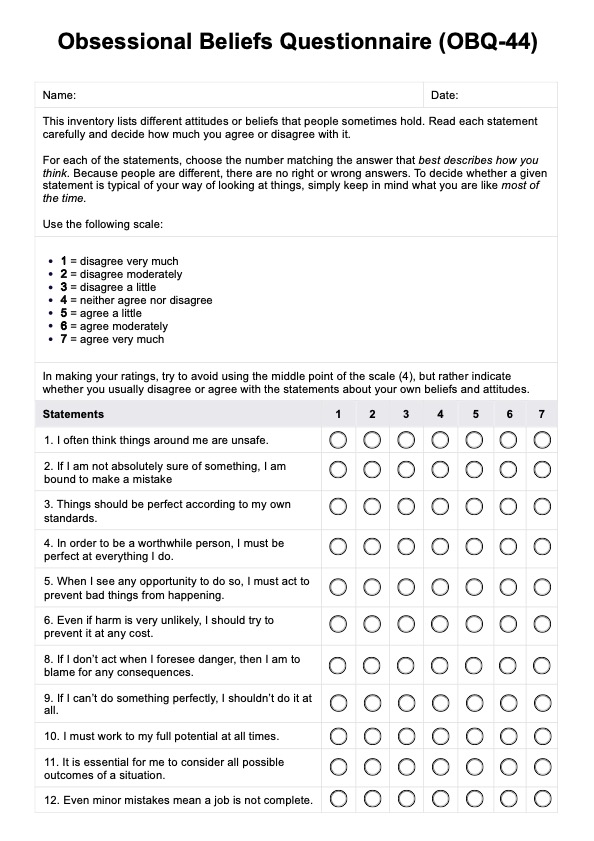




What is the Obsessional Beliefs Questionnaire-44 (OBQ-44)?
The Obsessional Beliefs Questionnaire-44 (OBQ-44) is a self-administered psychological assessment tool designed to evaluate dysfunctional beliefs that are commonly associated with obsessive-compulsive disorder (OCD). Developed by the Obsessive-Compulsive Cognitions Working Group (OCCWG), the OBQ-44 serves as a reliable and insightful resource for clinicians to understand the cognitive processes underlying OCD (1997).
This comprehensive questionnaire consists of 44 items, each rated on a Likert scale ranging from 1 (totally disagree) to 7 (totally agree). The scale's nuanced scoring system allows a detailed exploration of an individual's belief systems. These items are grouped into three core belief domains, reflecting key cognitive dimensions related to OCD:
Responsibility and threat estimation
This domain assesses beliefs tied to an exaggerated sense of personal responsibility and the tendency to overestimate potential threats. Individuals scoring high in this area may feel an overwhelming need to prevent perceived harm, even when the likelihood of such harm is minimal.
Importance of control of thoughts
This domain evaluates beliefs about the significance of intrusive thoughts and the perceived necessity to control them. Those with OCD often assign excessive meaning to their thoughts, believing that having certain thoughts is equivalent to acting on them or that failing to control such thoughts might lead to dire consequences.
Perfectionism and certainty
This domain measures beliefs associated with a need for perfection and absolute certainty in one's thoughts and actions. These beliefs often manifest as rigid standards and a fear of making mistakes, which can lead to compulsive behaviors aimed at achieving an unattainable sense of "rightness."
The OBQ-44 has been extensively validated across various languages and cultural settings, demonstrating strong psychometric properties, including high internal consistency and reliability (Moulding et al., 2011; Wang et al., 2015). Its adaptability to diverse populations ensures that it remains a widely accepted tool in both research and clinical practice.
Studies highlight the OBQ-44's ability to distinguish between individuals with OCD and non-clinical populations. Research conducted by Izadi et al. (2014) indicates that individuals with OCD consistently score significantly higher on the OBQ-44 than those without the disorder, underscoring its utility as a diagnostic and evaluative instrument.









