



What is the Parkinson’s Rigidity Test?
Before we discuss what the Parkinson’s Rigidity Test is all about, let’s briefly discuss what rigidity is in the context of Parkinson’s Disease.
Rigidity is one of the main symptoms of Parkinson’s Disease. Most people who have this disease will develop rigidity at some point as their condition develops and progresses.
When we speak of rigidity in this context, we mean the resistance to passive movement in a patient’s joints. Rigidity can also refer to joints and limbs becoming stiff or tight, resulting in a decreased range of motion. An example would be the arm swinging less while walking. Even trunk movements can be impacted by this.
The rigidity can also cause aches in the arms and legs, especially in the muscles. This may affect sleep and make the patient feel uncharacteristically tired.
There are two types of rigidity: Lead Pipe Rigidity and Cogwheel Rigidity. The former is characterized by a constant resistance throughout an entire range of motion, while the latter is characterized by a resistance that starts and stops every now and then while a limb or joint is being moved throughout its range of motion.
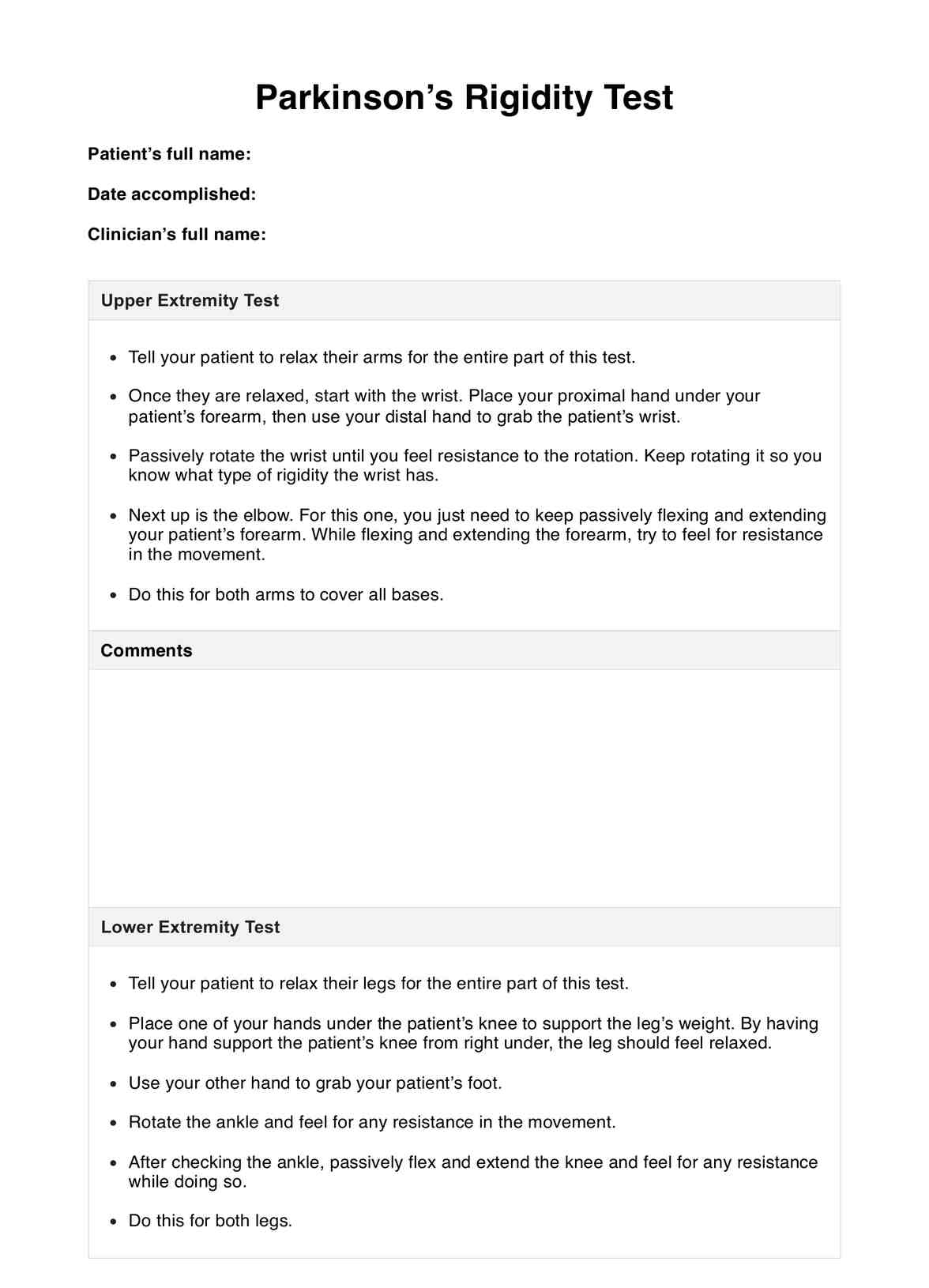
To gauge a patient’s rigidity, a healthcare professional will conduct the Parkinson’s Rigidity Test, which is an examination that involves the passive manipulation of a patient’s limbs and joints.