What are the benefits of the Parkinson’s Tremor Test?
It’s a good way to screen patients who are likely to have Parkinson’s Disease.
As mentioned earlier, it’s always best to screen patients before considering them for scans and neurological tests for Parkinson’s Disease. These screening tests include the Parkinson’s Tremor Test. The reason why this should be one of the first tests to be conducted is that there is a chance that a misdiagnosis can be made.
The Parkinson’s Tremor Test, along with the Parkinson’s Rigidity Test and Bradykinesia, will gauge the patients for disease symptoms. If these tests detect symptoms, then the patient should undergo scans and neurological tests because there’s enough grounding to consider the possibility they have the disease.
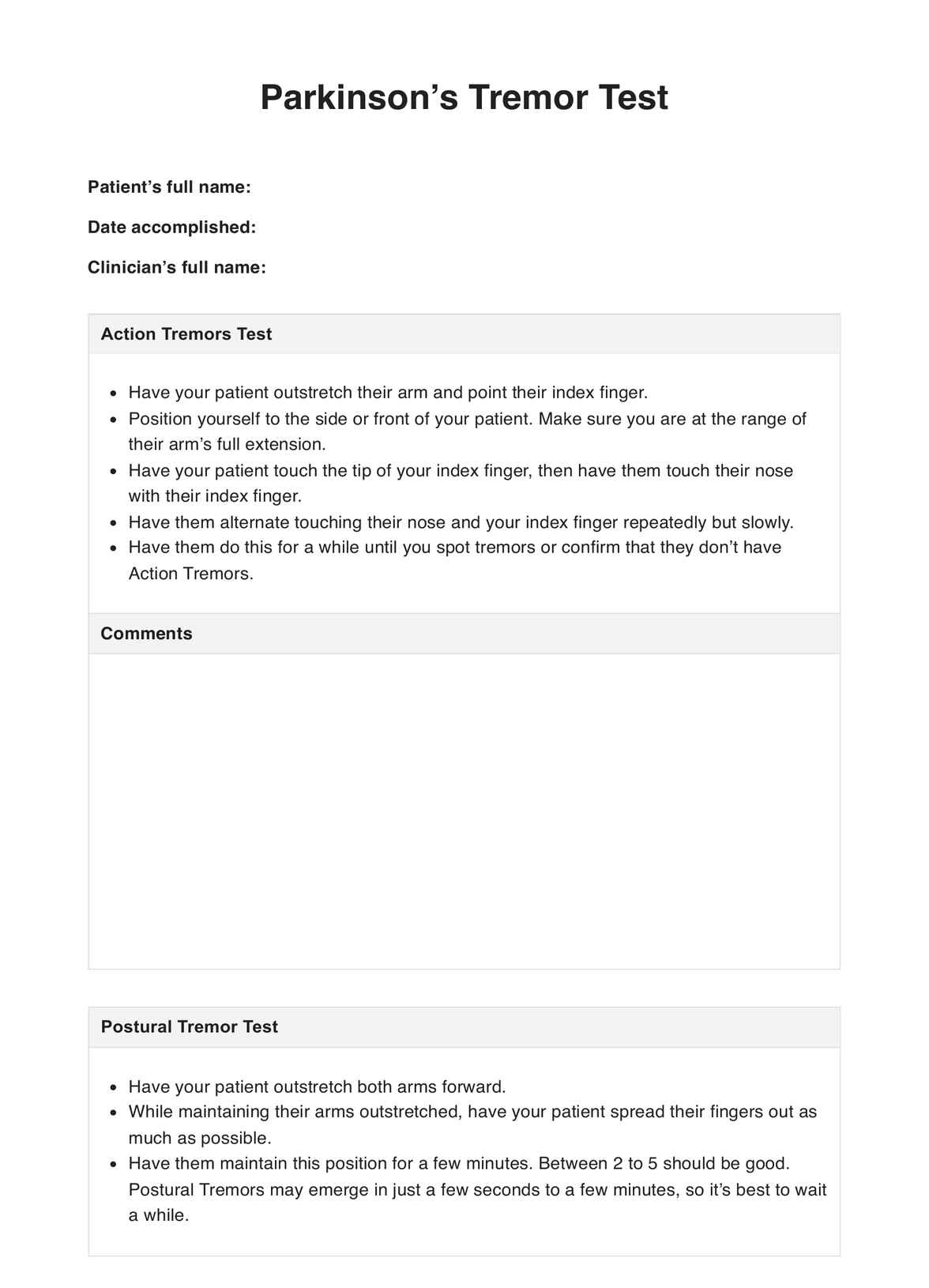
The Parkinson’s Tremor Test is easy to conduct.
The Parkinson’s Tremor Test is quite easy to conduct because it doesn’t require any special equipment for the healthcare professional to check for tremors. All they need are two chairs.
In terms of conducting the tests themselves, the healthcare professional simply needs to tell the patient the instructions and then have them do each one. Besides that, they just need to wait a bit and see if tremors emerge, then note them down. That’s it!
It can be conducted as a way to monitor patients down the line.
Unfortunately, Parkinson’s Disease doesn’t have a cure, but it can be made manageable! Treatment for this disease can involve medication, physical therapy, and even surgery, though the last one should be the last resort considering this involves operating on the brain.
For the sake of example, let’s say you developed and implemented a treatment plan for your patient with Parkinson’s Disease, and your plan involves medication and having them take physical therapy. It’s only natural to wonder how your patient is doing, so routine check-ups should be conducted.
During a routine check-up, you can conduct the Parkinson’s Tremor Test again to check if the tremors are still present, or at the very least, the tremors aren’t as bad as they were before.
If the tremors are present, but they no longer seem as bad as when you first conducted this test, or if the tremors are no longer present, especially after waiting for a while, it’s safe to say your patient is getting better (even if the progress is slow) and your treatment plan is working. If the tremors are still there and the intensity is the same or worse than before, you might want to change your treatment plan and see if those changes will do the trick.