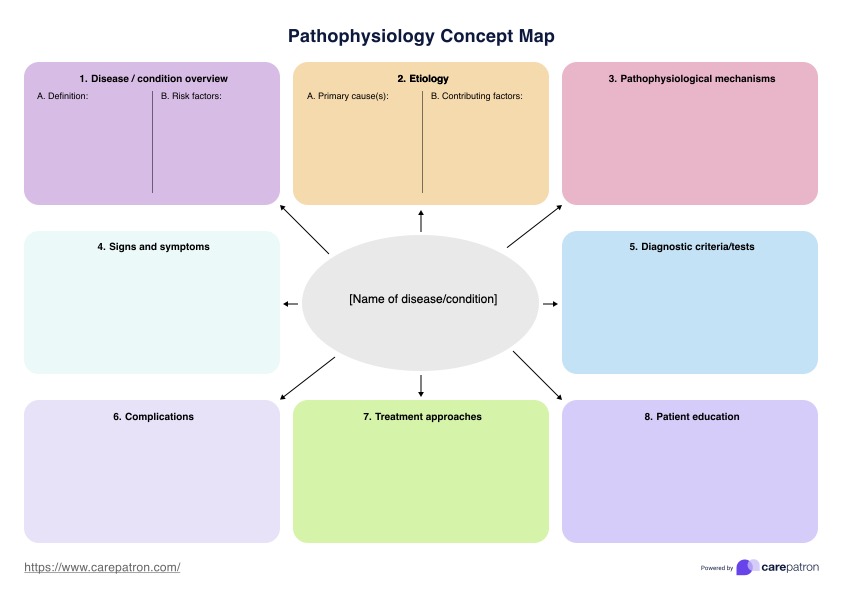
Aiming to understand pathophysiology better? Read our guide and learn about this form of study, and download our Pathophysiology Concept Map to help you practice examining disease processes and organize your observations.
## **What is pathophysiology?**
Pathophysiology is the study of functional changes that occur in the body as a result of disease or injury. It examines how normal physiological processes are altered by disease. It focuses on the underlying causes, mechanisms, and consequences of various health conditions. This field bridges basic science and clinical practice, helping healthcare professionals understand how diseases develop, progress, and affect the body at the cellular, tissue, and organ levels.
In medical education and nursing school, learning pathophysiology provides the foundation for diagnosis, treatment planning, and patient care. When you understand disease mechanisms, you can better anticipate potential complications, select appropriate interventions, and educate patients about their conditions. This knowledge is essential for nurses, physicians, and other healthcare professionals who need to connect symptoms with their underlying physiological changes.
Pathophysiology is the integration of multiple subjects, including anatomy, physiology, biochemistry, and pharmacology. It then creates a structured framework for understanding how diseases affect the human body. This comprehensive approach allows medical students and nursing students to develop clinical reasoning skills and make evidence-based decisions in practice.
## **Why is understanding pathophysiology in nursing important?**
In nursing, a deep understanding of pathophysiology is essential for delivering high-quality care. Grasping the underlying mechanisms of diseases through tools like concept maps allows nurses to make more informed decisions and improve patient outcomes.
- **Accurate assessment and diagnosis**: Understanding how disease processes affect the body on a cellular and organ level helps nurses better connect patient symptoms to their underlying causes. This enables them to make more accurate assessments and earlier escalation and intervention.
- **Informed care planning and intervention**: Once the pathophysiology of a patient's condition is identified, nurses can tailor a targeted care plan that addresses the specific mechanisms causing the problem. This may involve medication, therapies, or other interventions to correct the underlying dysfunction. A patho concept map can be valuable in designing these care plans.
- **Anticipating potential complications**: Knowing the common complications associated with different diseases allows nurses to monitor patients for early signs and symptoms proactively. This enables them to take preventive measures to avoid or minimize complications, enhancing patient safety and comfort.
- **Effective patient education and communication**: This can also help nurses empower patients to take an active role in their care. This can involve lifestyle changes, medication adherence, or participation in specific treatment programs. Clear patient education helps patients understand their disease development and management strategies.
All these also begin at the academic level. Research supports integrating concept mapping into medical education, highlighting its effectiveness in improving learning outcomes and fostering a deeper understanding of complex concepts.
For instance, a study conducted at NOVA Medical School during the academic years 2017-18 and 2018-19 assessed the impact of pedagogical changes to the concept-mapping methodology within the pathophysiology curriculum. Results showed positive feedback and improved performance, attributed to changes in core concept identification and mini-map construction. Students emphasized the utility of these changes, particularly their inclusion in final global maps (Fonseca et al., 2020).
Similarly, a study involving third-year MBBS students in India revealed a significant improvement between pretest and posttest scores, demonstrating the effectiveness of concept maps in enhancing students' knowledge. More than 50% of students scored full marks in the posttest, and the majority (82.09%) responded positively to using concept maps, reinforcing their effectiveness as a teaching and learning tool in medical education (Baliga et al., 2021).
## **What is a Pathophysiology Concept Map?**
A Pathophysiology Concept Map is an educational tool commonly used in nursing, health sciences, and medical education to visually represent the relationships between different components of a disease process. It helps learners understand how various factors, such as risk factors, symptoms, and underlying mechanisms, interact within the body to influence disease outcomes. These visual aids provide an organized way to study complex pathophysiological concepts and theory, making it easier for students and professionals to grasp how diseases develop and progress.
Concept maps work by presenting information in a visual, hierarchical structure that connects concepts through linking words and arrows. In pathophysiology, these maps typically include the central disease or condition, along with related ideas such as etiology (causes), pathogenesis (how the disease develops), risk factors, symptoms, complications, and treatment approaches. This visual, organized format allows users to identify patterns, recognize cause-and-effect relationships, and appreciate the body's intricate responses to different pathophysiological challenges.
Pathophysiology Concept Maps are particularly effective for enhancing the retention and understanding of complex information. Organizing data in a coherent visual format allows users to identify patterns, recognize cause-and-effect relationships, and appreciate the body's intricate responses to different pathophysiological challenges. Nursing students often use these maps to focus on critical aspects of diseases, facilitating better learning experiences and deeper comprehension of pathophysiological concepts.
## **The importance of understanding pathophysiology in nursing**
In nursing, a deep understanding of pathophysiology is essential for delivering high-quality care. By understanding the underlying mechanisms of disease through tools such as a concept map for pathophysiology, nurses can make more informed decisions, improve patient outcomes, and enhance their professional expertise. Understanding pathophysiology offers the following benefits:
- **Accurate assessment and diagnosis**: The best way to begin is by understanding how disease processes affect the body at the cellular and organ levels. Through this, nurses can better connect patient symptoms to their underlying causes. This enables them to make more accurate assessments and initiate earlier diagnoses, leading to faster interventions and improved outcomes. [Nursing concept maps](https://www.carepatron.com/files/nursing-concept-maps.pdf) can be beneficial in this process.
- **Informed care planning and intervention**: Once the pathophysiology of a patient's condition is identified, nurses can tailor a targeted care plan that addresses the specific mechanisms causing the problem. This may involve medication, therapies, or other interventions to correct the underlying dysfunction. A patho concept map can be valuable in designing these [nursing care plans](https://www.carepatron.com/templates/nursing-care-plan/).
- **Anticipating potential complications**: Knowing the common complications associated with different diseases allows nurses to monitor patients for early signs and symptoms proactively. This enables them to take preventive measures to avoid or minimize complications, enhancing patient safety and comfort.
- **Effective patient education and communication**: By explaining the pathophysiology of their condition in understandable terms, nurses can empower patients to take an active role in their care. This can involve lifestyle changes, medication adherence, or participation in specific treatment programs.
## **How to use our Pathophysiology Concept Map**
Our Pathophysiology Concept Map template is a customizable tool designed to help you systematically organize and analyze disease processes. You can download the Pathophysiology Concept Map PDF to start using it immediately, or click "Use template" to open and edit it within the Carepatron platform. You can also refer to the example we provided as a reference on how to use this resource. Using this concept map template effectively requires a step-by-step approach to capture and understand all relevant information.
### **Step 1: Orient yourself**
Begin by understanding the map's overall structure and main concepts. Identify the central disease or condition being represented. Note how these categories are arranged to show the flow from causation to clinical manifestation to management.
### **Step 2: Complete the template**
Fill in each section with relevant information about the specific condition you're studying. Under disease overview, provide a clear definition and list risk factors. In the etiology section, identify primary causes and contributing factors. For pathophysiological mechanisms, explain the specific mechanisms by which the disease develops and affects the body.
Document observable signs and symptoms, along with the diagnostic criteria or tests used to identify the condition. Include evidence-based treatment approaches and potential complications. Finally, note key points for patient education to support better understanding and management.
### **Step 3: Trace the flow**
Follow the arrows to understand how different concepts connect and interact. Observe how one concept leads to, contributes to, or impacts another. Our template is customizable, so you can add or retrace arrows to link concepts between each field. You can create a personalized visual map that reflects your understanding of the disease process.
### **Step 4: Analyze relationships**
Examine the connections to identify critical patterns and relationships between concepts. Consider how various factors contribute to disease development or influence its manifestations. Understand how different symptoms and complications are interconnected.
### **Step 5: Ask questions**
Use the map as an aid for inquiry and critical thinking. Pose questions like: "What are the primary risk factors?", "How does the disease progress?" "What are the potential treatment strategies?" This approach supports meaningful learning and helps you develop clinical reasoning skills.
### **Step 6: Review and edit**
Once created, review your concept map regularly. Update it as you gain new knowledge or encounter relevant research. This iterative process supports better recall, retention, and deeper understanding of pathophysiological concepts, making it an effective tool for both study and clinical practice.
Our template works best when you actively engage with it, focusing on making connections between concepts rather than simply filling in boxes. Whether you're a nursing student preparing for exams or a healthcare professional reviewing a complex case, this structured approach helps you organize your thinking and develop a comprehensive understanding of disease processes.
## **References**
Baliga, S., Walvekar, P., & Mahantshetti, G. (2021). Concept map as a teaching and learning tool for medical students. Journal of Education and Health Promotion, 10(1), 35. https://doi.org/10.4103/jehp.jehp_146_20
Fonseca, M., Oliveira, B., Carreiro-Martins, P., Neuparth, N., & Rendas, A. (2020). Revisiting the role of concept mapping in teaching and learning pathophysiology for medical students. Advances in Physiology Education, 44(3), 475–481. https://doi.org/10.1152/advan.00020.2020