
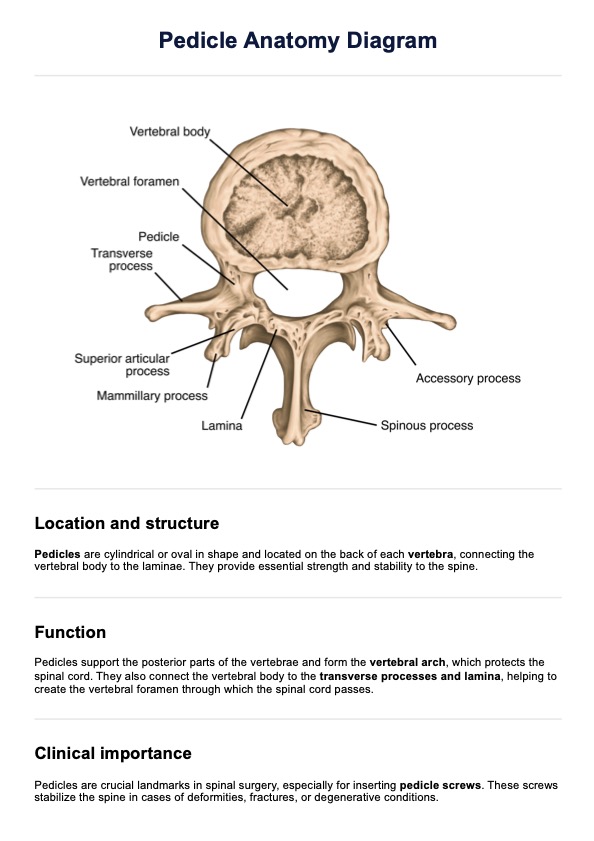




What is the pedicle?
The pedicle is a pair of short, thick, cylindrical bony structures that project posteriorly from the upper part of the vertebral body. Each pedicle forms the lateral boundary of the vertebral arch, contributing to the posterior arch of the spine. These structures link the anterior vertebral body to the posterior elements, including the laminae, transverse processes, spinous process, and articular facets, completing the ring that encircles the vertebral foramen and protects the spinal canal.
The orientation of the pedicles varies along the spine. In the thoracic spine, the pedicles are oriented medially from T1 to T10, which requires careful trajectory planning during procedures such as pedicle screw insertion. At T11 and T12, they become more neutral, aligning closer to the sagittal plane—more similar to the orientation seen in the lumbar region. This transition has clinical relevance in both diagnostic imaging and surgical interventions.
Pedicles also help form the vertebral notches, which align with those of adjacent vertebrae to create the intervertebral foramina—the openings through which spinal nerves exit. They serve as strong pillars that bear and transmit axial loads, distributing forces between the vertebral body and the intervertebral disc, while maintaining the integrity of the spinal canal and surrounding bony structures.









