## **What is a Personality Questionnaire?**
A Personality Questionnaire functions much like a psychological mirror—it offers individuals a structured opportunity to reflect on their inner qualities, behaviors, and tendencies. Rather than measuring intelligence or ability, this tool delves into the nuances of personality, revealing how a person typically thinks, feels, and acts across various contexts.
Personality Questionnaires, also known as personality tests, are systematic instruments used to evaluate and describe personality differences. These assessments help uncover subtle but meaningful traits, such as patterns in behavior, emotional responses, motivations, and preferences. Developed over decades of research in clinical psychology and personality theory, these tools are grounded in validated frameworks like the five broad dimensions of personality and models such as the Myers-Briggs Type Indicator.
Importantly, these tools are not designed to assign labels or confine individuals to rigid categories. Nor are they intended to produce socially desirable responses. Instead, Personality Questionnaires aim to promote self-awareness and support personal development by offering insight into how individuals relate to themselves and others, including how they respond in social situations or engage in the world around them.
Whether used by personality psychologists, career counselors, or individuals seeking clarity about their personality, these questionnaires offer a valuable foundation for self-exploration and growth.
## **How does it work?**
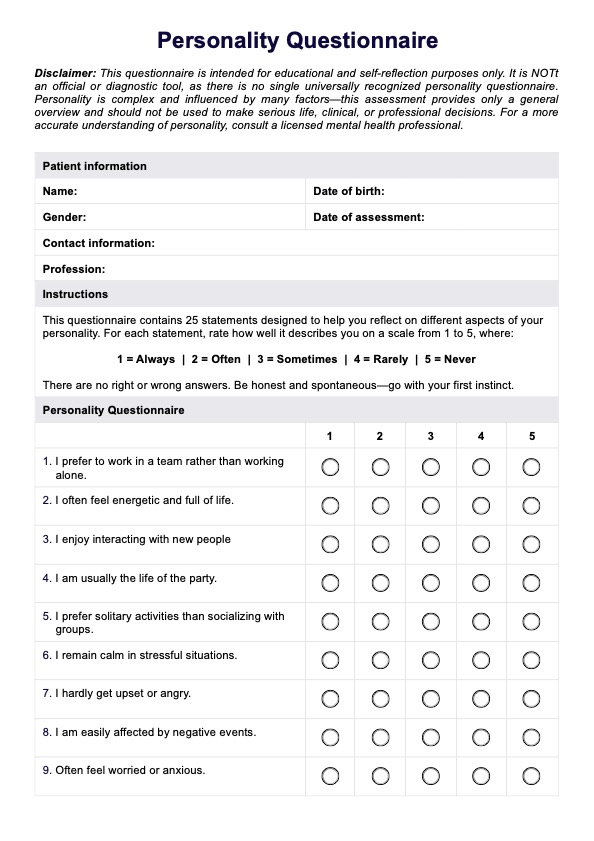
Carepatron’s Personality Questionnaire is designed as a quick, reflective tool to help individuals explore patterns in their personality. It draws on five broad dimensions commonly referenced in personality research—Openness, Conscientiousness, Extraversion, Agreeableness, and Neuroticism—without claiming to be a clinically validated assessment. However, while the questionnaire may highlight certain patterns, it is not intended to replace professional psychological evaluation or serve as a diagnostic tool.
### **Step 1: Introduction and purpose explanation**
Professionals should begin by explaining the questionnaire’s purpose to the client. Emphasize that it is a tool for understanding personality and that there are no right or wrong answers—only honest self-reflection. This step is crucial in establishing validity and setting the tone for accurate test results.
### **Step 2: Patient information gathering**
Collect the client’s basic details, such as name, age, and date, using the form’s designated information section.
### **Step 3: Test administration**
Guide the individual through each of the five personality trait categories, explaining how to respond using a scale (Always = 4 points, Often = 3, etc.). Encourage honest answers that reflect their usual behaviors and attitudes.
### **Step 4: Scoring**
Once completed, tally the scores for each category. Higher scores indicate stronger tendencies within a particular personality trait.
### **Step 5: Interpretation and discussion**
Discuss the results using the interpretation guide provided with the questionnaire. These insights can support therapeutic discussions, personal development goals, or career planning.
## **Scoring**
Scoring the Personality Questionnaire is a clear and structured process designed to yield meaningful insights into an individual's dominant personality traits. The assessment evaluates five key dimensions: Openness, Conscientiousness, Extraversion, Agreeableness, and Neuroticism.
Participants respond to a total of 25 statements—five per trait—using a scale ranging from ‘Always’ (4 points) to ‘Never’ (0 points). Once all responses are recorded, the points are totaled to produce a cumulative score ranging from 0 to 100.
The final score reflects the overall personality profile of the respondent and can be interpreted as follows:
- **80–100**: May suggest stronger extroverted tendencies, high emotional stability, and well-developed organizational skills. Individuals in this range might thrive in group environments, enjoy new experiences, and cope with stress effectively.
- **60–79**: Could reflect moderate extroversion, balanced emotional regulation, and dependable organizational habits. People scoring here often adapt well to change and generally function comfortably in social or team settings.
- **40–59**: May represent a balanced personality profile, showing a mix of introversion and extroversion, moderate stress regulation, and average organizational abilities.
- **20–39**: Could indicate a leaning toward introversion, some emotional fluctuation, and organizational challenges. Individuals in this range may prefer quieter environments, experience stress more strongly, and find structured planning more difficult.
- **0–19**: Might reflect stronger introverted traits, lower emotional stability, and limited organizational skills. People scoring in this range may find social interactions draining, struggle with stress management, and prefer flexible over highly structured tasks.
Note that this questionnaire is not a validated psychological tool and should not be used for diagnostic or clinical purposes. The results are best viewed as suggestive patterns or tendencies rather than definitive personality traits.
## **When to use this template?**
The Personality Questionnaire is versatile and applicable in a wide range of professional and personal settings. It is especially useful in the following contexts:
- **Mental health counseling**: Mental health counselors can use this Personality Test to understand their client's personality styles, which can guide therapeutic intervention planning. It helps to explore the potential strengths and weaknesses that a patient's personality can bring into their life.
- **Psychological evaluations**: The questionnaire can also be beneficial in conducting psychological evaluations for different purposes like educational assessments, vocational guidance, and even clinical diagnosis.
- **Personal growth and self-awareness:** For life coaches, motivational speakers, or even individuals committed to self-improvement, this free Personality Test can provide valuable insights. Understanding one's personality can guide personal growth strategies and promote self-awareness.
- **Occupational settings**: Employers may incorporate Personality Questionnaires into hiring processes to evaluate candidate fit and work style compatibility.
- **Psychological research purposes**: Researchers studying personality traits or human behavior can use this questionnaire for data collection. It provides a standardized way of measuring and comparing personality traits across different samples.
The Personality Questionnaire is a versatile tool appropriate for various scenarios. Its ability to map an individual's personality traits makes it a valuable resource for anyone seeking to understand personality styles and behavioral preferences better. Remember, there are no wrong answers. It encourages a more comprehensive, nuanced understanding of the human psyche, which can ultimately lead to more effective interventions, popular tests, and self-improvement strategies.
## **Benefits of this free Personality Trait Questionnaire**
Taking time to reflect on personality can open new opportunities for self-awareness, growth, and more meaningful connections with others. Carepatron’s free Personality Trait Questionnaire offers a simple yet structured way to explore these patterns, with benefits for both practitioners and individuals.
### **Enhanced understanding of personality traits**
This questionnaire allows practitioners and individuals alike to better understand others' or their own personality traits, providing a clear window into the individual's thoughts, behavior patterns, and feelings.
### **Aids in tailored interventions**
Understanding the dominant personality traits can help mental health professionals develop more personalized, effective therapeutic interventions.
### **Facilitates personal growth**
The free Personality Questionnaire can catalyze personal growth and self-improvement, offering individuals a roadmap to understand their strengths, weaknesses, and areas of development.
### **Accessibility**
Being a free resource, it ensures that this valuable tool is accessible to all, democratizing the understanding of personality traits.
### **Efficiency and time-saving**
The well-structured format saves time for professionals, allowing them to focus more on interpretation and strategy formation.