



Personification WorksheetsAI Template IconToolbar IconShare Icon

Personification Worksheets

Develop your learners' skills and understanding of figurative language with our Personification Worksheets. Download our free PDF and learn with us now!

Joshua Napilay avatar

By Joshua Napilay on Aug 2, 2025.

Fact Checked by Ericka Pingol.

Use Template

What is a Personification Worksheet?

We often use figurative language to enrich the impact and texture of our literary works. Among the many figurative language devices that we use is personification. It is a literary device that gives human qualities or characteristics to inanimate objects or concepts. For example, “the trees are dancing with the winds.” In this sentence, the trees are personified by giving them the human quality of “dancing.” This technique helps create vivid imagery in literature, making it easier for readers to understand the non-human elements in a literary piece.

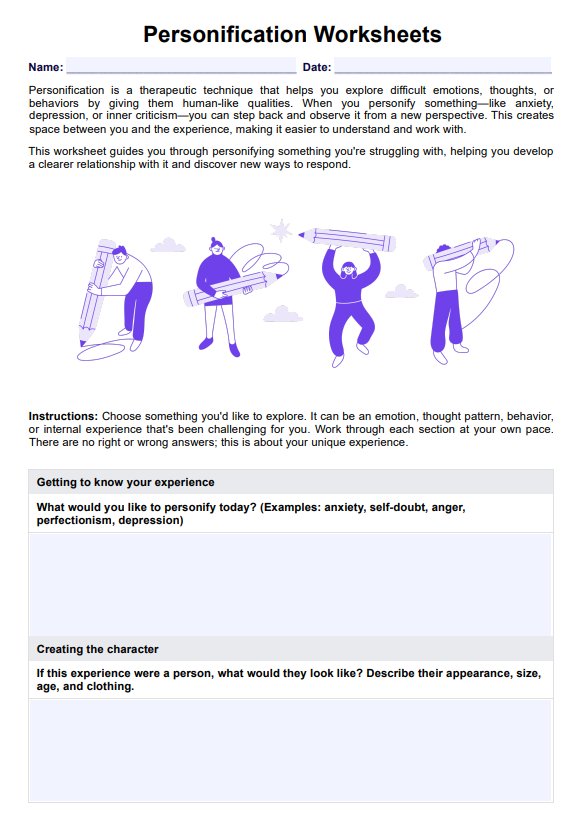
In a more therapeutic context, a Personification Worksheet can also serve as a tool that uses the literary device of personification to help clients explore their inner experiences. Unlike traditional figurative language worksheets used in educational settings, we have created therapeutic Personification Worksheets that focus on giving human qualities to emotions, thoughts, and behaviors. This approach helps clients develop a deeper understanding of their psychological patterns and create an emotional connection with difficult experiences.

The worksheet personification technique transforms non-human objects or abstract concepts, such as anxiety, depression, or self-criticism, into characters with human characteristics. When clients assign human traits to these experiences, they can step back and observe them from a new perspective, making it easier to understand and work with challenging emotions.

Personification Worksheets Template

Download PDF Template

How to use the Personification Worksheet

You can integrate Personification Worksheets into their therapeutic practice in several ways. The technique works well with various therapeutic approaches, including cognitive-behavioral therapy, acceptance and commitment therapy, and narrative therapy.

Step 1: Access or download a copy

Click on "Use template" to access a customizable file of the worksheet, or click "Download" to get a PDF copy.

Step 2: Introduce the worksheet to clients

Begin by explaining personification as a way to explore emotions rather than a literary exercise. Emphasize that there are no correct answers, to embrace their own writing process, and that the goal is understanding, not creative writing excellence.

Step 3: Guide clients in doing the worksheet

Guide clients through creating detailed descriptions of their chosen emotion, thought pattern, or behavior. Encourage them to consider the character's appearance, voice, intentions, and typical behaviors..

Step 4: Integrate insights into practice

Use the personified character as a starting point for therapeutic conversations. Questions might include: "What do you think this character needs?" or "How might you set boundaries with this character?"

Help clients develop practical strategies for working with their personified experiences in daily life. This might involve acknowledging the character when it appears, having internal dialogues, or negotiating new agreements about when the character's input is helpful.

When would you use this worksheet?

Personification Worksheets are versatile therapeutic tools that can be integrated into various treatment contexts and therapeutic approaches.

During individual therapy sessions

Personification Worksheets work particularly well in individual therapy when clients struggle to articulate their emotional experiences. You can introduce this technique when clients describe feeling overwhelmed by emotions they can't quite name or understand. The worksheet helps create psychological distance from intense feelings, making them more manageable to explore.

For clients with emotional dysregulation

When working with clients who experience intense emotional reactions or struggle to manage their feelings, Personification Worksheets can serve as a stabilizing tool. The technique helps clients step back from overwhelming emotions and observe them with greater objectivity. This is particularly helpful for clients with anxiety disorders, depression, trauma responses, or personality disorders where emotional intensity can feel unmanageable.

As homework and between-session work

Personification Worksheets serve as effective homework assignments that bridge the gap between therapy sessions. Clients can use them to explore emotions or situations that arise during the week, bringing their completed worksheets back to discuss in future sessions. This approach helps maintain therapeutic momentum and provides concrete material for processing.

Benefits of using this Personification Worksheet

The Personification Worksheet approach offers several therapeutic benefits:

  • Emotional regulation: Creating characters from emotions helps clients observe their feelings without becoming overwhelmed by them. This process supports emotional regulation skills that are essential for mental health recovery.
  • Insight development: Personification often reveals the protective intentions behind difficult emotions. Clients frequently discover that their anxiety character is trying to keep them safe, or their perfectionist character wants to help them succeed.
  • Cognitive flexibility: Working with emotions as characters promotes cognitive flexibility by offering multiple perspectives on the same experience. This skill transfers to other areas of life where clients can benefit from seeing situations from different angles.
  • Therapeutic relationship: The technique creates opportunities for meaningful dialogue between counselor and client about the client's internal world, strengthening the therapeutic relationship.

Research and Evidence

Incorporating worksheets into educational practices has boosted the learners’ performance and achievements. Substantial research has demonstrated the effectiveness of this technique in aiding educators and parents in teaching necessary knowledge and skills to learners.

Donnelly (2015) investigated the use of various art forms, including worksheets, in enhancing the learners’ understanding of poetry. Worksheets present excerpts from literature and prompt learners to identify and label figures of speech, including personification. The results demonstrate the potential benefits of incorporating worksheets and other artistic materials in teaching literature and poetry.

Worksheets are also helpful in developing learners’ skills in analyzing literary devices, including personification. In their book, “Response & Analysis, Teaching Literature in Secondary Schools (Second Edition),” Probst and Rief (2017) discussed different methods of teaching literature, including the use of worksheets. Worksheets guide learners in analyzing literary texts, including using literary devices like personification.

More than that, beyond learning personification, worksheets encourage learners’ critical thinking, as shown in the older publication by Paul and Elder (2006). Worksheets incorporate practice tests encouraging learners to engage in discussions and critically analyze literature. This, in turn, fosters higher-order thinking skills necessary for the lifelong growth of learners.

All of these show the value of worksheets, like personification worksheets, in the overall education of learners. By maximizing our resources, we can also maximize their growth.

Commonly asked questions

Personification worksheets are valuable educational resources professionals and non-professions utilize, including primary school and secondary school teachers, tutors, parents, and volunteers.

Personification worksheets are used in educational settings to teach and reinforce the literary device of personification. They are typically employed when educators want students to practice identifying, creating, and analyzing instances of personification in literary texts, helping them develop a deeper understanding of this figurative language technique.

Personification Worksheets can help learners enhance their understanding and application of the literary device. It aids in recognizing personification in literature, promotes critical thinking, and encourages creative expression. Through practice and analysis, learners develop more vital language skills, literary comprehension, and the ability to engage with texts on a deeper level.

EHR and practice management software

Get started for free

*No credit card required

Free

$0/usd

Unlimited clients

Telehealth

1GB of storage

Client portal text

Automated billing and online payments







