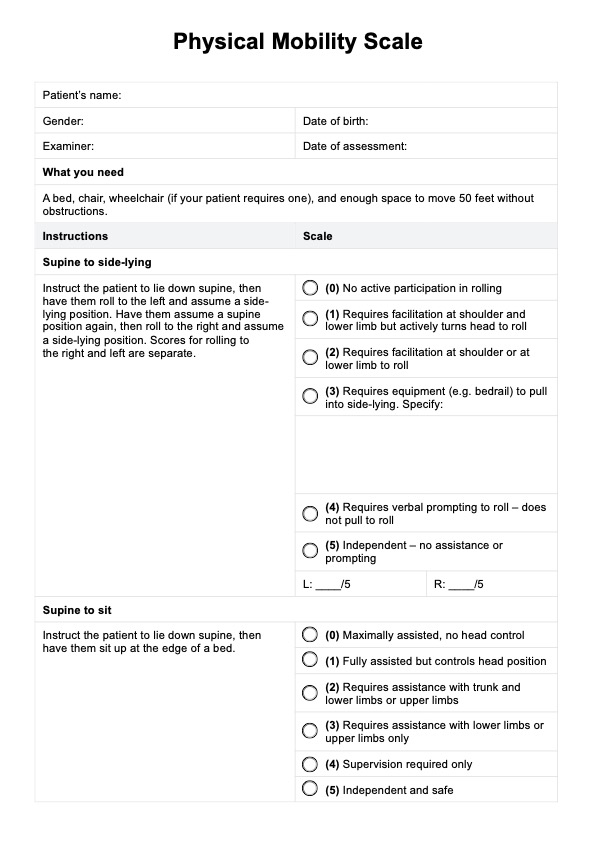
How to use the Physical Mobility Scale
Here's how you can incorporate this template into your practice:
Step 1: Download the template
This page offers free access to the Physical Mobility Scale PDF template. To download the PDF version, click the Download button on this guide. If you have a Carepatron account, you can access the template by clicking on the Use Template.
Step 2: Explain the assessment and prepare what you need
Explain to the patient the purpose of the assessment and how it may benefit them. Prepare all necessary equipment in advance, and take time to answer any questions the patient may have before starting.
Step 3: Conduct the test
To conduct an assessment using the Physical Mobility Scale, prepare a space with enough room to walk around without obstructions. This room should also have a bed, chair, and wheelchair (if the patient being assessed cannot walk). These also need to be present if the assessment is conducted during a house call.
Next, have the patient perform several movements, including:
- Supine to side-lying: Instruct the patient to lie down supine, then have them roll to the left and assume a side-lying position. Have them assume a supine position again, then roll to the right and assume a side-lying position. The ability to roll to the left and to the right is scored separately.
- Supine to sitting: Instruct the patient to lie down supine, then have them sit up at the edge of a bed.
- Sitting balance: Instruct the patient to sit on the edge of a bed and plant their feet on the floor. Tell them to turn and look over their shoulder (must be done on both sides), then have them reach down and touch the floor. They must maintain balance while doing both actions.
- Sitting to standing: Instruct the patient to sit on the edge of a bed and then stand up without using their hands for support.
- Standing to sitting: Instruct the patient to stand next to the edge of a bed, then have them sit down without using their hands for support.
- Standing balance: Instruct the patient to stand up and stay standing up with or without support. Have them turn and look over their shoulder (this must be done on both sides), put an object (anything works), and have them pick it up. Then, have them stand on their left or right leg for as long as they can.
- Transfers: Instruct the patient to sit on the edge of the bed, then have them stand up and transfer themselves to a wheelchair (if they require wheelchairs to move) or a chair (if they can walk).
- Ambulation: Instruct the patient to stand up (if they can walk) or have them sit in a wheelchair (if they require wheelchairs). Have them walk or push their wheelchair for a while. Make sure they move at least 50 feet.
While patients are performing each type of movement, the healthcare professional should observe them carefully and score them accordingly on the printable Physical Mobility Scale template.
Step 4: Record results and store for future reference
Document the results carefully and keep them securely for future reference. This allows easy access to the information later, which can be helpful for tracking progress or making comparisons over time.