How to use this template?
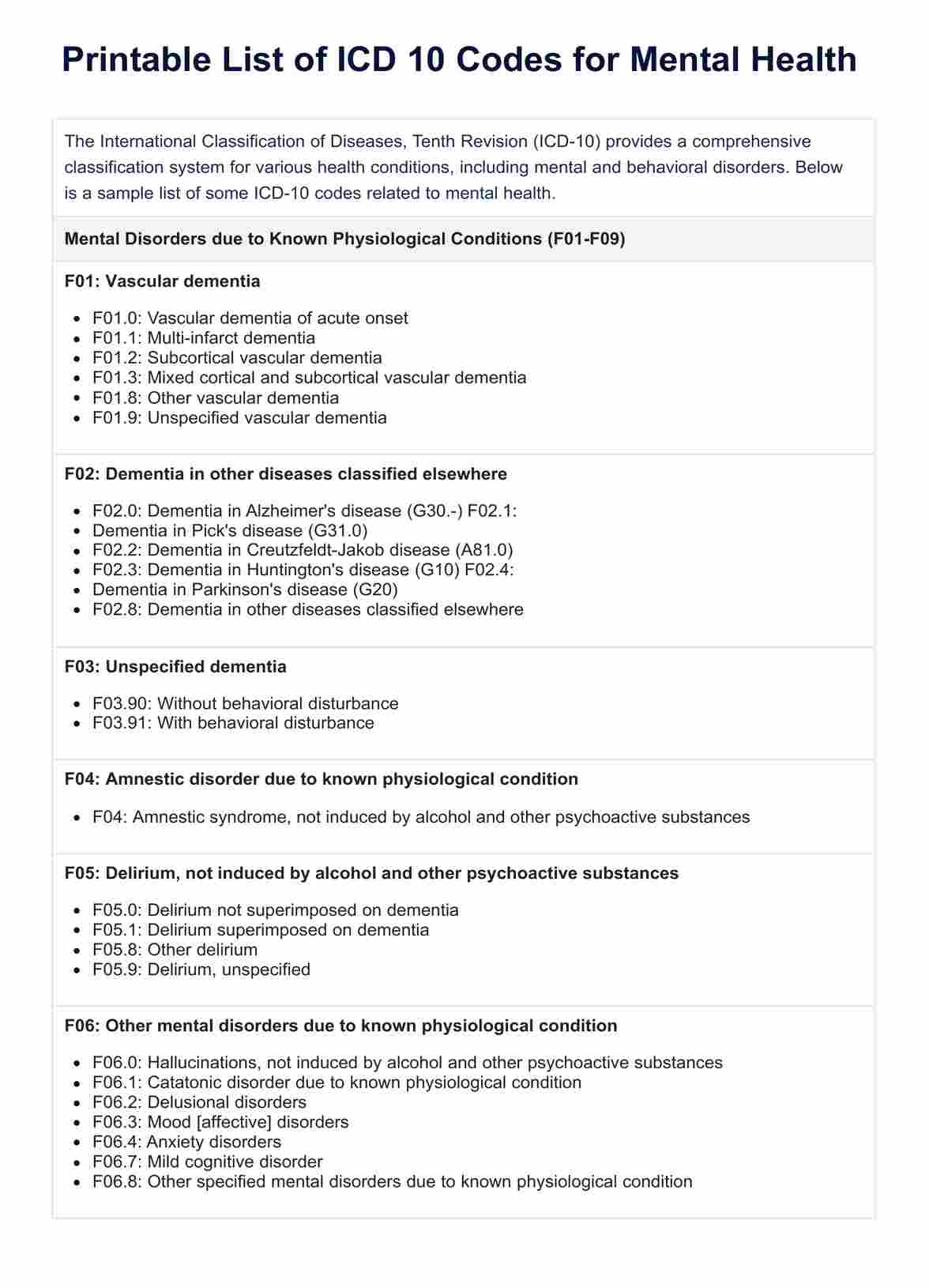
To effectively utilize our Printable List of ICD 10 Codes for Mental Health disorders, follow these step-by-step instructions, beginning with accessing the template:
Download the template from Carepatron
Initiate the process by downloading the comprehensive ICD-10 codes template specifically designed for mental health disorders from Carepatron. This ensures you have the most up-to-date and accurate coding resource.
Familiarize yourself with the template structure
Once downloaded, take some time to familiarize yourself with how the template is organized. Notice how the codes are categorized by disorder, making navigating the document easier.
Identify relevant ICD-10 codes
In the context of your practice, it's essential to adeptly navigate the ICD-10 coding system to identify and record mental health conditions accurately. This classification enables precise diagnosis and treatment planning. For instance:
- Attention-Deficit Hyperactivity Disorder (ADHD) should be coded as F90.0 for the predominantly inattentive presentation, F90.1 for the predominantly hyperactive-impulsive presentation, and F90.2 for the combined presentation. The unspecified ADHD, often a default for undetermined cases, is marked as F90.9.
- Major Depressive Disorder (MDD) is nuanced in its coding to reflect severity and episode frequency. For single episodes, use F32.0 through F32.9, where codes like F32.1 (moderate) specify the episode's severity. For recurrent depression, F33.x codes provide a similar range, underlining the importance of accurate episode characterization.
- Generalized Anxiety Disorder (GAD) is accurately captured with the code F41.1, indicating persistent and excessive worry across various aspects of life.
It's crucial to select the most fitting ICD-10 code, as these codes impact treatment strategies, facilitate clear communication within healthcare systems, and ensure appropriate billing and insurance processing.
Apply codes to diagnosis and billing
Apply the correct codes to your diagnostic process and billing paperwork. Accurate coding ensures patients receive appropriate care and that billing processes run smoothly with health insurance providers.
Refer to the template for complex cases
For more complex cases or when you encounter a mental health condition that you are less familiar with, refer back to the template. It can clarify the correct coding, especially for disorders with subtypes or specific criteria.
Update records as needed
As diagnoses are refined or if additional information becomes available, use the template to update patient records with the most accurate ICD-10 codes. This ensures ongoing accuracy in both patient care and billing.
Utilize additional resources
Remember, the template may also offer links to further resources or guidelines on applying ICD-10 codes in mental health. These can be valuable for deepening your understanding of diagnosis codes and staying updated on best practices.
By starting with the Carepatron template download and following these steps, healthcare professionals can streamline their diagnosis and billing processes, ensuring they utilize ICD-10 codes effectively in mental health care.