




What is proprioception?
Proprioception refers to the body's ability to sense its position, movement, and spatial orientation by integrating sensory information from various sources, including sensory receptors in muscles, joints, and the skin. It is a fundamental and essential component underlying human movement control.
Assessing proprioception
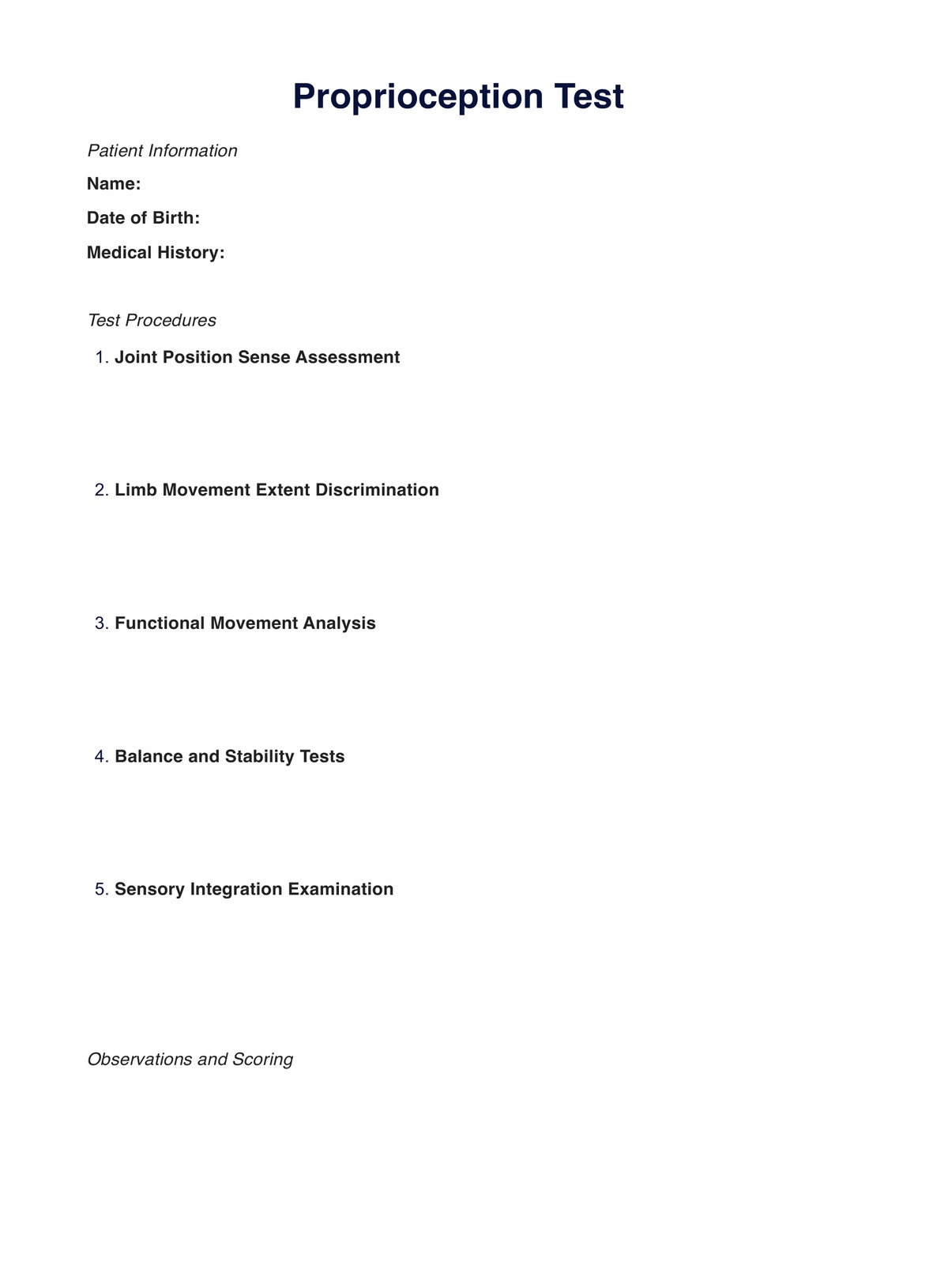
Proprioception tests assess joint position sense, limb movement extent, and proprioceptive abilities. Proprioceptive assessment techniques involve evaluating the accuracy with which individuals can determine the position of a joint and body part encompass the movement extent of their limbs or body in space.
Distal proprioception tests assess proprioceptive abilities in the extremities, such as the sense of ankle and shoulder joint position. The Romberg test evaluates balance and shoulder joint position sense alone, often conducted with mobile variations to assess performance under different conditions.
Use the Romberg Test template to assess a patient's balance and proprioception. This template helps evaluate how well patients maintain posture when their eyes are closed, providing crucial insights into their neurological function.
Proprioception and movement control
Proprioception is crucial to functional body movements, determining body segment positions, executing functional movements, and maintaining balance during various activities. The proprioceptive system contributes to coordinated body movement, and its underlying mechanisms involve both peripheral and central nervous system components.
Proprioceptive training is employed in physical therapy to enhance proprioceptive abilities and improve neuromuscular control.
Proprioception assessment techniques
Testing proprioceptive acuity involves evaluating an individual's ability to accurately judge limb movements or match a predetermined target with previously experienced joint position alone. Proprioceptive signal presentation methods vary, including very slow movement velocities and constant stimuli. Participants compared these against their previously experienced joint positions.
Exploring underlying proprioceptive control mechanisms may involve examining sensory receptors and conducting systematic reviews to understand underlying control processes.
Challenges and considerations
Proprioception lacks ecological validity in some testing scenarios, particularly when assessing everyday movement patterns. The variability in proprioceptive sensitivity measures and the potential for permanent proprioception impairment, such as in joint replacement surgery, pose challenges for standardized assessment.
Understanding how proprioception functions is crucial for designing practical proprioceptive assessments and interventions.









