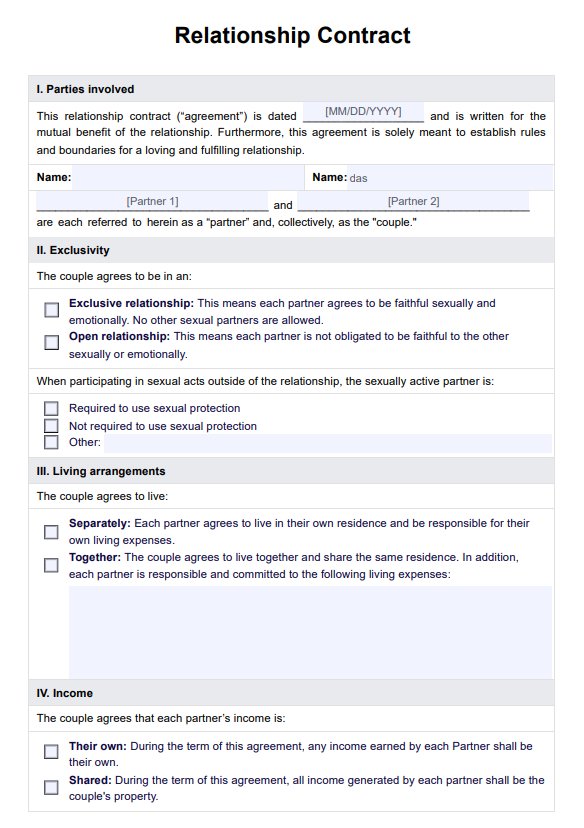
Relationships are often complex, influenced by personal histories, emotions, and changing circumstances. A Relationship Contract template can help structure conversations about expectations and boundaries, allowing you to guide clients toward clearer communication and mutual understanding.
## **What is a Relationship Contract, and does it strengthen relationships?**
A Relationship Contract is a written agreement between two people that defines expectations, boundaries, and shared responsibilities within a partnership. While not legally binding in most cases, it functions as a mutual commitment, encouraging couples to discuss key aspects of their relationship, such as finances, communication, intimacy, and conflict resolution. Research suggests that couples who regularly engage in open dialogue about expectations and shared values often report higher satisfaction and stability in their relationships (Owen et al., 2013)
A Relationship Contract helps partners practice clear communication and build mutual respect by putting implicit expectations into words. For instance, agreeing on how to divide household responsibilities or manage shared finances can prevent misunderstandings that often lead to resentment or conflict. It also helps establish [healthy boundaries](https://www.carepatron.com/templates/healthy-boundaries-worksheet/), giving each partner a sense of autonomy while maintaining connection—an important factor in relationship satisfaction (Daphnée Genesse et al., 2025)
However, there are limitations. A contract cannot guarantee emotional intimacy or commitment, and focusing too heavily on rules may make the relationship feel transactional. Some critics argue that over-formalizing a romantic partnership can reduce spontaneity or imply a lack of trust. Additionally, contracts only work if both partners are equally invested in upholding them. Otherwise, they may reinforce power imbalances instead of resolving them.
Ultimately, a Relationship Contract’s effectiveness depends on how it is used. When approached as a collaborative exercise rather than a rigid rulebook, it can strengthen communication, clarify values, and foster accountability. But if used as a control mechanism, it risks eroding trust and emotional connection.
## **What is a Relationship Contract template?**
A Relationship Contract template helps couples set clear expectations, responsibilities, and boundaries in their partnership. It encourages open discussions about topics like respect, finances, communication, and intimacy—helping partners align on what matters most in their relationship.
This template is handy when couples start living together or formalize their commitment. It can outline how to divide household chores, manage rent or savings, and clarify emotional boundaries such as exclusivity or personal space. It’s also valuable during significant life changes like marriage or relocation, guiding honest conversations about shifting roles and shared responsibilities.
The template is ultimately a tool for communication. By helping couples talk through sensitive topics early, it fosters mutual respect, reduces misunderstandings, and builds a stronger, more balanced relationship.
## **How does our free Relationship Contract template work?**
Our free printable Relationship Contract offers the scaffolding for this vital tool and outlines aspects of the relationship to discuss, define, and refine. Here's how to use this fully digital template:
### **Step 1: Download the template**
Open the template via the Carepatron app by clicking the "Use template" button. This lets you customize the form based on your clinic's specifications. You can also download a PDF version by choosing "Download."
### **Step 2: Have parties meet to discuss agreements**
Have all parties agree on a suitable time and place where everyone involved can devote a reasonable amount of time and energy to the contract-making process. Once conclusions, expectations, and goals are set, and all parties agree with them, sign the document and ensure everyone has their copy so that you can refer to it in case of any disagreement or dispute.
### **Step 3: Follow up and review**
Set dates in the future to discuss how the contract suits all parties, whether changes need to be made, and whether goals aren't being met.
## **How to foster open communication between partners**
Open communication is one of the strongest predictors of relationship satisfaction and stability. In therapy, helping couples express their needs, emotions, and concerns without defensiveness or blame lays the foundation for trust and collaboration.
Studies have consistently shown that constructive communication patterns, such as active listening and empathy, are linked to greater relationship quality and emotional security (Gottman & Silver, 2015; Lavner et al., 2012). In any romantic relationship, fostering open dialogue also supports emotional support, mutual understanding, and a sense of being truly heard.
### **Encourage active listening and empathy**
[Active listening](https://www.carepatron.com/templates/active-listening-skills-worksheet/) helps partners truly understand each other rather than simply waiting for their turn to respond. Encourage clients to paraphrase what their partner says (“What I’m hearing is…”) and reflect on how their words might affect the other person. This creates a safe space where both partners feel respected, even when discussing fears or sensitive topics. Empathy fosters connection and de-escalates tension, allowing each person to feel human and emotionally supported—an essential step toward lasting relationship agreements.
### **Promote the use of “I” statements**
Using [“I” statements](https://www.carepatron.com/templates/i-statements-worksheets) instead of “you” accusations reduces defensiveness and invites openness. For example, “I feel unsupported when plans change suddenly” communicates vulnerability, while “You never consider me” implies blame. This approach encourages couples to focus on their own emotions and truth rather than on what they think their partner did wrong. Therapists can model this strategy to help clients actively listen and respond in ways that maintain respect, understanding, and romance, even in conflict.
### **Normalize emotional honesty and vulnerability**
Partners often avoid sharing difficult emotions due to fear of rejection or conflict, especially if they grew up seeing divorce or communication breakdowns between parents. Therapists can help clients [reframe vulnerability](https://www.carepatron.com/templates/vulnerability-worksheet/) as strength, teaching that honesty, while uncomfortable, is crucial in a committed relationship. Creating space for open emotional expression helps both partners feel safe to share what’s really going on beneath their words, no matter the circumstances.
### **Schedule intentional check-ins**
Encourage couples to set aside time for brief, structured conversations outside therapy sessions. Each week, partners can share one thing they appreciated, one thing that challenged them, and one thing they’d like to improve.
This habit reinforces ongoing communication and helps prevent misunderstandings before they grow into resentment. When both partners feel consistently heard and supported, they’re more likely to maintain emotional balance, resolve conflicts respectfully, and strengthen their romantic relationship over time.
## **References**
Daphnée Genesse, Brassard, A., Marie‐Pier Vaillancourt‐Morel, Muise, A., Raposo, S., & Péloquin, K. (2025). Being me while loving you: The role of autonomy in the association between insecure attachment and relationship satisfaction. Journal of Marital and Family Therapy, 51(4). https://doi.org/10.1111/jmft.70079
Gottman, J., & Silver, N. (2015). The Seven Principles for Making Marriage Work. Harmony Books.
Lavner, J. A., Bradbury, T. N., & Karney, B. R. (2012). Incremental change or initial differences? Testing two models of marital deterioration. Journal of Family Psychology, 26(4), 606–616. https://doi.org/10.1037/a0029052
Owen, J., Rhoades, G. K., & Stanley, S. M. (2013). Sliding versus deciding in relationships: Associations with relationship quality, commitment, and infidelity. Journal of Couple & Relationship Therapy, 12(2), 135–149. https://doi.org/10.1080/15332691.2013.779097