## **What is a Relationship Questionnaire?**
Relationships are essential to our lives, adding richness and significance to our experiences. They come in various forms, such as romantic partnerships or long-lasting bonds with friends and family. Close emotional relationships shape who we are, bring happiness into our lives, and often push us to become better versions of ourselves.
The Relationship Questionnaire (RQ), developed by Bartholomew and Horowitz (1991), is a widely used psychological tool for assessing adult attachment styles. Rather than focusing on one partner or specific relationship events, the RQ encourages individuals to reflect on their general relational patterns and tendencies, capturing how they typically relate to others in attachment contexts.
The RQ is built on the idea that attachment can be understood through fundamental dimensions underlying measures of closeness: the self model (positive or negative view of the self) and the model of others (Griffin & Bartholomew, 1994). These dimensions help define each attachment category, including the secure style, preoccupied, fearful, and dismissing patterns. Together, these categories capture variations in trust, intimacy, and attachment avoidance in close emotional relationships.
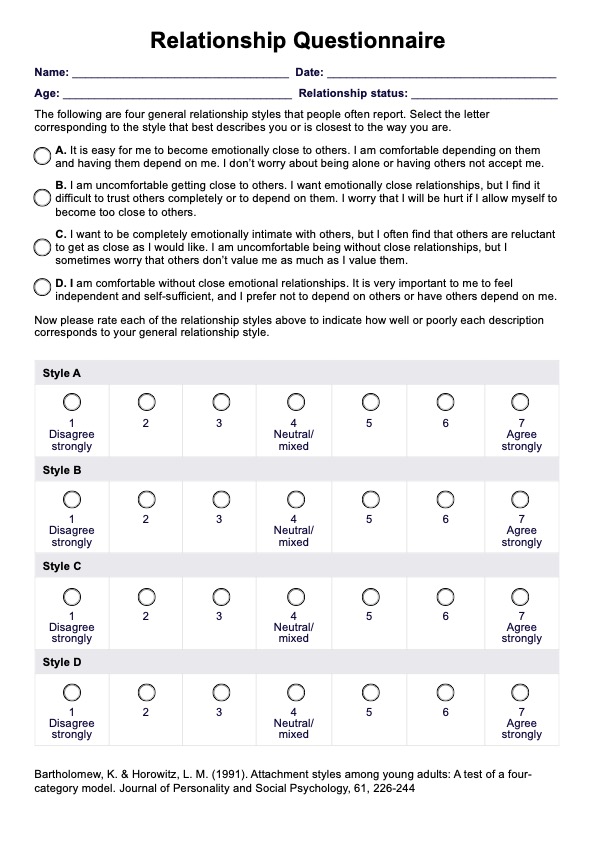
The questionnaire has two parts. The first part, RQ-1, asks respondents to select a single paragraph that best describes their overall attachment style, whether secure, fearful, preoccupied, or dismissing. The second part, RQ-2, asks respondents to rate each of those four styles on a scale, indicating how well each description reflects their relational experience (Wongpakaran et al., 2021).
# **How does it work?**
Carepatron's version of the Relationship Questionnaire provides a structured way to help individuals and couples reflect on their relational style. The process is simple, straightforward, and focused on encouraging honest self-reflection rather than offering a diagnosis.
### **Step 1: Introduction and purpose**
Begin by explaining that the Relationship Questionnaire is designed to identify broad patterns in attachment style. Emphasize that there are no right or wrong answers; the goal is to encourage self-awareness and provide a foundation for growth.
### **Step 2: Gather personal information**
Before completing the questionnaire, participants provide basic details such as name, age, and relationship status. This contextual information helps situate their responses.
### **Step 3: Gather personal information**
Before completing the questionnaire, participants provide basic details such as name, age, and relationship status. This contextual information helps situate their responses.
### **Step 4: Complete both parts of the RQ**
The RQ is divided into two parts:
- RQ-1 asks participants to read the four paragraph descriptions representing secure, fearful, preoccupied, and dismissing attachment, and select the one that best describes them.
- RQ-2 then asks participants to rate each of the four descriptions on a scale (typically 1 to 7), indicating how well each attachment style applies to them.
### **Step 5: Interpretation and discussion of results**
After completing both parts of the questionnaire, review the responses with your client. The attachment style chosen in RQ-1 and the highest-rated style in RQ-2 together indicate the individual’s dominant attachment pattern. These results can guide discussions about relationship strengths, areas for growth, and strategies for improvement. They may also highlight tendencies toward attachment anxiety or avoidance, offering valuable insights into how these patterns affect relational dynamics.
## **When would you use this template?**
The Relationship Questionnaire serves as a valuable tool in different situations where a deeper understanding of relationships is desired. Let's explore some ideal times to utilize this questionnaire:
### **Couples therapy**
Relationship therapists can employ the Relationship Questionnaire to gain insights into the dynamics between partners. It helps explore the strengths, challenges, and areas for growth within the relationship, informing the therapeutic approach.
### **Pre-marital counseling**
Before tying the knot, couples can benefit from using the Relationship Questionnaire to assess their compatibility, identify potential areas of conflict, and lay a strong foundation for their future together.
### **Dating and relationship coaching**
Relationship coaches and dating experts can use the questionnaire to assist individuals in understanding their dating preferences, values, and relationship patterns. This knowledge can guide them to make more informed choices and cultivate healthier connections.
### **Self-reflection and personal growth**
Individuals committed to personal growth and self-awareness can utilize the Relationship Questionnaire as a tool for self-reflection. It prompts them to explore their own needs, desires, and communication styles, fostering personal growth and facilitating healthier relationships.
### **Research and academic studies**
Researchers focusing on relationship dynamics can employ the Relationship Questionnaire to gather data for their studies. Its standardized format allows for consistent measurement and comparison of relationship variables across different samples.
The Relationship Questionnaire is a versatile tool suitable for various scenarios. Its ability to delve into the intricacies of relationships offers valuable insights for therapy, personal growth, coaching, and research purposes. By utilizing this questionnaire, individuals and professionals can gain a deeper understanding of relationships and work towards building stronger, more fulfilling connections.
## **Benefits**
Using the Relationship Questionnaire offers valuable insights for both individuals and professionals. Whether applied in therapy, coaching, research, or self-reflection, the RQ provides a simple yet powerful way to understand how attachment styles shape relationship dynamics.
### **Enhanced understanding of relationship dynamics**
The Relationship Questionnaire provides a valuable opportunity for individuals and professionals to gain a deeper understanding of the dynamics within adult romantic attachment in emotionally close relationships. It sheds light on various aspects such as communication styles, attachment theories, conflict resolution, and shared values, offering valuable insights into the intricacies of the partnership.
### **Guidance for tailored relationship strategies**
By utilizing the Relationship Questionnaire, therapists and relationship coaches can develop more personalized and effective strategies to address specific challenges within a relationship. The questionnaire's insights can inform interventions and guide couples toward healthier communication and connection.
### **Facilitates relationship growth and development**
The free Relationship Questionnaire catalyzes personal growth and relationship development. It helps individuals and couples explore their own needs, desires, and areas for improvement, fostering self-awareness and supporting the journey toward a more fulfilling and harmonious partnership.
### **Supports research on relationships**
For researchers studying relationships, the Relationship Questionnaire offers a reliable and standardized tool for gathering data. Its well-structured format allows for consistent measurement and comparison of relationship variables across different samples, facilitating meaningful research findings.
It can be used when trying to analyze prototypical attachment patterns (and even attachment prototype ratings), relationship styles, and more. We recommend using other relationship-related measures to cover more ground, especially ones that have the four attachment prototype ratings.
## **Research and evidence**
As mentioned, the Relationship Questionnaire was introduced by Bartholomew and Horowitz (1991) as a brief, practical way to assess adult attachment styles. Building on Hazan and Shaver’s (1987) three-category model, they added a fourth style, dismissing-avoidant, and created a simple format with four short paragraphs that respondents either select or rate.
Follow-up research has shown that the RQ holds up well over time. Scharfe and Bartholomew (1994) reported that when the questionnaire was given to young adults twice over an eight-month span, most attachment classifications stayed the same, suggesting the tool has moderate stability. Compared with interview methods such as the Adult Attachment Interview (AAI), it provides a more efficient, though less intensive, way to capture attachment patterns.
The RQ has also proven valid when tested against other measures. In a clinical study, Wongpakaran and colleagues (2021) compared it with the Experience in Close Relationships–Revised (ECR-R) and found the results lined up with expected patterns of attachment anxiety and avoidance. Reliability was especially strong when a person’s chosen style (RQ-1) matched the style they rated highest (RQ-2).
Cross-cultural studies have further strengthened the case for the RQ. Van IJzendoorn and Bakermans-Kranenburg (1996) showed that its underlying model—based on how people see themselves and others was consistent across a range of demographic and clinical groups. Schmitt and colleagues (2004), in one of the largest cross-cultural attachment studies to date, found the same framework held true in 62 cultural regions, confirming that the RQ taps into dimensions of attachment that are meaningful worldwide.
## **References**
Bartholomew, K., & Horowitz, L. M. (1991). Attachment styles among young adults: A test of a four-category model. Journal of Personality and Social Psychology, 61(2), 226–244. https://doi.org/10.1037/0022-3514.61.2.226
Griffin, D. W., & Bartholomew, K. (1994). Models of the self and other: Fundamental dimensions underlying measures of adult attachment. Journal of Personality and Social Psychology, 67(3), 430–445. https://doi.org/10.1037/0022-3514.67.3.430
Hazan, C., & Shaver, P. (1987). Romantic love conceptualized as an attachment process. Journal of Personality and Social Psychology, 52(3), 511–524. https://doi.org/10.1037/0022-3514.52.3.511
Scharfe, E., & Bartholomew, K. (1994). Reliability and stability of adult attachment patterns. Personal Relationships, 1(1), 23–43. https://doi.org/10.1111/j.1475-6811.1994.tb00053.x
Schmitt, D. P., Alcalay, L., Allensworth, M., Allik, J., Ault, L., Austers, I., Bennett, K. L., Bianchi, G., Boholst, F., Cunen, M. A. B., Braeckman, J., Brainerd, E. G., Caral, L. G. A., Caron, G., Casullo, M. M., Cunningham, M., Daibo, I., De Backer, C., De Souza, E., & Diaz-Loving, R. (2004). Patterns and universals of adult romantic attachment across 62 cultural regions. Journal of Cross-Cultural Psychology, 35(4), 367–402. https://doi.org/10.1177/0022022104266105
van IJzendoorn, M. H., & Bakermans-Kranenburg, M. J. (1996). Attachment representations in mothers, fathers, adolescents, and clinical groups: A meta-analytic search for normative data. Journal of Consulting and Clinical Psychology, 64(1), 8–21. https://doi.org/10.1037//0022-006x.64.1.8
Wongpakaran, N., DeMaranville, J., & Wongpakaran, T. (2021). Validation of the relationships questionnaire (RQ) against the experience of close relationship-revised questionnaire in a clinical psychiatric sample. Healthcare, 9(9), 1174. https://doi.org/10.3390/healthcare9091174