
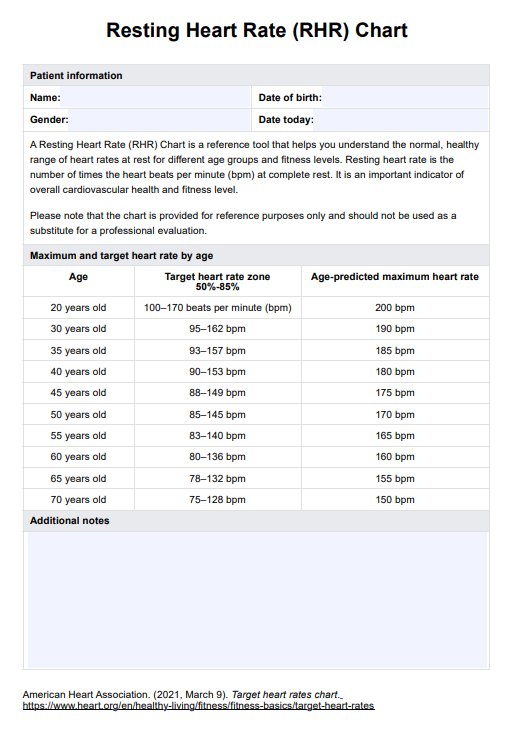




What is a Resting Heart Rate Chart?
A Resting Heart Rate(RHR) Chart is a clinical reference tool used to assess cardiac efficiency and overall autonomic balance at rest. It visually categorizes normative resting heart rate values, typically measured in beats per minute (bpm), stratified by age, sex, and estimated fitness level. The chart aids clinicians, exercise physiologists, and allied health professionals in interpreting cardiovascular status during baseline assessments or longitudinal health evaluations.
Resting heart rate is defined as the number of heartbeats per minute while the patient is at complete physiological rest, ideally measured in a supine or seated state following at least five minutes of inactivity (Healthdirect, 2019). It serves as a non-invasive biomarker of cardiovascular function and autonomic nervous system activity. Abnormal RHR values—either elevated or bradycardic—may warrant further investigation into potential underlying etiologies such as cardiovascular deconditioning, metabolic disorders, anemia, or autonomic dysfunction.
A typical resting heart rate for adults falls between 60 and 100 beats per minute. That said, the actual number can vary depending on factors such as stress levels, hormonal shifts, medications, and the amount of exercise a person engages in. For example, athletes or very active individuals often have resting heart rates as low as 40 bpm—a true sign of a relaxed, efficient heart.
In general, a lower resting heart rate is a good sign. It means the heart doesn’t have to pump as hard to keep blood moving, which reflects better cardiovascular fitness. On the flip side, a higher resting heart rate can point to lower fitness levels, elevated blood pressure, or a higher body weight.
Increased resting heart rate is associated with heightened risk of morbidity, including all-cause mortality, hypertension, and cardiac arrhythmias (Solan, 2024). Conversely, a lower RHR is typically correlated with higher cardiorespiratory fitness, although in some cases, especially when accompanied by fatigue, dizziness, or syncope, marked bradycardia may indicate conduction abnormalities or other pathologies.
Using an RHR chart allows clinicians to gain valuable insights into a patient's heart efficiency and to help inform decisions regarding exercise routines, lifestyle habits, and overall well-being. This tool also benefits individuals seeking to improve their fitness levels and professionals such as coaches, trainers, and healthcare providers working with clients or patients to achieve better cardiovascular health. It can also be useful for healthy adults seeking to maintain an optimal resting heart rate.
Locate pulse
To find the pulse, the best place is on the wrist. Turn the hands so that the palms are facing upwards, and place the three middle fingers from the other hand on top of the wrist. The wrist is an accessible area where two fingers placed on the thumb side can help detect beats. Press slightly to feel the pulse; however, if the patient does not feel anything, press a bit harder.
Alternatively, if a pulse cannot be found at the wrist, the neck beneath the jawbone, or the inside of the elbow may be checked. The neck top and wrists inside are key locations where the heart rate increases slightly and can be tracked effectively.
Checking the pulse
To assess heart rate, count each beat for 30 seconds and then double the number to determine beats per minute. This is known as the heart rate or the pulse, which is measured in beats per minute (BPM). This method is helpful for evaluating resting heart rate or heartbeats under various body positions.
It is important to note that the heart should beat at an even rhythm. If an individual has been recently active or consumed caffeine or other stimulants, it is recommended to wait at least five minutes before taking the pulse. This ensures a more accurate measurement, especially in healthy adults or a well-trained athlete.
Normal heart rate
A normal heart rate, otherwise known as the resting heart rate, is generally around 60 to 100 beats per minute (British Heart Foundation, 2024). Several factors can influence heart rate, including level of activity, body size, and fitness level. Athletes or physically active individuals may have a resting heart rate of less than 60 bpm, indicating a strong heart muscle and improved heart health. During activity, heart rate typically increases significantly, sometimes reaching 160 beats per minute or more.
If one feels anxiety, excitement, or fear, an individual's heart rate can also increase. Body position, medications like beta blockers, and other factors, such as dehydration or illness, can also cause variation.
Sometimes, individuals may experience an irregular pulse. This is known as an irregular heart rate or an arrhythmia. This is harmless in many cases, however, it may be indicative of a medical condition that can increase the chances of having a stroke or needing medical attention. An irregular heartbeat is different from heart palpitations, where an individual's heart may feel like it is going too fast or too slow, or it is fluttering or thudding. Heart palpitations are also generally harmless, however, if these are a regular occurrence, consultation with a healthcare professional is advised. This is especially important for those with high blood pressure or a history of heart disease.









