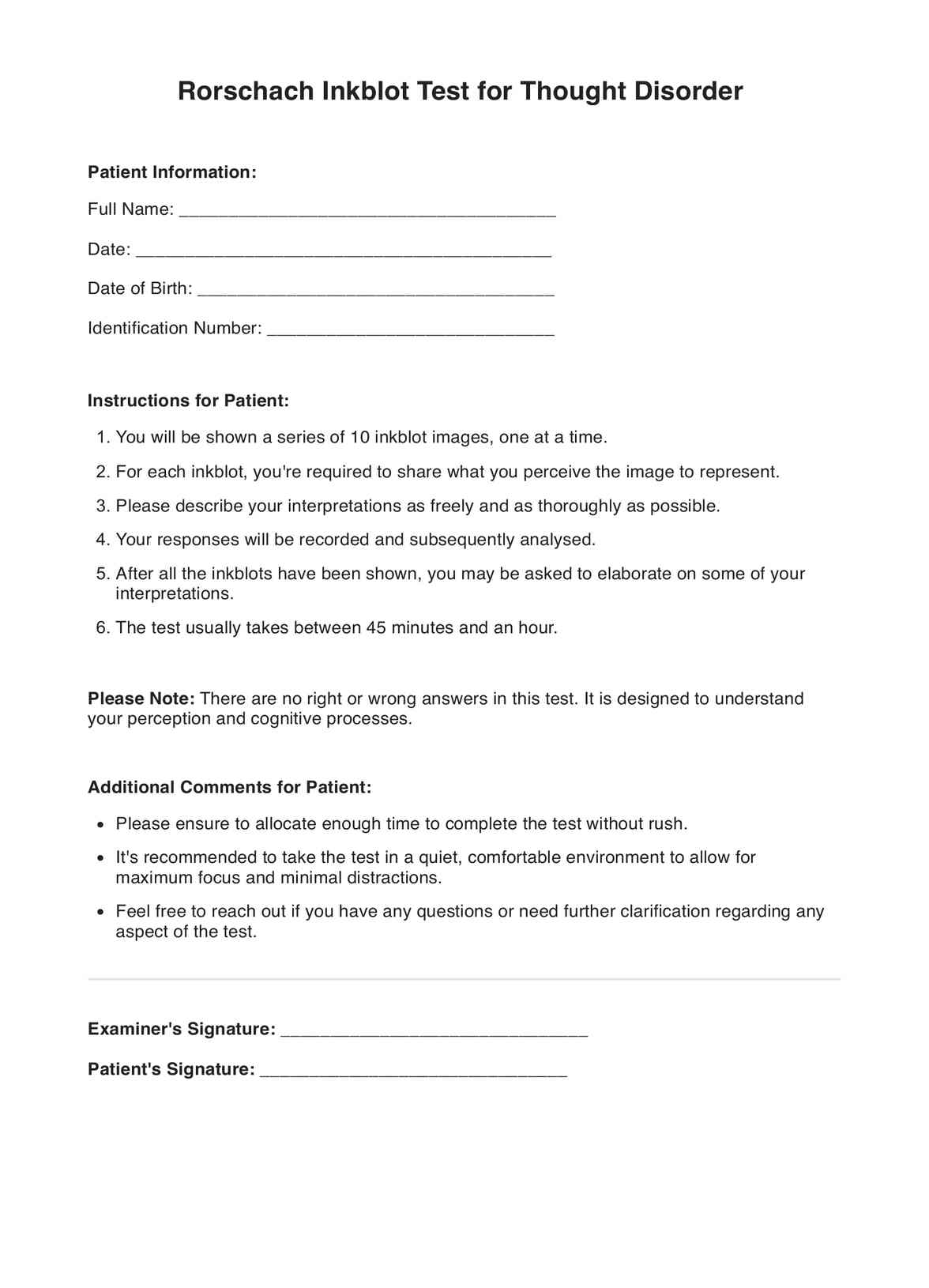




What is a Rorschach Inkblot Test for Thought Disorder?
The Rorschach Inkblot Test, often referred to as the Rorschach test, is a profound psychological tool that analyses an individual's perception and cognitive process. Crafted by Swiss psychiatrist Hermann Rorschach, the test intends to penetrate the subconscious mind, an area largely inaccessible through standard conversation or observation.
The test comprises ten symmetrical inkblots, some colored and others in black and white. Each participant's interpretation of these abstract inkblots can help reveal underlying thoughts, feelings, and potential psychological issues. Using these interpretations, mental health professionals can gain unique insights into the patient's cognitive functioning and emotional state.
The primary significance of the Rorschach test lies in its capacity to identify thought disorders marked by disruptions in thinking, attention, and communication. These thought disorders often manifest as abnormal patterns of speech, including tangential speech, circumstantial speech, pressured speech, and poverty of speech. Each of these terms represents different ways in which the coherence and clarity of speech may be lost.
- Tangential speech involves responding to questions in an oblique, tangential manner, often veering off the topic.
- Circumstantial speech refers to a style of conversation where the individual tends to include unnecessary and often irrelevant details, making it difficult for them to convey their point concisely.
- Pressured speech is rapid and frenzied, commonly observed in manic episodes.
- Poverty of speech denotes limited and often monotonous speech, usually associated with depression or schizophrenia.
These speech anomalies provide critical clues to the underlying thought disorder. The Rorschach Inkblot Test enables healthcare professionals to gauge these anomalies effectively and assess the extent of thought disorder. While some patients may be able to mask their symptoms during direct questioning or observation, their responses to the inkblots can reveal hidden disturbances in their thought patterns.