



RPE ScaleAI Template IconToolbar IconShare Icon

RPE Scale

Learn about the Rate of Perceived Exertion (RPE) scale and use it to track and adjust workout intensity. Get a free RPE chart template here.

Nate Lacson avatar

By Nate Lacson on Aug 2, 2025.

Fact Checked by Ericka Pingol.

Use Template

What is a Rate of Perceived Exertion (RPE) Scale?

The Borg Rating of Perceived Exertion (RPE) Scale is a tool that helps individuals rate the intensity of their physical activity based on how hard they feel they are working. It is often used in fitness and sports settings to help people monitor and adjust their workouts. The scale typically ranges from 1 to 10, with 1 being very easy and 10 being very hard. The RPE scale is based on the idea that each person has a unique response to exercise and that perceived exertion is a more accurate training intensity than heart rate or other physiological measures.

The Borg RPE scale helps monitor aerobic and resistance exercises, making it a versatile tool for exercise physiologists, physical therapists, sports coaches, personal trainers, physicians, cardiologists, and anyone interested in fitness. By using the RPE scale, you can monitor workout intensity and adjust workouts to ensure they are working appropriately for you or your clients' goals and fitness level.

How does this printable RPE Scale work?

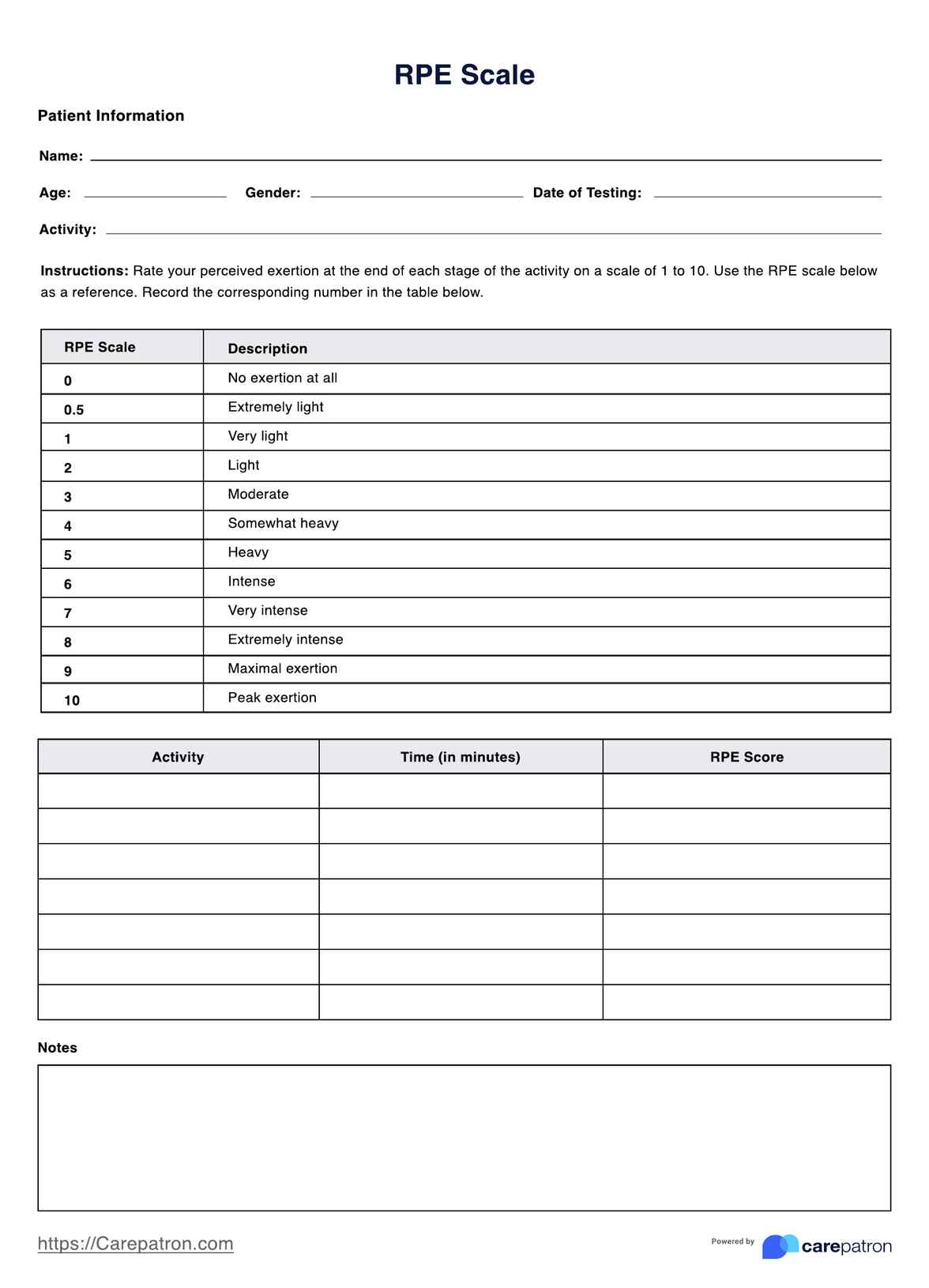
Our Rate of Perceived Exertion Scale template is based on the Modified Borg Scale (CR10) that only has scores ranging from 0-10 (compared to the original that has scores ranging from 6-20). It can help you assess your patient's or client's physical activity level. This step-by-step guide will provide instructions on how to use the RPE Scale to assess your patient's activity level.

Step 1: Introduce the scale

Introduce the scale to the client and explain that they will be asked to rate their perceived exertion during different stages of the activity they will perform. Emphasize that they should use the scale to rate their exertion level based on their own subjective experience—their breathing rate, heart rate, muscle fatigue, and sweatiness.

Step 2: Perform the activity

Have the client perform the activity and instruct them to rate their perceived exertion at the end of each stage.

Step 3: Record and analyze the score

Ask your patient about the corresponding RPE score for each stage of the activity, and record them in the table provided. Your patient or client may fill out this information if they are using the scale independently to monitor training intensity. Then, analyze the results by comparing RPE scores against your set targets.

Step 4: Provide feedback and advice

Provide feedback to the patient or client based on the overall RPE score. If the score indicates an appropriate level of exertion, advise the client to continue with the activity at this level or gradually increase the intensity as tolerated. If the RPE is too low for the intended goal, increase the load, speed, resistance, or duration, or decreasing rest periods. If the RPE is too high for the intended goal (or consistently high), there is a higher risk of injury, overtraining, or poor adherence. As such, reduce the intensity, duration, or frequency.

Scoring and interpretation

What do the numbers mean? Here's a quick run through of what number you should assign:

  • RPE 0-1 (Very light): Suitable for warm-ups, cool-downs, or very gentle recovery.
  • RPE 2-3 (Light): Corresponds to light activity, like a slow walk. Good for extended recovery or initial phases of rehabilitation.
  • RPE 4-6 (Moderate): Moderate intensity is the target for most general aerobic exercise and cardiovascular fitness improvements. The individual should feel their breathing and heart rate are elevated but can still hold a conversation (the "talk test").
  • RPE 7-8 (Vigorous): Activity feels hard; breathing is deep and rapid, and speaking more than a few words is difficult. This range is often targeted for improving performance, lactate threshold, and achieving significant cardiovascular benefits.
  • RPE 9 (Very hard): Activity is very strenuous and difficult to maintain for long. This is often encountered in high-intensity interval training (HIIT) or advanced anaerobic training.
  • RPE 10 (Maximal effort): Maximum effort, sustainable for only very short bursts. Typically reserved for specific fitness testing or peak efforts in sports.

As for what numbers you should be setting for your client's workout or activity, here are some targets based on what activity they are doing:

  • Cardio training/aerobic base building: Aim for RPE 4-6 for sustained periods.
  • Improving aerobic capacity/threshold training: Target RPE 7-8 for intervals or sustained efforts, depending on the individual's fitness.
  • Anaerobic/high-intensity interval training (HIIT): Work intervals might be in the RPE 8-9 range, with recovery intervals being much lower (e.g., RPE 2-4).
  • Strength/resistance training: RPE can be used to gauge effort within a set. For example, an RPE of 8-9 by the last repetition might indicate an appropriate load for hypertrophy or strength goals, suggesting 1-2 repetitions were left "in the tank" (reps in reserve).
  • Rehabilitation: RPE targets will vary greatly based on the injury and stage of recovery, often starting very low (RPE 1-3) and progressing cautiously.

When to do an RPE assessment?

RPE assessments are usually done during:

  • Exercise prescription: For monitoring exercise intensity and tailoring it to an individual's fitness level and health status.
  • Progress monitoring: To track improvements or plateaus in training or rehabilitation programs over time.
  • Specific populations: Including injury rehabilitation, cardiac rehabilitation, individuals with chronic conditions (like diabetes or COPD), and for optimizing sports performance.

While widely applicable, always consider if RPE is the most suitable measure for an individual and advise consultation with a healthcare professional before starting new exercise regimens.

Benefits of the free RPE Scale template

Here are some of the benefits of this scale:

Accurate assessment

With a well-designed RPE scale template, healthcare professionals can quickly assess their patient's perceived exertion level and make appropriate recommendations for their physical activity routine.

Consistent tracking

A consistent RPE scale can help track progress over time, allowing patients and healthcare professionals to see improvements in physical fitness.

Improved communication

Using a standardized RPE scale can help facilitate communication between healthcare professionals and their patients. This can help ensure patients can provide accurate and helpful information to their healthcare providers.

Increased motivation

RPE scale templates can help motivate patients and clients to continue their physical activity routine by clearly understanding their physical exertion levels.

Time efficiency

A pre-designed RPE scale template can save healthcare professionals time and effort, allowing them to focus on other essential aspects of patient care.

Versatility

RPE scale templates can be used for various physical activities, making them versatile tools for healthcare professionals in multiple settings.

Commonly asked questions

The Borg Rate of Perceived Exertion (RPE) Scale measures an individual's subjective perception of the intensity of physical activity, encompassing feelings of physical stress, effort, and fatigue, rather than objective physiological data like heart rate.

The original Borg Rate of Perceived Exertion (RPE) ranges from 6 to 20, designed to roughly correlate with heart rate when multiplied by 10 (e.g., an RPE of 12 approximates a heart rate of 120 bpm). The modified Borg or CR-10 scale uses a more subjective 0-10 range, offering a simpler way to rate exertion with verbal anchors that are easier for many to understand and apply, especially in strength training.

Yes, the RPE Scale can be used for any physical activity, from running and cycling to weightlifting and yoga. It works for aerobic exercises like running and swimming to resistance training, sports, and even daily physical tasks, as it reflects the individual's overall sense of effort.

EHR and practice management software

Get started for free

*No credit card required

Free

$0/usd

Unlimited clients

Telehealth

1GB of storage

Client portal text

Automated billing and online payments







