
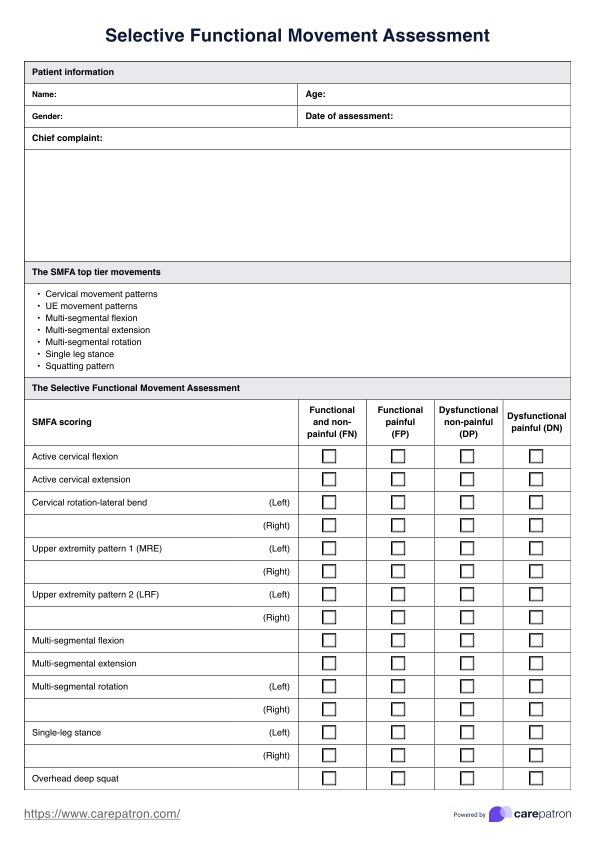




What is a Selective Functional Movement Assessment (SFMA)?
The Selective Functional Movement Assessment (SFMA) is a clinical diagnostic system developed by physical therapists Gray Cook and colleagues to evaluate movement dysfunctions in individuals experiencing musculoskeletal pain (Aghi et. al., 2023).
Unlike general screening tools like the functional movement screen, the SFMA is specifically designed for symptomatic patients, focusing on the root causes of pain rather than treating symptoms in isolation. It also aligns with the regional interdependence theory, which highlights how limitations in one region of the body can impact another.
This systematic assessment involves observing seven fundamental movement patterns such as cervical spine motion, shoulder movement, multi-segmental flexion and multi-segmental extension, rotation, single-leg stance, and a single-leg deadlift. Each pattern is analyzed for quality, pain response, and compensation strategies. Movements are categorized based on function and pain (e.g., functional/non-painful or non-functional/painful), helping clinicians distinguish between joint mobility restrictions (e.g., joint stiffness or joint mobility dysfunction), tissue extensibility dysfunction, and motor control or stability deficits.
Grounded in the principle of regional interdependence, the SFMA guides practitioners in identifying non-painful but dysfunctional patterns for further investigation. This enables targeted treatment plans that may include manual therapy, mobility work, and corrective exercises, leading to more precise, interventions-based strategies and improved patient outcomes. These outcomes are especially relevant for those recovering from injury or maintaining an active lifestyle.
The Selective Functional Movement Assessment (SFMA) is typically used by healthcare professionals to evaluate movement dysfunctions in scenarios such as injury rehabilitation, chronic pain management, athletic performance enhancement, and surgical recovery. It is also applied to improve movement quality in daily activities, with a focus on proper movement patterns and restoring pain free movement.









