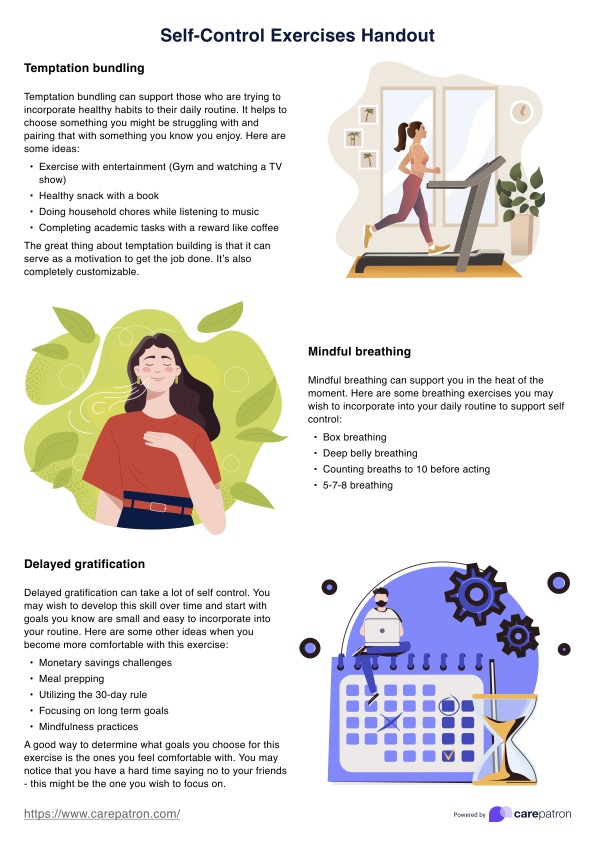
5 examples of self-control exercises
There are various exercises that can support developing long-lasting and robust habits that can contribute to battling self-control failure. Here are a few simple self-discipline activities that individuals can engage in to support their self-discipline goals:
Temptation bundling
Temptation bundling is an exercise that can be used for the development of self control. This exercise allows individuals to pair an activity they may not want to do; with something they enjoy. Put simply, individuals engage with activities they want whilst doing things they should (Kirgios et al., 2020). For example, someone who wants to take up going to the gym may also enjoy watching a specific TV show. In this case, the client would watch that program at the gym whilst they exercise. Temptation bundling has been found to have a high success rate. In their study, Kirgios et al. (2020) found that providing participants with an audiobook increased weekly visits to the gym by 10-14%.
Mindful breathing
The practice of mindfulness has long been found to be helpful in other therapy goals. Mindful breathing can be implemented for those who are in the process of building self-discipline. By taking a few moments each day to practice mindful breathing, individuals can focus on their breath, manage impulses and increase awareness. Individuals who may find it difficult to practice self control may too easily give in to impulsive thoughts and actions. By taking a moment of regular meditation before making decisions, individuals may be more included to think the activity through.
Delayed gratification
Another way that individuals may enhance their self-control skills is through delayed gratification. Estimated results from a study conducted by Gschwandtner et al. (2021) show that when an individual has the ability to delay gratification, it can significantly fewer addictive behaviors that impact their well-being. An example of delayed gratification is studying for an exam instead of going out with friends. In this scenario, socialization with friends is the instant gratification, where dedicating time to studying for an exam will help the individual to do better in the long run with better grades and a greater sense of achievement.
Habit stacking
Habit stacking is another way that individuals can implement more healthy habits into their lifestyle to improve self-discipline. In this strategy, individuals will place a healthy and proactive habit on top of one task they may already have. For example, individuals who typically drink a morning coffee may choose to habit stack this activity by also saying a few daily gratitude during this time. This exercise can help those who may struggle with consistency since there is already a habit taking place.
Journaling
Finally, journaling can support increased self-awareness and support emotional control. The great thing about choosing journaling as a self-control activity is that it can take place at any time of the day. An individual may choose to wake up 5 minutes earlier to complete an affirmation for the day entry, or they may choose to spend time during the evening wind down to complete an entry. Journaling can also serve as a reminder to individuals about what they are working on and why. Taking time to reflect on their day can also support their overall goals and help develop more self-control.