



Self-Destructive Behavior TestAI Template IconToolbar IconShare Icon

Self-Destructive Behavior Test

Uncover patterns of self-destructive behavior with our comprehensive test. Identify self-sabotage, understand its causes, and take steps toward healing with our free PDF download.

Telita Montales avatar

By Telita Montales on Aug 2, 2025.

Fact Checked by Nate Lacson.

Use Template

What is a Self-Destructive Test?

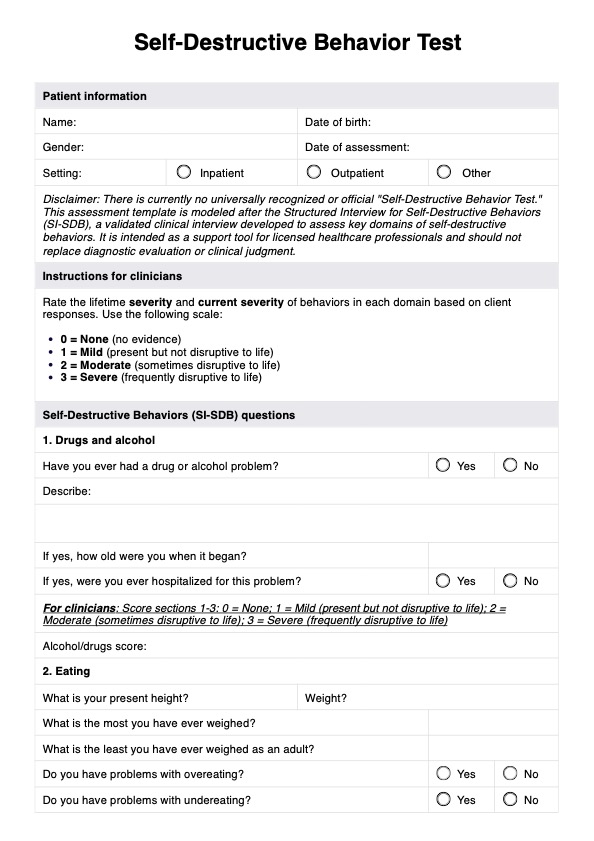
A Self-Destructive Test is an informal term that refers to tools or assessments designed to evaluate self-destructive behaviors (SDBs), including suicidality, self-injury, substance abuse, disordered eating, and risky sexual behaviors. While there is no universally recognized test by this name, the Structured Interview for Self-Destructive Behaviors (SI-SDB) serves as a well-researched framework for such assessments (Carlson et. al., 2013). These types of assessments are sometimes referred to as a self-destructive behavior test and can provide insight into patterns of self-sabotage and self-destructive tendencies that affect mental health.

Originally administered to psychiatric inpatients, the SI-SDB demonstrated strong internal consistency and external validity, particularly in identifying psychiatric diagnoses related to substance abuse and disordered eating. Clinicians use this tool to rapidly assess behaviors that can vary widely in frequency, intent, and severity. These behaviors may serve a range of psychological functions, from expressing emotional pain to regulating distressing thoughts. SDBs are often observed in individuals with complex trauma histories, borderline personality disorder, substance use disorders, and other psychiatric conditions that impair mental well-being and personal success.

Importantly, the presence of one form of self-destructive behavior is highly predictive of others, reinforcing the need for comprehensive evaluation. For instance, individuals with eating disorders frequently experience comorbid self-injury or substance abuse, and those who self-harm may also have a history of suicide attempts (Hambleton et. al., 2022). Because SDBs can have overlapping functions and risks, understanding the patterns and interplay of these behaviors is essential for accurate diagnosis and effective treatment planning, especially for those experiencing low self-esteem, chronic avoidance, or negative self-talk.

The SI-SDB offers a structured, efficient way to assess behaviors that significantly impact mental health outcomes and identify self-destructive actions that may lead to self-destruction without professional help.

Self-Destructive Behavior Test Template

Download PDF Template

Examples of self-destructive behaviors

Self-destructive behaviors are a complex spectrum of actions that individuals may engage in, often as a means to cope with underlying emotional pain, stress, or trauma. These behaviors can significantly impact an individual's mental and physical health, social life, and overall well-being.

Here are more detailed examples of self-destructive behaviors, expanding on the initial list:

  • Engaging in risky behaviors without considering the consequences: This can include driving recklessly, engaging in unprotected sex with multiple partners, or experimenting with illegal substances. Such actions pose immediate physical dangers and can lead to long-term health problems or legal issues, reflecting a disregard for one's safety and future. These behaviors often stem from self-sabotaging beliefs or a lack of self-awareness and may include illegal behavior and risky sex.
  • Impulsive eating or substance abuse: Turning to food, alcohol, drugs, or other substances as a way to numb emotional pain or fill a void can lead to addiction, health problems, and worsen the emotional issues they're meant to mask. Impulsive eating can result in eating disorders or obesity, while substance abuse can disrupt personal and professional life, deteriorate physical health, and lead to dependence. Acts like binge eating, alcohol use, and impulsive eating may be signs of deeper mental health issues.
  • Negative self-talk and harsh self-criticism: Constantly belittling oneself, questioning one's worth, and focusing on perceived failures can erode self-esteem and lead to mental health disorders such as depression and anxiety. This thinking pattern reinforces self-destructive behaviors by convincing individuals that they do not deserve happiness or success. Self-worth and self-esteem are deeply affected, and the beliefs formed often fuel self-destructive patterns.
  • Procrastination and avoidance of important tasks: Regularly putting off tasks, whether due to fear of failure, perfectionism, or a lack of motivation, can create a cycle of stress, lower productivity, and feelings of guilt and worthlessness. This behavior can impact both professional achievements and personal goals, ultimately affecting one's self-image and overall quality of life. Individuals may often begin to procrastinate on important tasks, harming their future and sabotaging their success.
  • Self-harm as a coping mechanism for emotional distress: Some individuals may resort to self-harm, such as cutting, burning, or other forms of physical injury, as a way to express or manage overwhelming emotions. This dangerous coping mechanism signals deep emotional distress and a need for coping strategies that address the root causes rather than the symptoms.

These behaviors are often signs of deeper psychological issues, such as unresolved trauma, low self-esteem, or mental health disorders. They serve as maladaptive ways to handle stress, emotional pain, or traumatic experiences, underscoring the importance of recognizing these patterns and seeking professional help.

Causes of self-destructive behaviors

Self-destructive behaviors stem from a complex interplay of psychological, biological, and environmental factors. Childhood trauma, including abuse or neglect, often disrupts emotional development and fosters harmful coping mechanisms (Kerig, 2017). Mental health conditions such as depression, PTSD, and borderline personality disorder (Kulacaoglu & Kose, 2018) can intensify distress and trigger self-injurious behaviors. Childhood trauma is especially linked with poor mental health and future self-destructive behavior.

Low self-esteem and poor self-image may drive individuals to seek relief or validation through destructive actions. Substance abuse is also a common contributor, often used to numb emotional pain but ultimately reinforcing harmful patterns. Social isolation, unstable relationships, and genetic or neurobiological vulnerabilities further increase the risk, making self-destructive behavior a multifactorial clinical concern. These causes create layers of emotional distress, deeply affecting personal well-being and increasing the chance of risky behaviors.

How to diagnose self-destructive behavior?

Diagnosing self-destructive behavior requires a comprehensive approach that includes both self-assessment and professional evaluation. This process helps identify harmful patterns and their impact on an individual's life, recognizing signs of self-sabotage, such as recurrent failure to achieve goals despite possessing the necessary capabilities. Many individuals started engaging in these behaviors gradually, but the consequences can be severe.

Understanding the underlying beliefs and emotions driving these behaviors is essential for developing an effective treatment plan. Mental health professionals play a crucial role in this process, offering the expertise and objectivity necessary to diagnose and address the root causes of self-destructive behavior accurately. This is essential for improving motivation, emotional control, and education about one’s psychology and behavioral risks.

How to diagnose self-destructive behavior?

Diagnosing self-destructive behavior requires a comprehensive approach, including self-assessment and professional evaluation. This process helps to identify harmful patterns and their impact on the individual's life, recognizing signs of self-sabotage, such as recurrent failure to achieve goals despite having the capabilities.

Understanding the underlying beliefs and emotions driving these behaviors is essential for developing an effective treatment plan. Mental health professionals play a crucial role in this process, offering the expertise and objectivity needed to diagnose and address the root causes of self-destructive behavior accurately.

Scoring and interpretation

Scoring and interpretation of the SI-SDB involve assigning severity ratings to each of the five behavioral domains: substance abuse, disordered eating, disordered sexual behavior, self-injury, and suicidality. Each domain is explored through structured, neutral questions, with behaviors rated on a scale of 0 (none) to 3 (severe). These ratings reflect the degree to which the behaviors disrupt the individual’s life, both historically and currently. The lifetime and current scores help assess chronicity and severity. Total scores range from 0 to 15, providing a comprehensive picture of risk and impairment. Interview length varies based on the number and intensity of behaviors reported.

Treatment for self-destructive behavior

The path to addressing and overcoming self-destructive behavior is multifaceted, incorporating various therapeutic approaches and strategies tailored to the individual's specific needs and the root causes of their behavior. Treatment options are designed not only to alleviate the symptoms but also to address the underlying factors contributing to self-destructive patterns.

  • Cognitive-behavioral therapy (CBT): CBT is a cornerstone in treating self-destructive behaviors (American Psychological Association, 2017), focusing on identifying and challenging negative thought patterns and behaviors. This therapy helps individuals recognize their automatic thoughts and their impact on their actions and emotions. By working to alter these thought patterns, CBT aims to change behavior and reduce the inclination towards self-sabotage.
  • Developing healthy coping mechanisms and self-care practices: Learning and implementing healthy coping strategies is crucial for individuals prone to self-destructive behaviors. This includes stress management techniques, mindfulness, regular physical activity, and a balanced diet with adequate rest. Developing a self-care routine not only helps manage stress but also promotes overall well-being.
  • Engaging in activities that promote self-awareness and positive self-image: Journaling, meditation, art therapy, or participation in group therapy can enhance self-awareness and contribute to a more positive self-image. These activities encourage individuals to constructively explore their thoughts and feelings, fostering a deeper understanding of themselves and their behaviors.
  • Addressing underlying issues with professional support: Often, self-destructive behaviors stem from unresolved trauma or co-occurring mental health disorders. Professional support from psychologists, psychiatrists, or counselors is vital. Therapy may involve trauma-focused interventions, medication for managing symptoms of mental health disorders, and ongoing support to navigate the challenges associated with these conditions.
  • Building a support network: Engaging with support groups or seeking the support of trusted family members and friends can provide additional layers of encouragement and understanding. A strong support network can offer a sense of belonging and community, which is essential for lasting recovery.

Effective treatment is a journey that requires patience, commitment, and the willingness to engage in self-exploration and change. By addressing the symptoms and the root causes of self-destructive behavior, individuals can work towards healing, personal growth, and a more fulfilling and balanced life.

References

American Psychological Association. (2017). What is cognitive behavioral therapy? https://www.apa.org/ptsd-guideline/patients-and-families/cognitive-behavioral

Carlson, E. B., McDade-Montez, E., Armstrong, J., Dalenberg, C., & Loewenstein, R. J. (2013). Development and initial validation of the Structured Interview for Self-Destructive Behaviors. Journal of Trauma & Dissociation, 14(3), 312–327. https://doi.org/10.1080/15299732.2012.762822

Kerig, P. K. (2017). Self-destructive behavior. In The encyclopedia of juvenile delinquency and justice (pp. 1–5). Wiley. https://doi.org/10.1002/9781118524275.ejdj0137

Kulacaoglu, F., & Kose, S. (2018). Borderline personality disorder (BPD): In the midst of vulnerability, chaos, and awe. Brain Sciences, 8(11), 201. https://doi.org/10.3390/brainsci8110201

Hambleton, A., Pepin, G., Le, A., Maloney, D., Aouad, P., Barakat, S., Boakes, R., Brennan, L., Bryant, E., Byrne, S., Caldwell, B., Calvert, S., Carroll, B., Castle, D., Caterson, I., Chelius, B., Chiem, L., Clarke, S., Conti, J., & Crouch, L. (2022). Psychiatric and medical comorbidities of eating disorders: Findings from a rapid review of the literature. Journal of Eating Disorders, 10(1). https://doi.org/10.1186/s40337-022-00654-2

Commonly asked questions

Look for patterns of behavior that consistently hinder your progress towards goals, accompanied by negative self-talk and fear of success.

It often stems from deep-seated beliefs about unworthiness, fear of failure or success, and unresolved emotional trauma.

Underlying mental health issues, negative conditioning from past experiences, and protective mechanisms against perceived threats to one's self-image.

EHR and practice management software

Get started for free

*No credit card required

Free

$0/usd

Unlimited clients

Telehealth

1GB of storage

Client portal text

Automated billing and online payments







