Benefits
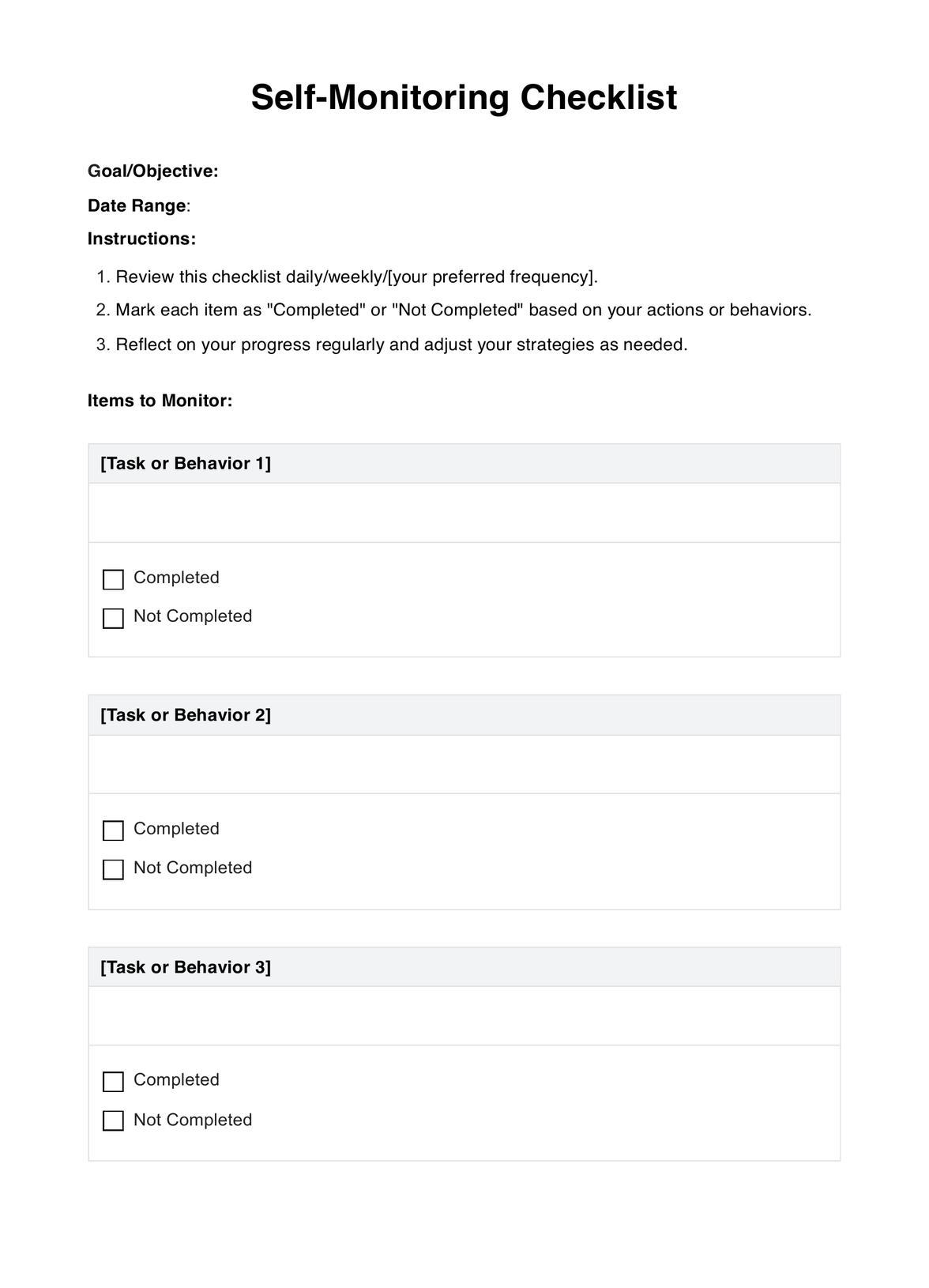
Utilizing a Self Monitoring Checklist offers a multitude of benefits, each contributing significantly to personal and professional growth:
Increased accountability
A Self Monitoring Checklist is a daily reminder of your commitments. By marking tasks as completed or not completed, individuals become more accountable for their actions. It reinforces the importance of following through on your goals and tasks, fostering a strong sense of responsibility. This heightened sense of accountability can be a powerful motivator, encouraging you to work toward your objectives consistently. It can also support identifying individual needs. It can also teach discipline as well as control within oneself.
Improved self-awareness
Regularly reviewing and recording your actions and behaviors promotes self-awareness. It allows you to gain a deep understanding of your habits, tendencies, and patterns of behavior. This increased self-awareness can be transformative, as it empowers you to identify your strengths and areas for improvement. With this knowledge, you can make more informed decisions about adjusting your own behavior to align with your goals. It can also support development of your own executive functioning skills.
Goal achievement
One of the primary purposes of a Self Monitoring Checklist is to provide a structured path to achieving your objectives. It is a roadmap that outlines the specific tasks and behaviors required to reach your goals. Tracking your progress on the checklist ensures that you stay focused on your goals and measure your progress accurately. This can be idea for class period where there should be student self monitoring happening. Being able to self monitor also allows targeted behavior to be obtained through the use of intrinsic or extrinsic rewards.
This clarity and structure can be a game-changer, helping you break down larger goals into manageable steps and celebrate each milestone. It can support student self monitoring by being able to start paying attention, within general education, specific learning, and is a great way to measure student's progress.
Effective time management
Time management is a crucial skill in achieving any goal. A Self Monitoring Checklist encourages users to prioritize tasks and allocate their time more efficiently. It helps you identify the most critical actions that can be deferred or eliminated. As you become more adept at managing your time, you can ensure that essential activities are addressed promptly, maximizing your productivity and effectiveness.
Motivation
A Self Monitoring Checklist serves as a visual representation of your progress. Seeing tasks marked as completed on the checklist can be incredibly motivating. It provides tangible evidence of your efforts and accomplishments, which, in turn, boosts your confidence and self-esteem. This motivation can be a powerful force, helping you maintain enthusiasm and dedication to your goals, even in the face of challenges.
Data-driven decisions
The act of recording data on your Self Monitoring Checklist provides you with a valuable source of information. You can evaluate this data to gain insights into your behaviors and their impact on your progress. Armed with this information, you can make informed decisions about your strategy. For example, if you're tracking your diet and exercise, you can identify patterns that help you adjust your routines for better results.
This data-driven approach ensures that your actions align with your objectives and that you can adapt your strategies to succeed.