How to Use the Seligman's Four Strategies PTSD Worksheet
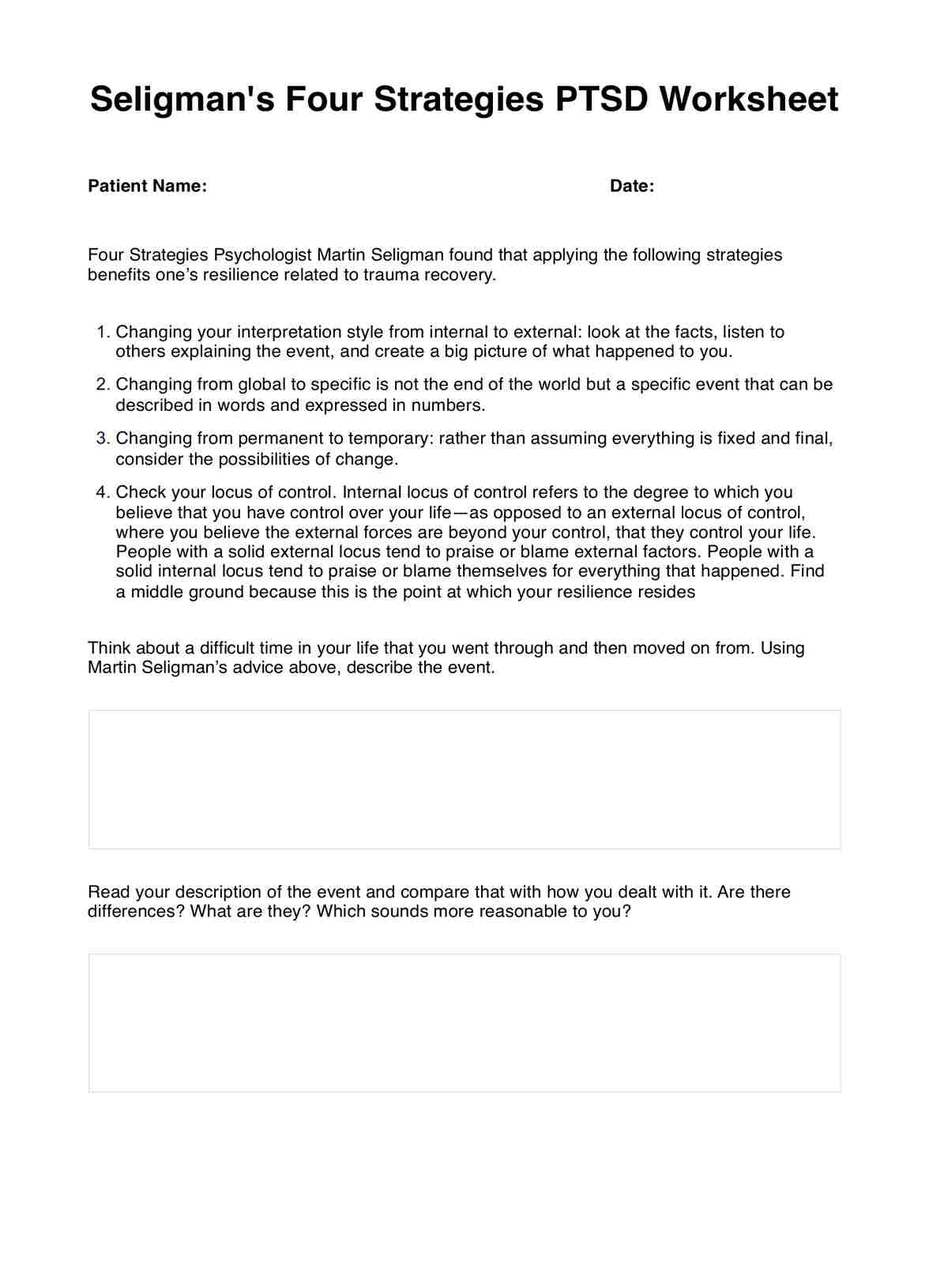
Seligman's Four Strategies PTSD Worksheet is a valuable tool designed to aid individuals in their recovery from trauma and the associated symptoms of Post-Traumatic Stress Disorder (PTSD). Based on psychologist Martin Seligman's pioneering work, this worksheet provides a structured approach to address traumatic experiences and promote resilience.
Here, we will elucidate how to effectively utilize this worksheet, breaking down the process into key steps.
Step 1: Introduction and Preparation
Begin by introducing the worksheet to the individual seeking assistance in trauma recovery. Explain that it is designed to facilitate a cognitive shift in their perspective on the traumatic event and its aftermath. Ensure a comfortable and private environment for the individual to work through their thoughts and feelings.
Step 2: Identifying a Traumatic Event
Encourage the individual to reflect on a traumatic event in their life that they have experienced and subsequently moved on from. This event serves as the focal point for applying Seligman's Four Strategies.
Step 3: Applying the Strategies
a. Changing Interpretation Style: In this section, the individual should recount the traumatic event while changing their interpretation style from internal (self-blame) to external (objective assessment). Encourage them to consider the facts, seek input from others, and construct a holistic view of the event.
b. Changing from Global to Specific: Have the individual shift their perspective from viewing the traumatic event as a global catastrophe to understanding it as a specific incident that can be described in detail and quantified.
c. Changing from Permanent to Temporary: Guide them in altering their perception of the event's permanence. Encourage them to consider the possibilities of change and healing rather than assuming the trauma's effects are fixed.
d. Checking Locus of Control: Prompt the individual to assess their locus of control. Discuss the balance between internal and external attributions for the event and encourage them to find a middle ground.
Step 4: Reflect and Compare
Instruct the individual to read their description of the traumatic event, noting the changes in perspective resulting from applying Seligman's strategies. Have them compare their initial interpretation with the transformed one, considering which perspective seems more reasonable and constructive.
Step 5: Integration and Next Steps
Discuss how the revised perspective can inform their trauma recovery journey. Encourage them to integrate these insights into their daily life, focusing on resilience-building and well-being.
Seligman's Four Strategies PTSD Worksheet is a structured pathway to promote cognitive restructuring and enhance resilience in individuals navigating the challenging terrain of trauma recovery and PTSD management. It empowers individuals to regain control over their narrative, fostering a more adaptive and constructive outlook on life beyond trauma.