
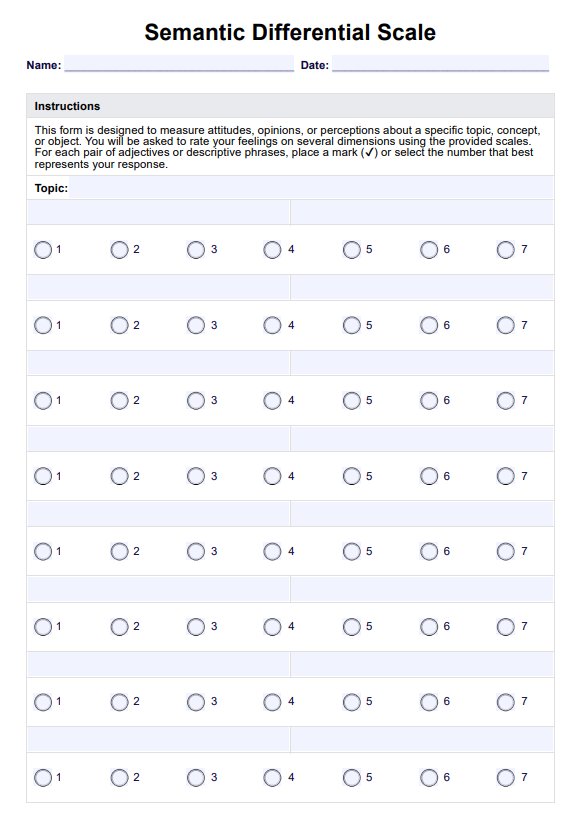




What is a Semantic Differential Scale template?
A Semantic Differential Scale is a widely used rating scale for measuring attitudes, opinions, or perceptions about a specific topic, concept, or object.The concept of semantic diffrential was developed by psychologist Charles Osgood, this tool uses bipolar adjective scales, such as "Happy-Sad" or "Strong-Weak," to capture respondent perceptions. The original semantic differential (SD) questionnaires used a series of seven-point scales ranging from −3 to +3, anchored by bipolar adjectives (e.g., good–bad, light–dark, social–unsocial) with a neutral midpoint at zero (Wright, 2015). Only the endpoints of the scales were labeled, and the intervals were assumed to represent equal distances. This structure enables the collection of nuanced data, with lower scores reflecting alignment with the left adjective, higher scores with the right, and the midpoint indicating neutrality.
Our Semantic Differential Scale is designed for professional use and includes fields for recording the respondent's name, date, and detailed instructions for completing the semantic differential scale questions. Each row contains a field for pair of polar adjectives with a 7-point scale, enabling respondents to provide feedback by selecting the position that best represents their attitude. The scale captures subtle differences in emotional attitudes and opinions, making it a valuable tool for collecting responses in diverse contexts such as cognitive science, employee satisfaction, and surveys.









