




What is dissociation?
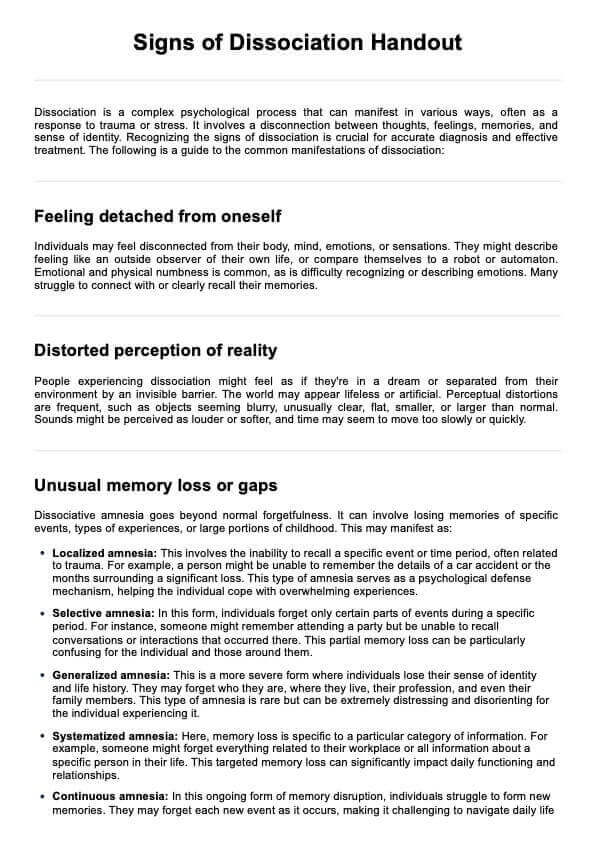
Have you noticed a client seeming detached from their surroundings or themselves? These might be signs of dissociation, which can manifest in various forms and significantly affect one's day-to-day functioning. Whether you're a mental health professional or another healthcare provider, understanding dissociation and its signs can help you provide the necessary support. Here, we will explore dissociation, how to identify it, and how our Signs of Dissociation Handout can be valuable for addressing possible mental health conditions.
Dissociation is a mental process in which a person experiences a disconnection or lack of continuity between their thoughts, memories, surroundings, actions, and identity. It's like someone is "disconnected" from their normal thinking or feeling. Dissociation can happen to anyone, but it's more common in people who have experienced traumatic events or have a history of abuse.
Dissociation can become a coping mechanism that individuals use to detach from reality, often in response to a traumatic or stressful event. Although everyone experiences other mild forms of dissociation occasionally, such as daydreaming or getting lost in a book, it becomes a concern when it disrupts daily life and can be associated with a possible mental illness.
Common types of dissociative disorders
There are several types of dissociative disorders, each with unique characteristics:
- Dissociative identity disorder (DID): Previously known as multiple personality disorder, DID involves the presence of two or more distinct personality states or identities.
- Dissociative amnesia: This involves an inability to recall important information, usually of a traumatic or stressful nature.
- Depersonalization/derealization disorder: This involves persistent feelings of detachment from one’s body (depersonalization) or surroundings (derealization).









