
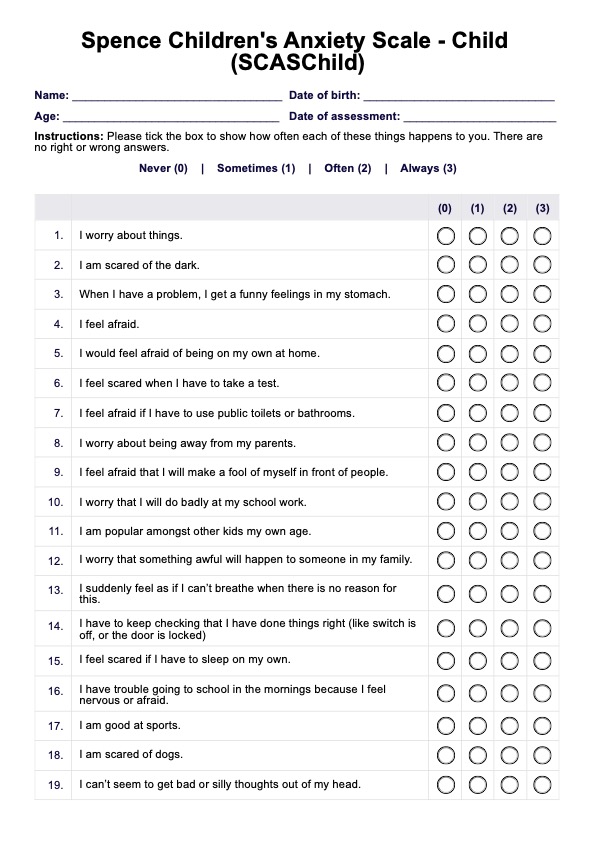




What is the Spence Children’s Anxiety Scale - Child Report?
The Spence Children's Anxiety Scale (SCAS) is a psychological assessment tool developed by Dr. Susan Spence to evaluate the severity of anxiety symptoms in children aged 8 to 15 (Magiati et. al., 2017). It was designed in line with the dimensions of anxiety disorders, such as separation anxiety, social phobia, obsessive-compulsive disorder, panic/agoraphobia, generalized anxiety, and fears of physical injury. The Spence Childrens Anxiety Scale Child Report is widely recognized in the field of child anxiety assessment (Spence, 1998).
Anxiety is a natural and normal brain response to threats or danger. It is usually characterized by fear, worry, or uneasiness about events that may appear uncertain or challenging. It is not necessarily pathological. The right amount of anxiety is a crucial survival stimulus that facilitates productivity. It only becomes pathological when experienced at severe levels, disrupting functioning, well-being, and overall quality of life.
Anxiety in children is different from anxiety in adults (Beesdo et. al., 2009). For instance, children differ in expressing their symptoms because they struggle to verbalize their feelings and emotions. Instead of words, their child's anxiety symptoms are revealed by their behaviors such as crying, tantrums, clinginess, avoidance, or physical complaints. Apart from that, anxiety in children is difficult to identify because their development involves distinct periods of anxious behaviors, including stranger anxiety, nighttime fear, and the like. This makes it more crucial to devise methods to identify potential child anxiety disorders.
This anxiety scale allows an in-depth assessment of anxiety symptoms, making it easier for clinicians or professionals to identify the nature and severity of anxiety in children.









