
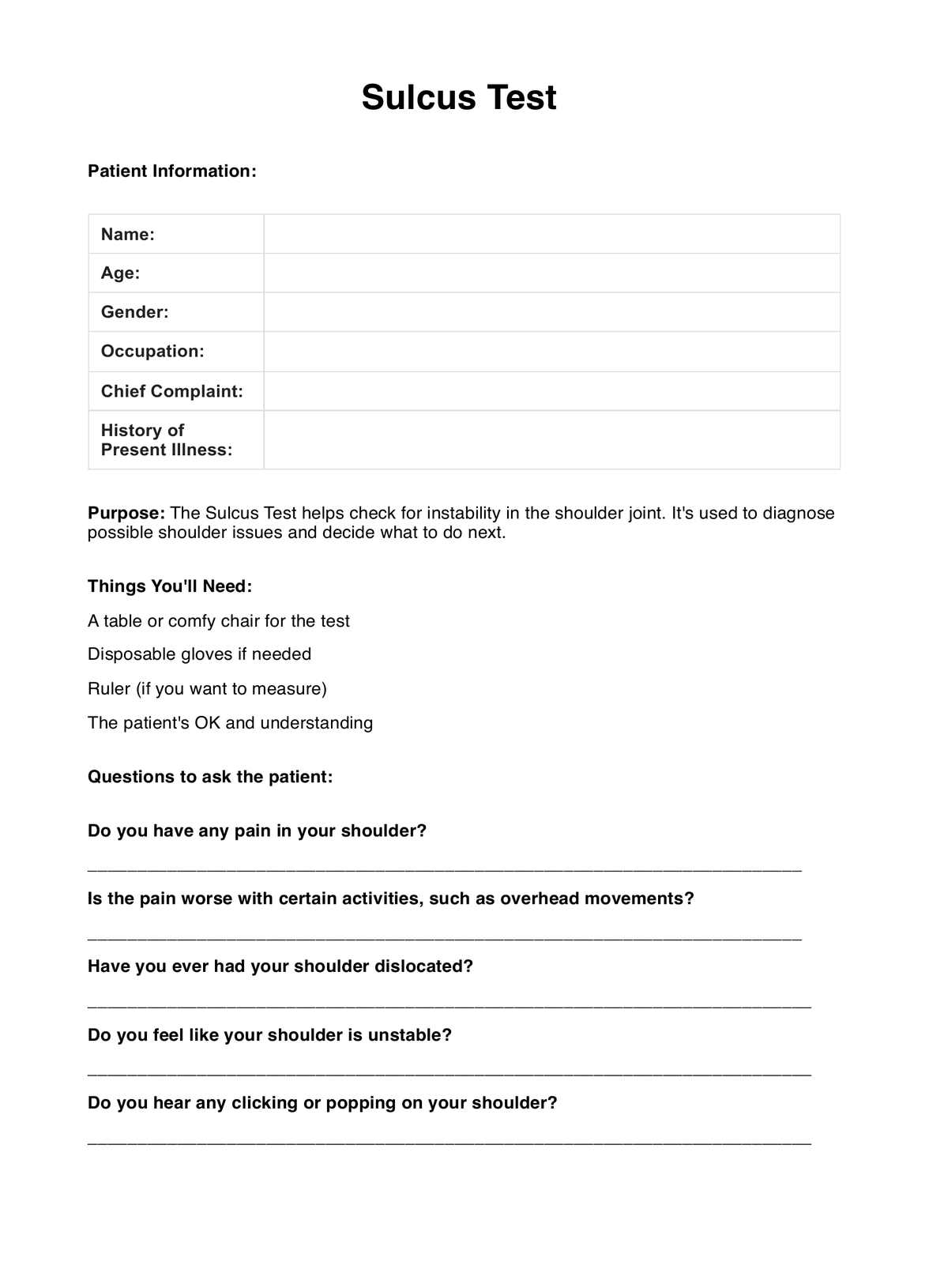




What is a Sulcus Test?
"Sulcus" refers to a crevice, groove, furrow, or fissure found in various body parts. These sulci can be present in different organs and structures, such as the brain, heart, bones, etc. In biological morphology and anatomy, a sulcus is a depression or indentation in a surface, which can serve as a natural division or separation between different parts of an organ or structure.
The is a commonly used orthopedic examination test designed to assess inferior instability in the shoulder's glenohumeral joint. This examination focuses on the glenohumeral joint capsule and the ligamentous structures, particularly the superior glenohumeral and coracohumeral ligaments. You can use this orthopedic examination template to elevate your practice.
The test is typically conducted with the subject seated and the arm to be evaluated in a relaxed position. One of the examiner's hands stabilizes the shoulder girdle on the tested side while the other hand firmly grasps the elbow of the tested arm. The movement involves pulling down on the subject's elbow.
A positive outcome of the Sulcus Sign test is indicated by the noticeable inferior movement of the arm relative to the shoulder, often accompanied by a visible 'sulcus' or 'step-off deformity' between the acromion and the humeral head. While pain and apprehension may or may not be present, a positive result suggests the presence of inferior or multidirectional instability (MDI) in the shoulder.









