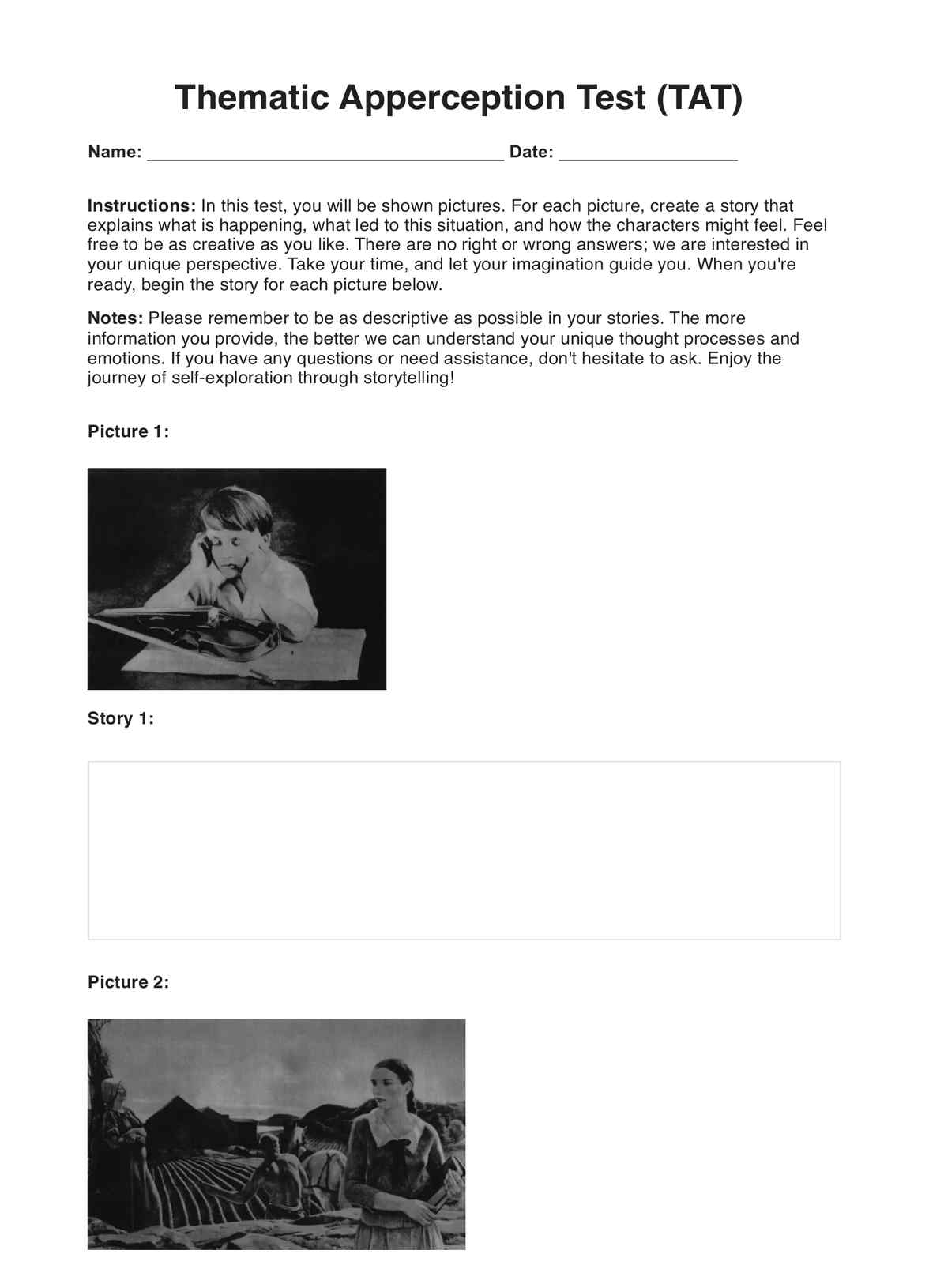
Read our guide to learn more about the Thematic Apperception Test, then use our test template as a part of personality assessment and potentially reveal their hidden thoughts and emotions.
The TAT provides valuable insights into personality traits, interpersonal relationships, defense mechanisms, and emotional conflicts through the picture interpretation technique. You can use this projective assessment to understand how your clients perceive themselves, others, and their environment.
## **What is projective theory?**
Projective techniques are grounded in psychodynamic theory, which suggests that individuals project their unconscious thoughts, feelings, and desires onto ambiguous stimuli. The theoretical foundation for the thematic apperception test draws from the work of Henry A. Murray and his concept of personology—the study of the whole person in context (Carey, 2024).
According to projective theory, when presented with ambiguous images, individuals will interpret them based on their own experiences, needs, conflicts, and personality characteristics. This projection occurs because the lack of clear structure in the stimuli allows the person's internal psychological state to shape their interpretations (Lilienfeld et al., 2000).
The TAT operates on the assumption that the stories people create about picture cards reveal aspects of their personality that may not be accessible through direct questioning or self-report measures. The narratives constructed around these images can uncover:
- Underlying motivations and needs
- Relationship patterns and interpersonal relations
- Emotional conflicts and coping strategies
- Defense mechanisms used to manage anxiety
- Aspirations and fears
This theoretical framework positions the TAT as a window into the unconscious, allowing clinicians to assess psychological traits and dynamics that influence behavior and emotional well-being.
## **What is a Thematic Apperception Test (TAT)?**
The Thematic Apperception Test was developed by Henry A. Murray and Christiana D. Morgan at the Harvard Psychological Clinic in the 1930s. Originally created as part of Murray's exploration of human needs and motivations, the TAT has become one of the most widely researched [projective tests](https://www.carepatron.com/files/projective-testing.pdf) in psychology.
The test consists of a series of picture cards depicting various scenes with ambiguous images. The complete version includes 31 cards, though clinicians typically use a subset based on the client's age and gender. Each card shows people in situations that lack clear context, encouraging the respondent to project their internal world onto the picture presented.
The TAT has been employed in various contexts, including clinical settings, research settings, therapeutic environments, and even forensic evaluations to evaluate crime suspects. While historically used to assess individuals across diverse populations, modern applications focus primarily on therapeutic and diagnostic purposes in mental health settings.
### **Limitations and considerations**
While the TAT offers valuable qualitative insights, it has limitations that clinicians should consider. The test is time-consuming to administer and score, typically requiring 1-2 hours for administration and additional time for interpretation. Unlike standardized measures, the TAT's interpretation can be subjective, and inter-rater reliability varies depending on the scoring system used (Lilienfeld et al., 2000).
The test's validity has been debated in psychological literature. While some research supports its clinical utility, critics note concerns about the lack of standardization in administration and interpretation (McLeod, 2024). The TAT should not be used in isolation but as part of a comprehensive assessment battery that includes structured interviews, behavioral observations, and other validated measures.
Cultural factors also influence the responses. The original picture cards depict predominantly Western, mid-20th-century scenarios that may not resonate with diverse populations. Clinicians must account for cultural context when interpreting narratives and consider whether the images are appropriate for their clients.
### **When to use the TAT**
The thematic apperception test is particularly valuable in the following situations:
- **Routine psychological evaluations**: The TAT template provides a structured approach to understanding personality through analyzing the stories clients construct in response to the ambiguous images. It complements other assessment methods by offering qualitative depth.
- **Emotionally disturbed individuals**: For clients experiencing emotional difficulties, the TAT helps reveal aspects of emotional conflicts relevant to their psychological well-being. It offers insights into their emotional investment and potential defense mechanisms they use to cope with distress.
- **Psychotherapy and treatment planning**: In therapeutic settings, particularly within [psychodynamic traditions](https://www.carepatron.com/guides/psychodynamic-therapy-techniques/), the TAT serves as a projective test to explore emotional conflicts and unconscious processes. The stories created in response to the cards provide a window into the client's inner world, informing treatment approaches.
- **Adolescent and child assessment**: The TAT can be particularly useful with children and adolescents who may struggle to articulate their emotional experiences directly. The storytelling format provides a non-threatening way for young clients to express their internal world.
## **How to use our Thematic Apperception Test template?**
Our TAT template provides a structured format for administering this projective test and recording client responses. The template includes 10 carefully selected picture cards that represent common TAT images used in clinical settings, along with space for documenting narratives and clinical observations.
Our template streamlines the administration process. It provides clear instructions for clients, designated spaces for each story, and prompts that encourage rich, detailed responses. This standardized format helps you maintain consistency across assessments while reducing administrative burden.
The template is designed for busy clinicians who need reliable assessment tools without complex setup. You can use it immediately after downloading, and it's formatted for easy note-taking during sessions. The structure also helps ensure you don't miss important aspects of the stories that emerge during testing. It's also customizable to fit your workflow, such as when you want to include other picture cards.
### **Step 1: Prepare the environment**
Create a comfortable, quiet space free from distractions. Ensure you have adequate time (typically 60-90 minutes) to complete the assessment without rushing. Have the template ready, either in printed form or on a device for note-taking.
### **Step 2: Introduce the assessment**
Explain the purpose of the TAT to your client in a way that reduces anxiety and encourages authentic responses. You might say: "I'm going to show you some pictures, and I'd like you to create a story about each one. Tell me what's happening in the picture, what led to this situation, and how the characters might feel. There are no right or wrong answers. I'm interested in your unique perspective."
### **Step 3: Present the pictures systematically**
Show one picture at a time. The clinician selects which of the 10 cards to use based on clinical judgment and the client's presentation. Allow the client to view each image for a moment before they begin their narrative.
### **Step 4: Record the stories**
Document each story as completely as possible. Note not only the content but also the client's affect, hesitations, changes in tone, and any difficulty generating narratives. These process observations are as important as the story content itself.
### **Step 5: Use prompts when necessary**
If a client gives a very brief story or struggles to engage, use gentle prompts like: "What do you think led to this situation?" or "How might these people be feeling?" Avoid leading questions that suggest specific interpretations.
### **Step 6: Maintain a neutral stance**
Your role is to facilitate storytelling, not to assess or judge the narratives as they emerge. Maintain a supportive, curious stance that encourages the client to project freely onto the ambiguous images.
### **Step 7: Document clinical observations**
After completing all picture cards, use the template's notes section to record your initial impressions, recurring themes you noticed, and any notable patterns in how the client approached the task.
## **Scoring**
Once you've completed the TAT administration using our template, you'll have a comprehensive record of the client's responses ready for analysis. The structured format makes it easier to identify themes across stories and to compare narratives over time if you use the TAT in ongoing therapy.
Analyzing TAT stories requires a systematic review of content, themes, and emotional tone. While several formal scoring system approaches exist, most clinicians use a combination of structured analysis and clinical judgment.
The most commonly applied TAT scoring method, created by Murray, focuses on identifying the main character in each story, understanding what drives this character (such as striving for accomplishment, seeking control, or expressing anger), recognizing the situational forces influencing them, and analyzing how these internal drives and external influences combine to address psychological conflicts (Gatewood et al., 2000).
When scoring and interpreting the TAT, consider:
- Recurring themes and preoccupations across multiple stories
- The emotional tone and affective quality of narratives
- How characters are portrayed and how they interact
- The outcome of stories (positive, negative, ambiguous)
- Unusual or idiosyncratic interpretations of the pictures
- Coherence and organization of narratives
- Evidence of defense mechanisms or coping strategies
- The person's thoughts about causality and motivation
The TAT should never be interpreted in isolation. The insights gained from TAT responses are most valuable when integrated with information from clinical interviews, behavioral observations, self-report measures, and the client's history. The TAT provides hypotheses about psychological functioning that should be confirmed or refined through other assessment methods and through the ongoing therapeutic relationship.
The scoring system you use should align with your theoretical orientation and the clinical questions you're trying to answer. Regardless of the approach, document your analysis thoroughly and be prepared to explain how you arrived at your interpretations.
## **References**
Carey, M. E. (2024). Henry A. Murray. EBSCO. https://www.ebsco.com/research-starters/history/henry-murray
Gatewood, R. D., Perloff, R., & Perloff, E. (2000). Handbook of psychological assessment, 505–525. https://doi.org/10.1016/b978-008043645-6/50098-7
Lilienfeld, S. O., Wood, J. M., & Garb, H. N. (2000). The scientific status of projective techniques. Psychological Science in the Public Interest, 1(2), 27–66. https://doi.org/10.1111/1529-1006.002
McLeod, S. (2024, January 25). How projective tests are used to measure personality. Simply Psychology. https://www.simplypsychology.org/what-is-a-projective-test.html