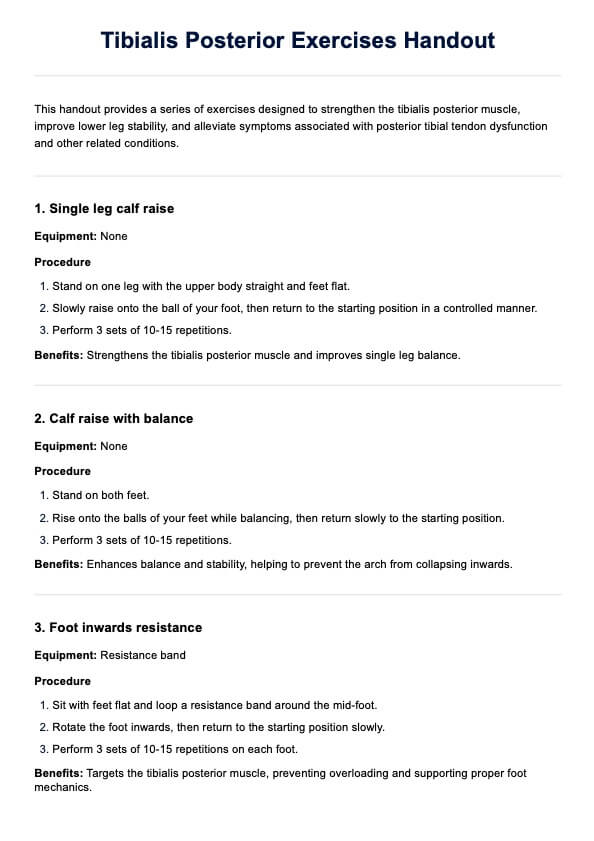
10 exercises for tibialis posterior tendon
Physical therapists can teach these exercises to patients to strengthen the tibialis posterior tendon, improve foot stability, and manage conditions like PTTD. These exercises help physical therapists guide patients in strengthening the tibialis posterior muscle, preventing pain, and improving lower leg stability.
Here are some exercises you can demonstrate for your patients:
1. Single-leg calf raise
Equipment: None
Stand on one leg with the upper body straight. Slowly raise the ball of your foot and return to the starting position. Perform this exercise slowly and control to strengthen the tibialis posterior.
2. Calf raise with balance
Equipment: None
Stand on both feet, rise onto the balls of your feet while balancing, and slowly return to the starting position. This exercise helps with single-leg balance and reduces the risk of the arch collapsing inward.
3. Foot inwards resistance
Equipment: Resistance band
Sit with feet lying flat, loop a band around the mid-foot, and rotate the foot inwards. Slowly return to the starting position. This exercise targets the tibialis posterior muscle and prevents overloading.
4. Standing posterior tibialis stretch
Equipment: None
Stand facing a wall with one leg behind and the knee straight. Lean forward to stretch the leg and maintain a good arch throughout this exercise. This helps reduce the gradual degeneration and weakening of the tendon.
5. Arch support exercise
Equipment: None
Stand on one leg, balance the other leg and focus on maintaining a good arch. Hold for 30 seconds, then switch legs. This prevents overloading the tibialis posterior and reduces pain or shin splints.
6. Seated foot flexion
Equipment: None
Sit with legs extended, and feet should be flat on the floor. Flex your foot toward the shin and then return slowly to the starting position. This motion exercise helps strengthen the tibialis posterior and maintains a neutral position.
7. Single leg balance with heel raise
Equipment: None
Stand on one leg with the upper body slightly backward. Slowly raise the heel of the standing leg and then return to the ground. This improves leg balance and strengthens the tibialis posterior.
8. Resistance band foot eversion
Equipment: Resistance band
Sit with feet flat and loop a band around the mid-foot. Evert the foot outward and return to the starting position. This exercise targets the tibialis posterior and helps with types of shin pain.
9. Standing toe touches
Equipment: None
Stand with the feet on the floor and bend forward to touch your toes, keeping the knee straight. This stretch helps reduce the causes of shin pain and supports the posterior tibialis.
10. Wall press arch exercise
Equipment: None
Stand facing a wall and press the ball of your foot against it. Maintain the arch and slowly return to the starting position. This exercise strengthens the posterior tibialis and prevents gradual degeneration of the tendon.
By incorporating these exercises into a patient's routine, physical therapists can effectively address tibialis posterior tendinopathy, strengthen the tibialis posterior muscle, and improve overall lower leg stability.