




What is the Twenty Statements Test?
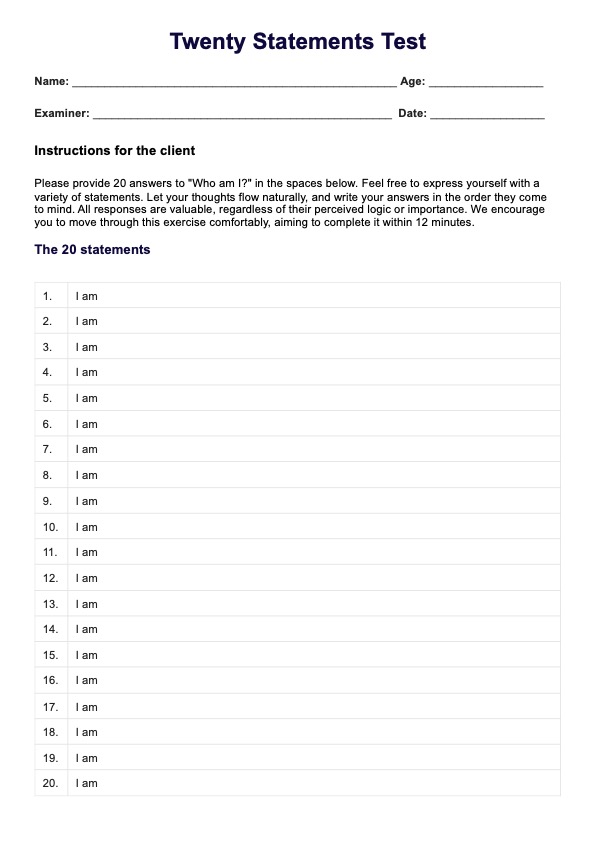
The Twenty Statements Test (TST) is a standardized measure of self-concept and self-attitudes developed by Manford H. Kuhn and Thomas S. McPartland in 1954. It is designed to elicit individuals' self-descriptions through an open-ended format. In this test, respondents are presented with 20 numbered blank spaces and asked to provide up to twenty responses to the simple question "Who am I?" or complete the prompt "I am..." (Kuhn & McPartland, 1954). The test typically takes only a few minutes to administer, making it a quick and efficient tool for researchers and clinicians.
The TST has been widely used in cross-cultural psychology and various other fields to examine differences in self-concept across ethnic groups, genders, generations, and cultures. Its ability to measure assumptions and self-attitudes in a standardized yet flexible manner has made it a valuable tool.









