
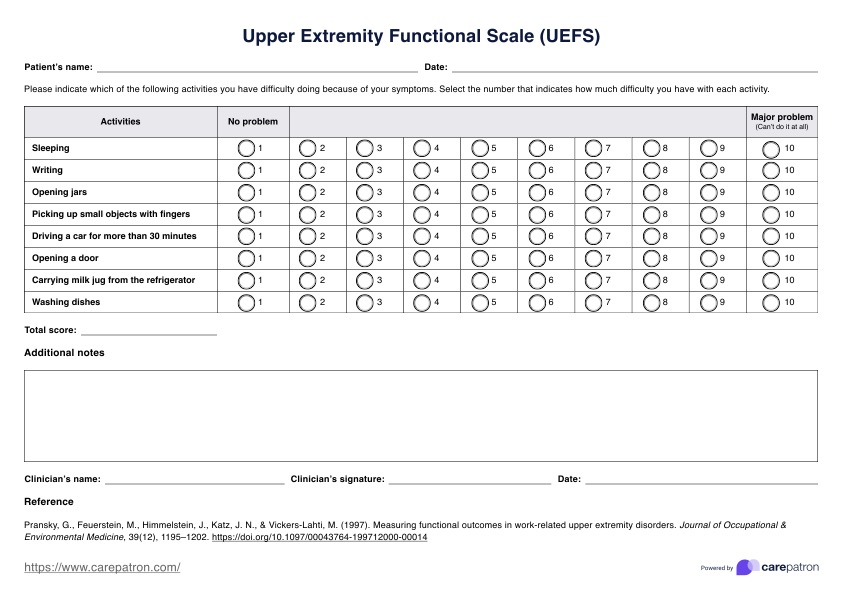




What is Upper Extremity Functional Scale (UEFS)?
Upper limb pain can be caused by a variety of medical conditions, ranging from acute injuries to chronic diseases. It can occur in any part of the upper extremity, including the shoulder, elbow, wrist, and hand. This pain is often accompanied by weakness, numbness, tingling, or stiffness in the affected area.
Healthcare professionals, especially physical therapists, utilize the (UEFS) to assess the impact of upper limb pain on daily activities. This objectively measures an individual’s level of function and is one of the most commonly used tools in physical and occupational therapy.
The UEFS consists of 20 questions and assesses a person's ability to perform essential functions such as lifting, reaching, grasping, pushing, and pulling. Each question is scored from 0 to 4. The total score ranges from 0-80, where 80 indicates a complete inability to perform the tasks.
To measure lower limb extremities, clinicians can use the Lower Extremity Functional Scale (LEFS). This tool has similar items as the UEFS but is adapted for assessing lower limb pain and function.









