When patients visit urgent care, they often need quick but accurate documentation to validate time off, referrals, or follow-up care. This guide walks you through how to use and complete a free Urgent Care Doctor’s Note efficiently.
## **What is urgent care?**
Urgent care offers same-day, unscheduled evaluation and treatment for time-sensitive, non-life-threatening conditions. It bridges the gap between primary care and emergency departments, designed for patients who need prompt attention but whose conditions do not warrant emergency-level intervention. Common presentations include:
- Minor musculoskeletal injuries (sprains, stable fractures)
- Simple lacerations requiring closure
- Mild to moderate asthma exacerbations without severe distress
- Ear and throat infections
- Conjunctivitis or uncomplicated urinary tract infections
- Rashes without systemic illness
- Low-grade fever with stable vital signs
- Medication refills with safeguards
- Return-to-work or school documentation after short-term illness
Use of these facilities continues to grow. In 2019, approximately 32.3% of women and 26.0% of men in the United States reported visiting an urgent care center or retail health clinic one or more times within the previous 12 months (Black & Adjaye-Gbewonyo, 2021). This trend underscores the growing importance of urgent care as a primary access point for acute, low-complexity medical needs.
Because patients often conflate urgent and [emergency care](https://www.carepatron.com/templates/emergency-room-documentation-templates/), it’s essential to clarify the difference. Emergency care addresses potential threats to life, limb, or organ function, such as chest pain suggestive of acute coronary syndrome, stroke symptoms, severe respiratory distress, uncontrolled bleeding, major trauma, or rapidly progressive infections. Clearly communicating these red flags helps set patient expectations, reduce inappropriate utilization, and align documentation with sound triage decisions.
## **What is an Urgent Care Doctor’s Note?**
An Urgent Care Doctor’s Note is a concise, externally facing document that confirms a patient’s medical evaluation at an urgent care clinic, summarizes clinical impressions and care, and communicates short-term functional guidance for non-clinical recipients such as employers, schools, and insurers. It serves as an official doctor’s note created by licensed medical professionals to document that the patient received appropriate medical care, including treatment plans and any prescribed medications.
Unlike a full [clinical record](https://www.carepatron.com/templates/personal-health-record-template/), this note is written for lay readers and should contain only the minimum necessary information to justify time off, modified duties, or follow-up care. This approach ensures compliance with privacy regulations and avoids over-disclosure of relevant medical records.
The note should identify the patient and date of evaluation, state the reason for the visit in plain language, include a brief assessment or working diagnosis, list the treatment provided, outline clear return-to-work or school timing/recommendations, and specify any temporary restrictions.
Clinicians may issue an official doctor’s note when patients require documentation for various health reasons, such as acute illness or recovery from a medical emergency. In some cases, patients seek a doctor’s note quickly for health concerns that warrant short-term rest or limited duties under policies such as the Family and Medical Leave Act (FMLA). Clear communication in these notes helps ensure that patients receive appropriate support while protecting their privacy and clinical details.
### **HIPAA and limitations**
While Urgent Care Doctors’ Notes are essential for documenting medical treatment and validating absences, they must comply with the Health Insurance Portability and Accountability Act (HIPAA) and related privacy regulations. Every healthcare provider is required to share only the minimum necessary information to meet the note’s purpose. In most cases, this means:
- Confirming the encounter and date of service
- Summarizing the patient’s medical condition or functional limitations
- Outlining clear recommendations for recovery or return to activity
Avoid including unnecessary details from the medical history unless the patient provides explicit, written authorization.
Employers, schools, or other third-party recipients, such as a human resources department, are not HIPAA-covered entities. This means protected health information (PHI) cannot be released directly to them without written consent (U.S. Department of Health and Human Services, 2025). When documentation is required, keep it neutral and objective. For example, note that a patient was “evaluated for a medical condition requiring two days of rest” rather than disclosing a specific diagnosis such as “acute bacterial sinusitis” or “migraine.” This maintains privacy while meeting administrative needs.
Clinicians should also refrain from making prognostic statements, fitness-for-duty certifications, or disability determinations in routine urgent care visits, unless they are qualified and authorized to do so. When uncertain, restrict the note to factual findings and time-bound recommendations, and direct employers or insurers to occupational health or disability channels for further evaluation and assessment.
Each official doctor’s note should be stored as part of the designated record set under HIPAA. Maintaining it alongside other relevant medical records ensures traceability, accountability, and continuity of care. Proper recordkeeping also supports future medical appointments, follow-ups, or additional evaluations if the patient requires immediate medical attention.
## **How to use our Urgent Care Doctor's Note template**
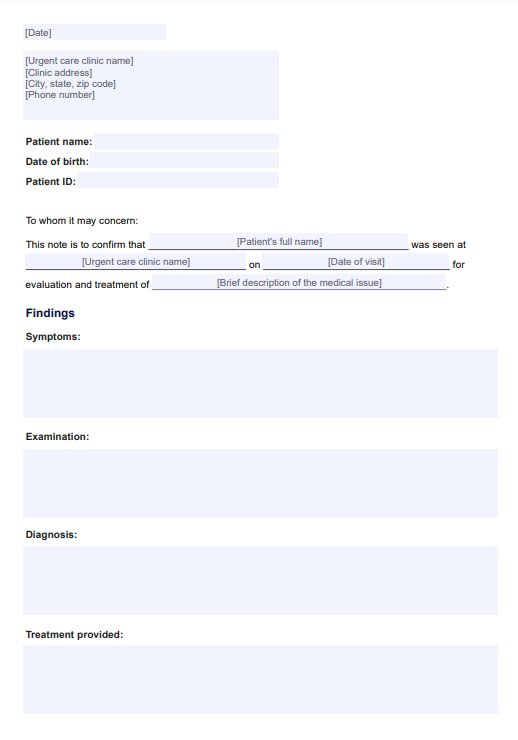
A printable Urgent Care Doctor's Note online template is a pre-formatted document that allows for the quick and easy documentation of a patient's visit to the urgent care center.
When filling it out during a medical appointment, follow these instructions:
1. Download the printable urgent care doctor's note template from the Carepatron app or through the preview provided on this page. Fill in the patient information, which includes the patient's name, date of birth, contact information, and insurance information if relevant.
2. Record the date on which you examined the patient. This date is usually indicated in the template's opening section.
3. Document the findings and treatment provided and make sure they are clearly stated. This information is crucial for the patient's institution to understand why the patient is absent.
4. If the patient's medical condition limits their school or work duties, clearly outline these restrictions in the recommendations. This information will help the recipient of the letter determine if any accommodations are necessary.
5. Sign the note and provide your specialty and contact information. This ensures the note's authenticity and allows the employer to verify the physician's credentials.
## **Common errors to avoid**
Even when you’re experienced, it’s easy to miss small details when completing an Urgent Care Doctor’s Note, especially during a busy shift. These oversights can create confusion for patients, employers, or insurers. and in some cases, lead to compliance issues. Here are some common pitfalls to watch out for, along with strategies to avoid them.
### **Including unnecessary medical details**
Don’t include sensitive diagnoses, a full medical history, or specific treatment details unless your patient has provided written authorization. Stick to the minimum necessary information, why the patient was seen, their functional limitations, and your short-term recommendations.
### **Using vague or open-ended timeframes**
Avoid phrases like “until further notice” or “as tolerated.” Always provide specific start and end dates for time off or work restrictions, and indicate when you would like the patient to return for reassessment.
### **Leaving out your credentials or signature**
A missing signature or title can make a note invalid. Always include your full name, professional credentials, specialty, and contact information so recipients can verify authenticity.
### **Sharing notes without patient consent**
Never send a note containing PHI directly to an employer or school without written consent. Instead, provide the document to the patient or send it securely through your practice management system.
### **Making assumptions about recovery**
Avoid phrases like “the patient will be fully recovered in two days.” Keep your language objective and limit your notes to factual observations and reasonable timeframes. If recovery is uncertain, recommend a follow-up appointment instead.
## **References**
Black, L., & Adjaye-Gbewonyo, D. (2021). Urgent care center and retail health clinic utilization among adults: United states, 2019 key findings data from the national health interview survey. https://www.cdc.gov/nchs/data/databriefs/db409-H.pdf
U.S. Department of Health and Human Services. (2025, March 14). Summary of the HIPAA privacy rule. https://www.hhs.gov/hipaa/for-professionals/privacy/laws-regulations/index.html