



Urinalysis Normal Values ChartAI Template IconToolbar IconShare Icon

Urinalysis Normal Values Chart

Explore the Urinalysis Normal Values Chart. Understand key health indicators with our comprehensive guide and example. Get your free PDF download now!

Audrey Liz Perez avatar

By Audrey Liz Perez on Aug 2, 2025.

Fact Checked by Ericka Pingol.

Use Template

What is a urinalysis test?

A urinalysis test is a detailed examination of urine used to detect and manage a wide range of disorders, such as urinary tract infections, kidney disease, and diabetes mellitus. It involves a series of tests conducted on a urine sample, which can be either from a single collection or from a 24-hour urine sample, to assess the urine's appearance, concentration, and content. The test is designed to check for abnormal levels of substances like red blood cells, uric acid crystals, and other compounds that might indicate a medical condition.

Individuals may need a urinalysis test for various reasons, often as part of a routine check-up to monitor overall health or when symptoms suggest problems with the urinary tract or kidneys. For instance, if there's a suspicion of a urinary tract infection, a urine culture can be done to confirm the diagnosis.

The test also helps evaluate kidney function and how well the kidneys concentrate urine. In cases of liver disease, dilute urine or abnormalities in urine osmolality may be identified, necessitating further investigation.

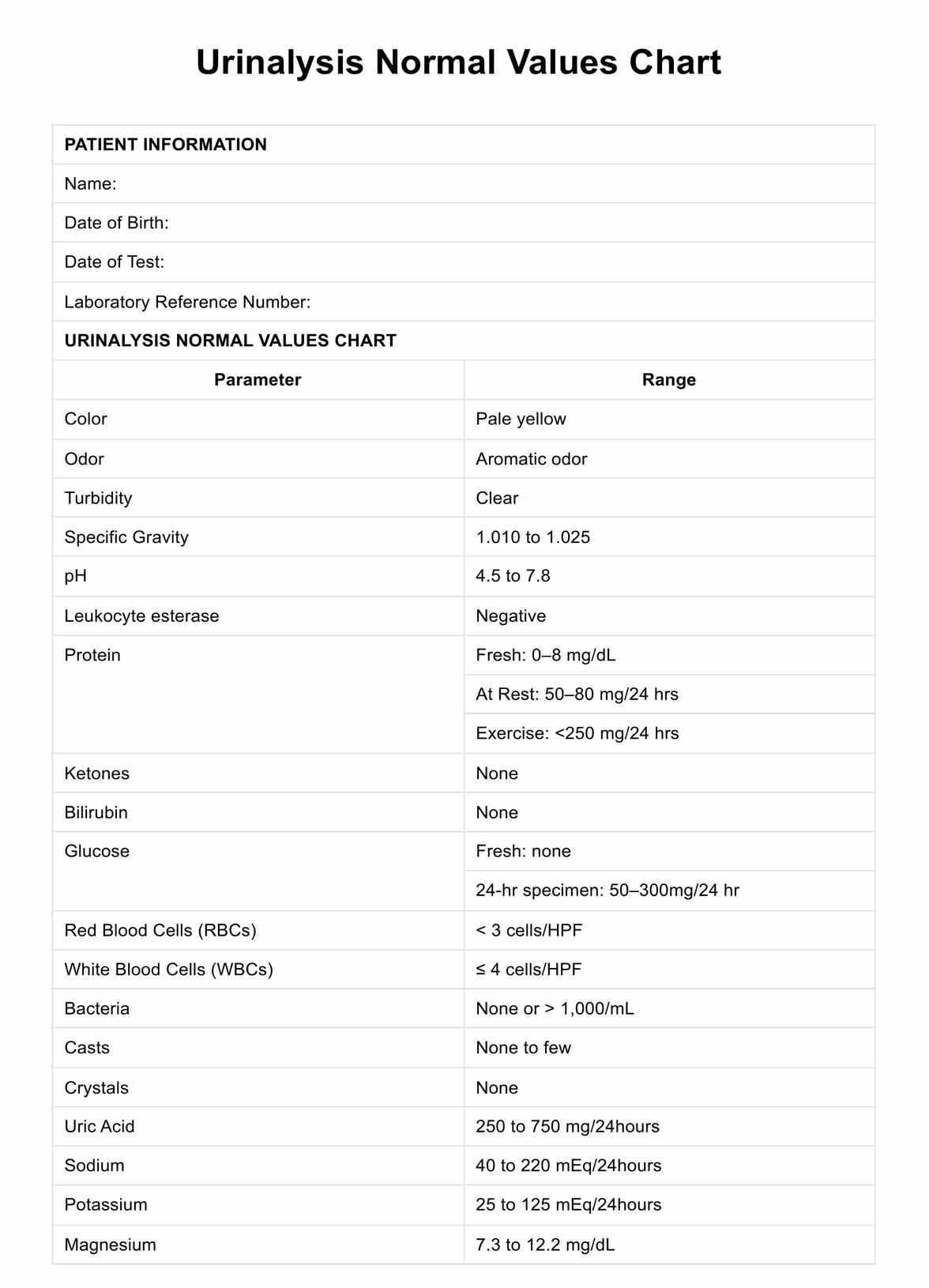
Urinalysis Normal Values Chart Template

Download PDF Template

What issues can urinalysis tests uncover?

Urinalysis tests play a pivotal role in the early detection of several health issues. They can uncover urinary tract infections by revealing white blood cells.

Moreover, they can detect diabetes mellitus by identifying glucose levels. Renal tubular acidosis, a disorder affecting the kidney's ability to acidify urine, is another condition that can be spotted. The presence of red blood cells can indicate kidney stones or other renal problems.

Over a 24-hour urine collection period, changes in the urine's concentration, such as concentrated urine or increased urine osmolality, can signal varying health concerns, including dehydration or the overproduction of substances, such as uric acid crystals.

How do healthcare professionals conduct this test?

Healthcare professionals begin the urinalysis process by collecting a urine specimen, which the patient provides by urinating into a clean container. This sample is then sent to a laboratory, which will undergo a series of evaluations.

The initial step typically involves a visual and chemical examination to test urine for various substances, including urine bilirubin and glucose levels, measured in milligrams per deciliter (mg/dL). Additionally, the test assesses the urine pH, which can indicate metabolic or renal disease when levels are unusually high or low. The chemical analysis is often performed using a dipstick that changes color to reflect the presence and concentration of different substances.

Following the initial assessment, a microscopic exam is conducted on the urine specimen to identify and count the types of cells present, including red blood cells, which can indicate conditions like kidney stones or infections.

The microscopic analysis can also detect casts, crystals, and other substances that may not be found with a chemical test. The test results from both the chemical and microscopic exams are then compiled to provide a comprehensive view of the patient's health.

A low urine pH, for example, might suggest a risk of uric acid kidney stones or may be seen in conditions such as diabetic ketoacidosis or renal tubular acidosis.

How does our Urinalysis Normal Values Chart work?

Our Urinalysis Normal Values Chart is vital for interpreting the findings from a complete urinalysis. The chart functions in three fundamental steps:

  1. Comparison against normal ranges: The chart lists typical ranges for various urine components, such as the acceptable number of red blood cells and the expected urine concentration. Healthcare providers use these benchmarks to determine whether a patient's urine specimen falls within the normal urine parameters. This step is crucial because it sets the stage for identifying deviations indicative of health issues.
  2. Identification of abnormalities: Once the urine test results are available, each component is evaluated against the chart. For example, an acidic urine pH might be normal, but when combined with a positive nitrite test, it could suggest a urinary tract infection. If the urine concentration is exceptionally high or low, it may signal dehydration or overhydration, respectively.
  3. Clinical correlation: Healthcare professionals consider the patient's overall clinical picture after identifying values outside the normal ranges. For instance, a lower-than-normal count of red blood cells may not be concerning if all other parameters are normal. However, an elevated count could indicate renal disease. Similarly, the presence of substances that aren't typically found in normal urine, such as yeast cells, might suggest an infection.
  4. Severe liver disease may be suspected if urine bilirubin levels are high, underscoring the importance of correlating test findings with other diagnostic information to form a comprehensive assessment.

By following these steps, the Urinalysis Normal Values Chart aids in the detection and management of potential health concerns, guiding both diagnosis and treatment.

Benefits of urinalysis test

Urinalysis tests are invaluable in the medical field, providing insights into an individual's health status by examining urine. These tests offer a non-invasive way to detect and monitor various conditions early, aiding in prompt treatment and management. Below are four key benefits of undergoing a urinalysis test:

Early detection of Urinary Tract Infections (UTIs)

One of the primary benefits of a urinalysis test is the early detection of urinary tract infections. The presence of urinary nitrates, converted from nitrites by bacteria, can indicate a UTI. Early diagnosis through urinalysis allows for timely treatment, reducing the risk of the infection spreading to the kidneys, which could cause severe complications.

Monitoring kidney health

Urinalysis is crucial in monitoring kidney health and detecting renal dysfunction at an early stage. By analyzing urine specific gravity, healthcare providers can assess how well the kidneys concentrate urine, which is crucial in diagnosing conditions like advanced renal failure or glomerular disease. Changes in specific gravity may indicate a need for further testing to evaluate kidney function and structure.

Identifying glomerular diseases

The test can also help identify glomerular diseases affecting the tiny filtering units of the kidneys. The presence of proteins or red blood cells in the urine, conditions often associated with glomerular disease, can be detected through urinalysis. Early detection is vital for managing symptoms and preventing progression to more severe kidney issues.

Detecting kidney stones

Urinalysis is beneficial in detecting kidney stones early. The presence of triple phosphate crystals in urine samples can indicate the formation of kidney stones, allowing for early intervention. By identifying these crystals, healthcare providers can recommend dietary changes or medications to prevent the stones from growing larger and causing more severe problems, such as renal dysfunction.

Commonly asked questions

High specific gravity in urine can indicate dehydration or conditions that prevent the kidneys from properly diluting urine, such as renal dysfunction.

Yes, urinary nitrates can be present in normal urine; however, elevated levels are often associated with urinary tract infections.

Red blood cells in urine can point to various conditions, from benign (like exercise-induced) to serious issues like kidney stones or glomerular disease.

EHR and practice management software

Get started for free

*No credit card required

Free

$0/usd

Unlimited clients

Telehealth

1GB of storage

Client portal text

Automated billing and online payments







