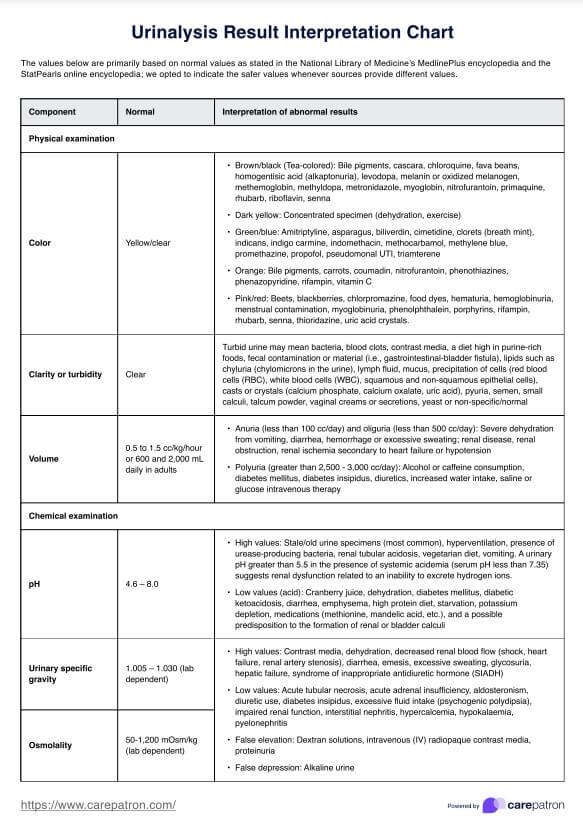
How to use our Urinalysis Result Interpretation Chart template
Understanding the workings of urinalysis and the subsequent interpretation of results is a multi-step process that requires precision and attention to detail. Here's a breakdown of how you can use our normal urine test results chart template in your practice:
Step 1: Access the template
Use the Carepatron app to access our chart template. Click “Use Template” to open it in the app, allowing you to customize, fill out, and share the template. Alternatively, you can click “Download” to save a non-editable PDF version for printing or manual use.
Step 2: Collect the urine sample
Accurate results depend on the quality of the urine sample. A clean-catch, midstream specimen is essential to avoid contamination. Instruct patients to urinate briefly, pause, and then collect the sample midstream. This ensures a representative sample for analysis.
Step 3: Conduct the urinalysis
You can perform a urinalysis yourself using a dipstick test or send the urine sample to a laboratory for a more detailed examination. The process typically includes a physical, chemical, and microscopic examination to detect substances like proteins, glucose, ketones, and signs of bacterial growth. A complete urinalysis includes identifying abnormalities in color, clarity, pH, specific gravity, and microscopic elements such as cells or crystals.
Step 4: Use the chart for interpretation
Once the results are available, use the Urinalysis Result Interpretation Chart as a reference. The chart lists normal ranges for each parameter and provides insights into what abnormal results may indicate. For example, the presence of nitrites could suggest a urinary tract infection (UTI), while glucose in the urine could indicate diabetes. We'll discuss this further in a later section, but for a complete list, use the template.
Step 5: Clinical assessment
Finally, any deviations from normal values are considered alongside the patient's clinical presentation. This integrated approach ensures that the urinalysis results contribute meaningfully to the diagnostic process, guiding further testing or immediate treatment if necessary.
Do take note that this template is best used as a reference; if you are looking for a template for documenting the results of a urinalysis test, take a look at our Urinalysis Test Results template.