




What is Dan Siegel's Wheel of Awareness?
Dan Siegel's Wheel of Awareness is a mindfulness tool designed to help individuals enhance focus, presence, and inner peace. This tool enables users to experience open awareness by integrating different aspects of their consciousness. By engaging with the Wheel of Awareness, users can reduce their stress levels, anxiety, and depression while also improving their mental and emotional well-being and their interpersonal skills. It serves as an excellent tool for personal growth, allowing individuals to connect more deeply with themselves and others (Garrisson Institute, 2018).
Created by Dr. Dan Siegel, a clinical professor of psychiatry at the UCLA School of Medicine and founding co-director of the Mindful Awareness Research Center, this visual metaphor also supports a healthy mind through integration and awareness practices rooted in interpersonal neurobiology and science.
Core beliefs informing the Wheel of Awareness
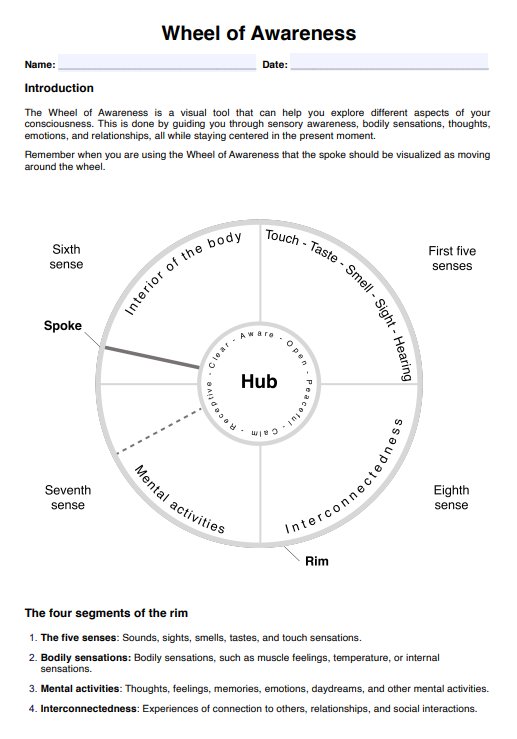
Dan Siegel's Wheel of Awareness is based on the idea that consciousness can be visualized as a wheel, with the hub representing our awareness and the rim representing the various elements of our experience, including thoughts, feelings, and sensations. The awareness practice utilizes a "spoke of attention" to focus on various aspects of the rim, helping individuals integrate these parts and find a sense of wholeness. The goal Dr. Dan Siegel has set is to enhance mental well-being by focusing attention and creating harmony between the differentiated parts of our mind, fostering clarity and a more profound sense of stability through this integration. Many individuals find this process helpful as it creates a central hub of knowing, peace, and presence.
Parts of the Wheel of Awareness
The Wheel of Awareness divides the rim mentioned above into four segments that represent different categories of experience:
- First five senses: This part includes basic sensory experiences—touch, taste, sight, sound, and smell. The practice begins with grounding in the present moment by focusing on these five sensations, supporting awareness, and mindful living.
- Bodily sensations (sixth sense): This part of the wheel focuses on internal bodily sensations, such as breathing, heartbeat, and muscle tension. By honing in on these bodily signals, individuals can gain insight into how physical states impact mental well-being. This sixth sense, often overlooked, is essential in linking the mind and body in therapy.
- Mental activities (seventh sense): The third part of the rim allows individuals to focus on the mind, including thoughts, feelings, and memories. Taking a moment to observe these mental activities without judgment enables the separation of awareness from the contents of the mind, which can help reduce stress and anxiety. This step is where many patients acces awareness of internal processes, allowing the mindful therapist to better support their journey.
- Interconnectedness: The final segment represents an individual's connection to the outside world, including people closest to them, their city, country, and natural environment. This practice fosters a sense of belonging in the external environment. For many, this segment links the wheel to life, the world, and nature in profound ways.
In practice, each of the four segments of the rim is examined by moving the spoke of attention. This spoke symbolizes the individual's focused awareness, which can be directed and shifted to explore various areas of the wheel. Since the spoke is linked to the hub, it is essential to stay grounded in the center while engaging with any one point on the rim. The hub represents the calm knowing that can access every differentiated part of the mind through kind intention and focus.









