



Whooping CoughAI Template IconToolbar IconShare Icon

Whooping Cough

Discover the latest updates on Whooping Cough Test methods, including PCR testing for accurate diagnosis and prompt treatment of pertussis. Stay informed, stay healthy.

Telita Montales avatar

By Telita Montales on Aug 2, 2025.

Fact Checked by Ericka Pingol.

Use Template

What is a Whooping Cough Test?

A Whooping Cough Test is a crucial diagnostic instrument employed by healthcare professionals to ascertain whether an individual has been infected with Bordetella pertussis. This bacterium is the causative agent behind whooping cough, a highly contagious respiratory tract infection characterized by severe, hacking coughs followed by a high-pitched intake of breath that sounds like a "whoop." According to the Centers for Disease Control and Prevention (2024), whooping cough remains one of the critical vaccine-preventable diseases, making prompt testing essential.

The testing procedure typically involves using a nasopharyngeal (NP) swab. In this process, a sample is collected from the nasopharynx, the upper part of the throat behind the nose. This sample is then analyzed in a laboratory for the presence of the Bordetella pertussis bacterium. The presence of the whooping cough bacteria in diagnostic samples confirms infection and allows for timely interventions. The entire process, while simple, requires professional medical supervision and precise laboratory testing.

This diagnostic tool plays a pivotal role in detecting the disease early and initiating timely treatment, thus preventing the further spread of this potentially life-threatening condition, especially among young children and infants.

How to use our Whooping Cough Test template

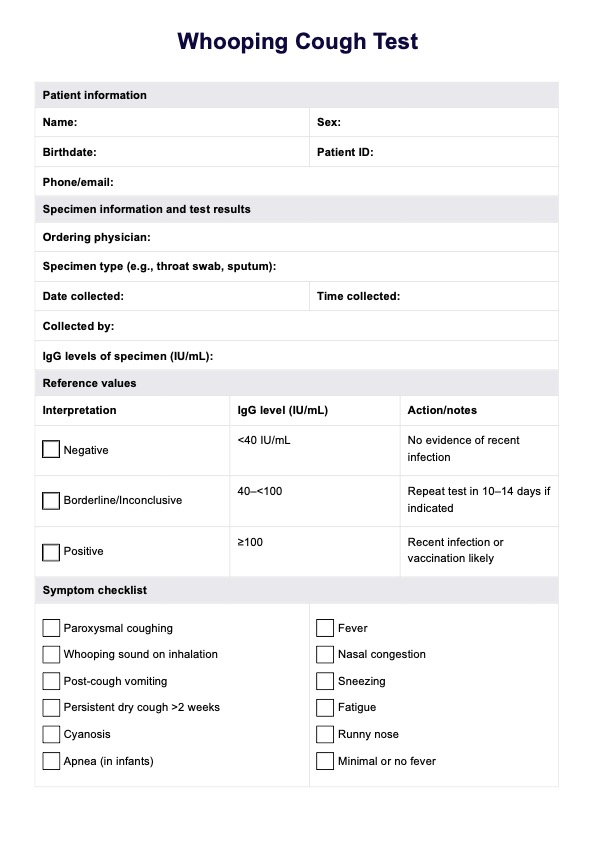
Our Whooping Cough Test template includes empty fields designed to help healthcare professionals plan personalized care plans, document interventions, and track results clearly and effectively.

Step 1: Access the template

To begin, click the "Use template" button to access it digitally in the Carepatron app, or select the "Download" button to obtain a printable PDF version.

Step 2: Assess the patient

Evaluate the patient carefully for signs of respiratory infection and other severe symptoms indicative of whooping cough. Determine if the patient meets the criteria for suspected pertussis and record initial observations.

Step 3: Administer diagnostic tests

Carry out appropriate diagnostic tests, which typically include obtaining a nose or throat culture and using the polymerase chain reaction (PCR) method to accurately diagnose whooping cough. You may also perform a blood test if necessary for a comprehensive evaluation.

Step 4: Document and discuss results

Accurately document all results in the provided fields of the template. Clearly discuss the outcomes with the patient, explaining how whooping cough, diagnosed early, can be effectively managed. During this step, instruct the patient on understanding their results and encourage any relevant questions.

Step 5: Initiate treatment and follow-up

Based on the results, initiate appropriate interventions. Record how the pertussis infection (whooping cough) will be managed, including antibiotic therapy or other supportive measures, and schedule follow-up appointments to evaluate treatment effectiveness.

When would you use this test?

A Whooping Cough Test is a critical diagnostic tool in healthcare, particularly when dealing with highly contagious respiratory disease symptoms. The test is typically employed when an individual presents specific signs that align with whooping cough, also known as pertussis.

Common symptoms include severe and prolonged coughing spells, often ending with a high-pitched "whoop" sound during the subsequent inhalation. This characteristic "whoop" is where the disease gets its common name. Other symptoms may include a runny nose, low-grade fever, and, in some cases, vomiting after intense coughing bouts.

The test becomes imperative in cases involving infants and young children at an elevated risk for severe complications from whooping cough. These complications range from pneumonia and slowed or stopped breathing to weight loss and brain damage. In certain instances, whooping cough can even be life-threatening for this age group, making timely diagnosis and treatment crucial.

Testing is also beneficial in the context of public health. Given the contagious nature of whooping cough bacteria, early testing helps prevent outbreaks. Identifying a pertussis case can help initiate preventive measures, such as administering prophylactic antibiotics to close contacts, thus reducing the risk of disease spread. Guidelines provided by the Centers for Disease Control and Prevention strongly recommend testing individuals displaying persistent cough symptoms or those who have been in close contact with confirmed pertussis cases.

Furthermore, healthcare providers may use the test in differential diagnosis when faced with patients presenting persistent and unexplained cough illnesses, especially if the patient has not received a pertussis vaccine or has an unknown vaccination status.

What do the results mean?

Interpreting the results of a Whooping Cough Test is a crucial step in the diagnostic process, as it sets the course for subsequent treatment. The test results can be either positive or negative, each with its own implications.

A positive result signifies the presence of the Bordetella pertussis bacterium in the patient's nasopharyngeal sample. This confirmation of infection allows healthcare providers to promptly initiate appropriate treatment measures, typically involving a course of antibiotics. The sooner the treatment begins, the better the chances of preventing the disease from spreading to others and reducing the severity of symptoms.

However, a negative result does not eliminate the possibility of a whooping cough infection. The sensitivity of the test depends on the timing of the sample collection relative to the onset of symptoms. A false-negative outcome may occur if the test is performed late in the disease, when bacterial numbers have decreased. Therefore, a negative result should be interpreted in the context of the patient's symptoms, the timing of the test, and their vaccination and exposure history.

Additionally, it's important to note that the test doesn't provide information about the patient's immunity against whooping cough. Vaccination or past infection can confer some immunity, but this wanes over time and does not guarantee complete protection against future infections.

References

Centers for Disease Control and Prevention. (2024, April 2). Pertussis. Centers for Disease Control and Prevention. https://www.cdc.gov/pertussis/about/index.html

Commonly asked questions

Healthcare providers typically request a whooping cough test when a patient presents symptoms consistent with the disease.

Whooping Cough Tests are used when individuals show symptoms of whooping cough, especially in high-risk groups like infants and young children.

Whooping Cough Tests are used to confirm the presence of Bordetella pertussis, the bacterium causing whooping cough.

EHR and practice management software

Get started for free

*No credit card required

Free

$0/usd

Unlimited clients

Telehealth

1GB of storage

Client portal text

Automated billing and online payments







